
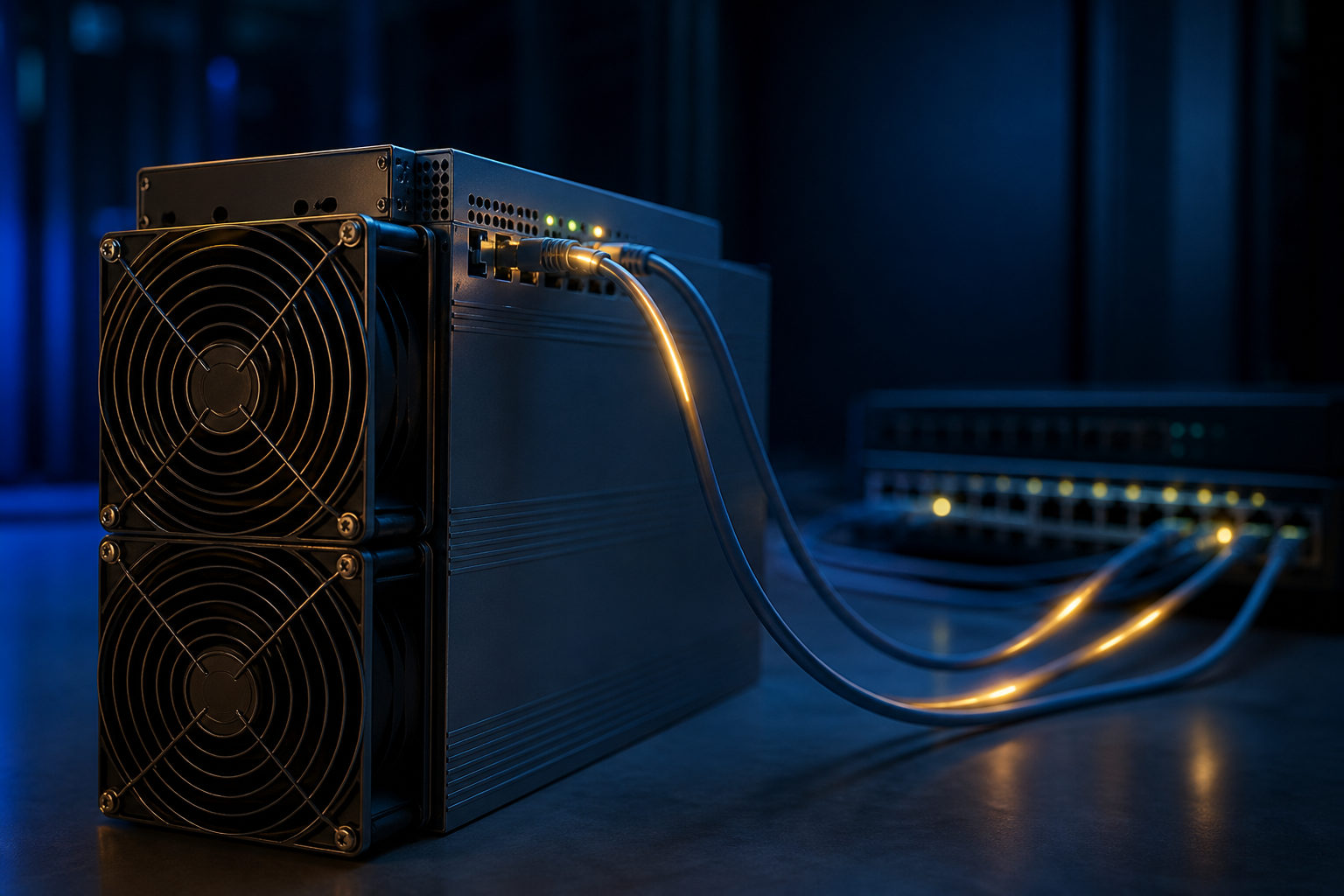
How much data does bitcoin mining use? In most setups, data traffic is not the main barrier. Power, hardware, cooling, and a stable internet connection usually matter more than raw bandwidth.
What data is actually moving during bitcoin mining
People often imagine bitcoin mining as a nonstop stream of huge downloads. That picture is off. Mining is closer to a bookkeeping race: a miner receives work based on a candidate block, then performs repeated hash calculations on the machine itself. The heavy lifting happens in local computation, not in moving giant files back and forth.
The network side mainly carries new block information, unconfirmed transaction data, mining pool jobs, and work submissions from miners. In simple terms, the internet connection keeps the miner synchronized with the rest of the system. It does not do the mining for you; it tells your machine what to work on and when conditions change.
Your data usage depends more on setup than on mining itself
When people ask how much data bitcoin mining uses, they often treat all mining as one thing. It is not. A single ASIC connected to a mining pool behaves differently from a setup that also runs a full node. A hosted machine is different again, and cloud-based products shift most of the network activity away from the user entirely.
| Setup | What the connection handles | Likely data pressure | What usually matters more |
|---|---|---|---|
| Pool mining | Receives jobs and submits shares on an ongoing basis | Often manageable | Electricity, machine cost, cooling, noise |
| Mining with a full node | Syncs and validates more blockchain data in addition to mining traffic | Higher | Storage, maintenance time, stable connectivity |
| Hosted mining | The facility handles machine-side traffic; you mostly access a dashboard | Low on your local connection | Provider reliability, terms, control over hardware |
| Cloud mining style products | You usually do little to no direct mining communication | Very low locally | Transparency, contract structure, counterparty risk |
If you are using a home connection, the better question is often not whether your plan includes enough data, but whether your internet service stays online consistently. Mining can tolerate modest traffic better than it can tolerate repeated disconnects. A connection that drops, restarts, or changes behavior under long sessions can create more trouble than a narrow but steady one.
Why mining traffic is often smaller than people expect
The reason sits inside proof-of-work. Once a miner has current work, the machine keeps trying new hashes locally. Think of it like a contest where everyone gets the same worksheet and then solves it at their own desk. The network distributes the worksheet and collects valid progress signals, but the repeated effort happens on the miner.
Bitcoin produces a new block about every 10 minutes, so block-level synchronization is active but not the same as constant transfer of massive media files. In pool mining, the pool coordinates job assignment while the machine reports shares and updates its state when needed. That pattern creates steady communication, yet the data itself is often less intimidating than newcomers assume.
That said, “not huge” does not mean “irrelevant.” A weak router, unstable Wi-Fi, mobile hotspots, or internet services that throttle long-running connections can still make a mining setup frustrating to manage. The issue may look like a data question on the surface, while the real problem is connection quality.
What to evaluate before you try mining at home
If you are serious about participating, put data usage in context. It is one line in a larger operating picture, and often not the line that decides the outcome. A home setup can fail even when the connection is fine, simply because the environment is not built for equipment that runs continuously.
| Check item | What to look at | Why it matters |
|---|---|---|
| Connection stability | Frequent drops, restarts, changing network conditions | Interruptions hurt continuity and remote management |
| Bandwidth sharing | Whether other devices heavily compete for the same connection | Helps avoid lag and management issues |
| Power delivery | Whether your circuits can handle sustained load safely | This is a common real-world limit |
| Cooling and airflow | Ventilation, room temperature, heat handling | Mining hardware runs hot for long periods |
| Noise tolerance | Whether the space and people around it can handle machine noise | A frequent home-mining deal breaker |
| Maintenance effort | Firmware updates, monitoring, reconnects, troubleshooting | Mining hardware needs ongoing attention |
Running a full node changes the picture. A full node gives you the ability to validate blockchain data independently, which appeals to users who care about self-verification and the broader design of Bitcoin. It also adds storage demands, more sync activity, and extra maintenance. Many people blur “running a miner” and “running a node,” then end up with the wrong expectation about data use.
Common mistakes when asking about bitcoin mining data use
One mistake is treating any internet access as good enough. A connection can be fast in short bursts and still be a poor fit for a machine that is expected to stay online for long sessions. Temporary lines, mobile tethering, and unstable home gear may work for testing, but they are harder to trust for steady operation.
Another mistake is comparing a regular computer to dedicated mining hardware as if they face the same practical conditions. At the communication level, both still need to receive work and send back results. In real use, dedicated mining machines are built around that job, while general-purpose computers run into heat, efficiency, and system-load issues much sooner.
| Common assumption | Closer to reality |
|---|---|
| Mining mainly consumes huge amounts of data | In many cases, electricity, hardware, and cooling are the bigger constraints |
| Higher internet speed always solves the problem | Consistency and uptime often matter more than peak speed |
| If a home can browse the web, it can mine comfortably | Power capacity, heat, noise, and maintenance can stop the plan first |
| Using a miner means you are automatically running a full node | They can work together, but they are separate roles |
FAQ
Can a home internet connection handle bitcoin mining?
Often yes, at least from a pure data-traffic perspective, especially for pool mining. The bigger question is whether the connection stays stable over time and whether your home power and cooling setup can support always-on hardware.
Does running a full node use more data than pool mining alone?
Yes. A full node has to sync and validate more blockchain data instead of only handling mining-pool communication. That extra independence comes with higher storage, network, and maintenance demands.
Can I mine over a phone hotspot?
You might use one for quick testing or setup, but it is usually a poor long-term choice. Signal changes, throttling, disconnects, and awkward remote management make it unreliable for sustained mining use.
Should beginners focus on data use first or electricity first?
For most people, electricity and the physical operating environment deserve attention first. Data use matters, but unstable power, excess heat, and noise complaints are more likely to end a home-mining plan early.
What if I do not want to maintain the hardware myself?
Hosted mining and cloud-style products reduce your local network burden, but they replace it with trust and contract risk. Before choosing them, look closely at transparency, who controls the equipment, and how the service explains its operating terms.
If you want a practical next step, check your connection stability, your power setup, and your cooling conditions before worrying about headline data use. That sequence gives a more realistic view of what bitcoin mining actually asks from you.
Disclaimer: This article is for informational and educational purposes only and is not investment, financial, or legal advice. Crypto assets are highly volatile and you could lose your entire investment. Do your own research and decide carefully.