
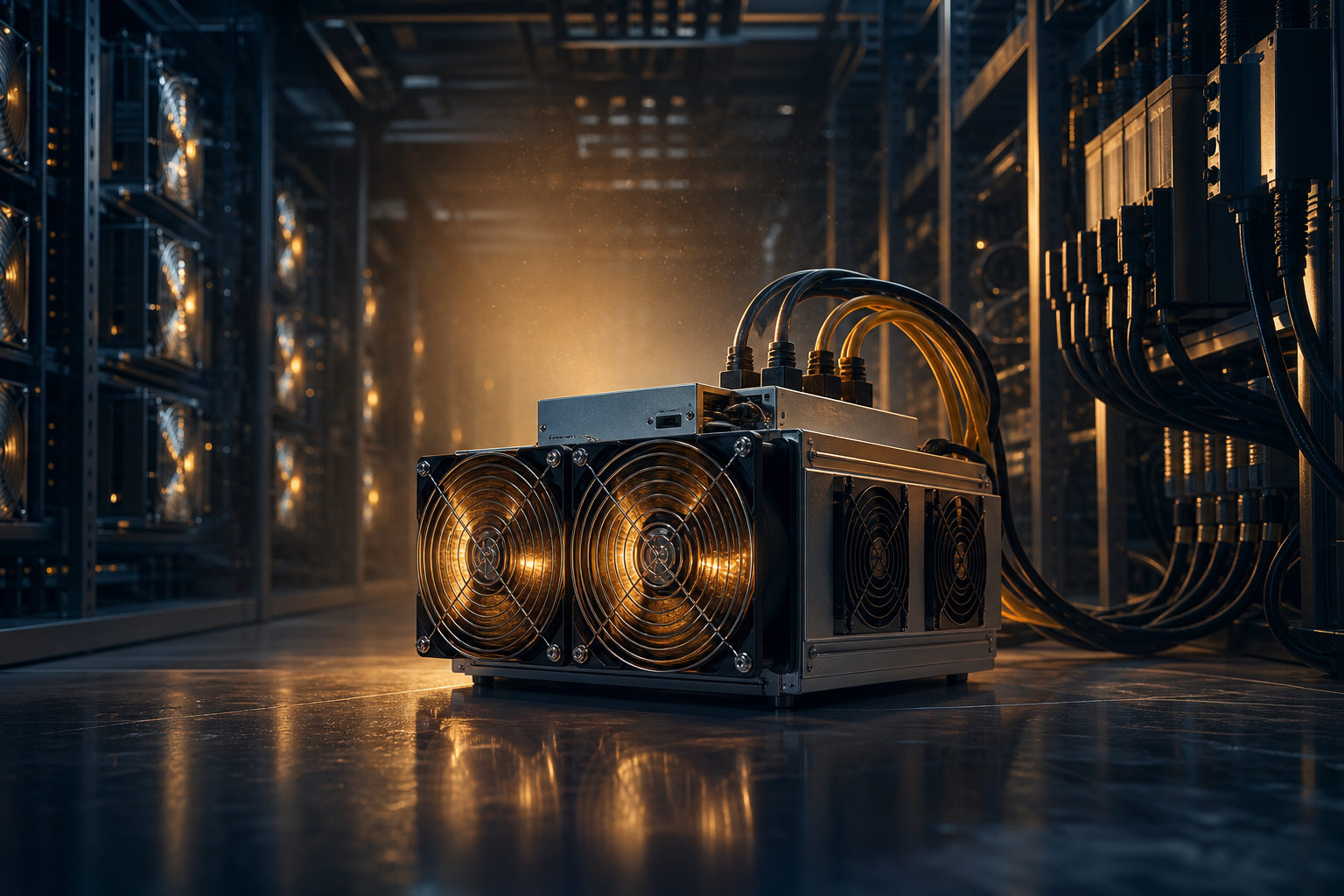
How much electricity does bitcoin use? The short answer is that most power use comes from mining competition, not from one payment by itself. Electricity is spent on machines that keep running to win the right to add the next block.
Why Bitcoin uses electricity in the first place
A simple way to picture Bitcoin is a public bookkeeping race. Miners compete to package recent transactions into a new block, and the winner gets to append that block to the chain under the network rules.
This system is called proof of work. It does not reward a clever guess in the usual sense. It rewards sustained computing effort, which means specialized machines stay active for long periods and draw power the whole time.
Bitcoin produces a block about every 10 minutes. The network also adjusts mining difficulty so block production stays near that pace, which means more machines joining the race usually raises competition rather than making the process effortless.
Where the electricity goes
When people ask how much electricity Bitcoin mining uses, they often imagine each transfer triggering a huge burst of energy use. That is not the best way to frame it. Mining hardware runs continuously, and transactions are included in blocks that miners are already competing to produce.
The main power draw usually comes from three places: the mining machines doing repeated hash calculations, the cooling systems needed to manage heat, and the site infrastructure that keeps the operation running. The send and receive screen in a wallet is only the user-facing part of a much larger process.
- Mining hardware: specialized machines perform nonstop calculations.
- Cooling: active equipment produces heat and needs airflow or other cooling methods.
- Facility operations: power distribution, monitoring, maintenance, and networking add overhead.
So if you are asking how much electricity mining bitcoin uses, the real subject is the full operating system behind the network, not the click of one transaction.
Why there is no single fixed answer
Many readers want one neat figure for Bitcoin electricity use. In practice, that figure changes because mining depends on hardware efficiency, local power prices, cooling conditions, total network competition, and downtime.
Even with the same machine, operating results can look very different in a cooler site with steady power versus a hotter site with weaker ventilation or more interruptions. Newer and older machines can also differ a lot in efficiency, so a universal answer will miss the actual context.
Another source of confusion is mixing network-wide power use with the cost of one miner. The network total reflects all participants together. A single operator faces a different question: what equipment is running, for how long, under what conditions, and with what operating setup.
Does joining a mining pool reduce electricity use?
Not directly. A mining pool changes how rewards are shared among participants, but it does not make your hardware consume less power on its own. It mainly smooths out how results are distributed over time.
Who actually pays the electricity bill
Most people who buy, hold, or transfer bitcoin are not paying a mining site's electricity bill themselves. For ordinary users, the practical concerns are wallet security, transaction fees, confirmation timing, and safe custody habits.
The direct power cost falls on miners and mining businesses. For them, electricity is a daily operating constraint, not just a talking point in online debate. Buying machines is only one part of the picture; cooling, maintenance, physical space, noise, and uptime also matter.
That is why the phrase “how much electricity does bitcoin use” can be misleading when taken out of context. It sounds like a single environmental question, but it is also an industry question about hardware efficiency, competition, and cost control.
How to think about the debate around Bitcoin power use
Public discussion usually splits into two views. One side focuses on resource consumption and sees the mining process as an energy-intensive security model. The other side argues that proof of work uses real-world cost to make the ledger harder to rewrite and the system harder to control.
Both views continue because they are answering different questions. One asks what the system consumes. The other asks what that cost is buying in return. If you separate those issues, the conversation becomes easier to follow.
For a casual user, Bitcoin electricity use is mostly a design question. For someone thinking about mining, it becomes a hard operating-cost question from day one.
FAQ
Is Bitcoin itself using electricity, or is mining the part that uses it?
The more accurate answer is that mining is the main source of electricity use. Bitcoin is a network and a rule set; the power draw comes from the machines and facilities taking part in proof of work.
Does one bitcoin transaction use a large amount of electricity by itself?
It is better not to treat it that way. Mining machines usually run continuously, so a single transaction is not cleanly tied to one fixed chunk of electricity use.
How much electricity does mining one bitcoin use?
There is no one-size-fits-all figure. The answer depends on machine efficiency, power prices, heat management, mining difficulty, and whether equipment stays online consistently.
Does a mining pool make bitcoin mining more energy efficient?
A pool does not automatically lower the power draw of your machines. It mainly changes how rewards are shared, which can make income timing less uneven without removing the underlying electricity cost.
Should regular users care about how much electricity Bitcoin mining uses?
Yes, but the reason depends on your role. If you only hold or transfer bitcoin, it helps you understand how the network works; if you want to mine, it becomes a core business and cost question.
What to check next
If you want a better answer to how much electricity does bitcoin use, first decide whether you mean the whole network or a single mining operation. Then look at machine efficiency, cooling setup, mining pool terms, and local power pricing before making any deeper commitment.
Disclaimer: This article is for informational and educational purposes only and is not investment, financial, or legal advice. Crypto assets are highly volatile and you could lose your entire investment. Do your own research and decide carefully.