
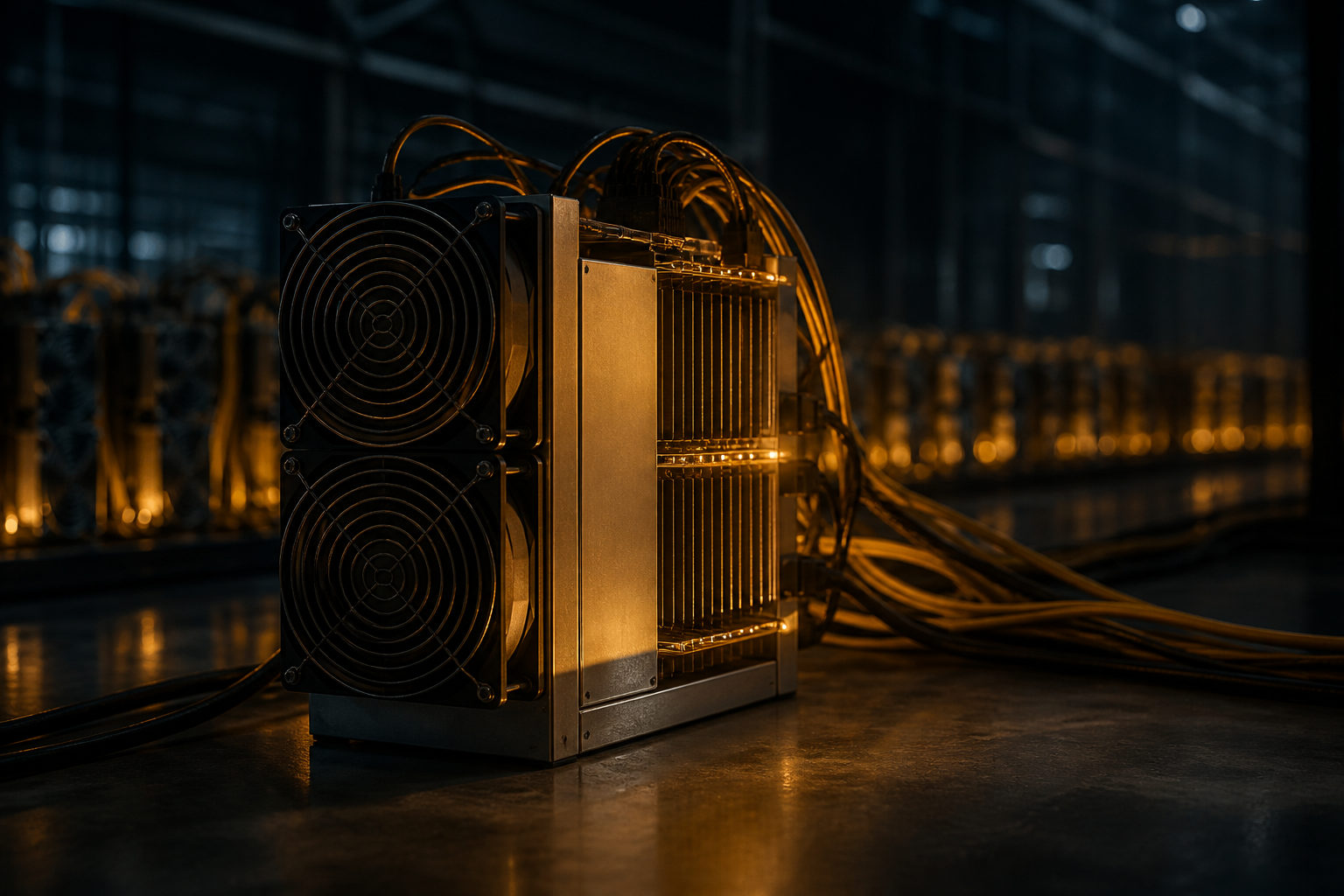
Bitcoin mining does not use a single fixed amount of energy. Power demand changes with network competition, machine efficiency, cooling needs, and the way a miner takes part in what is, at its core, a nonstop race to win the next right to write to the ledger.
Why bitcoin mining uses so much energy
A simple way to picture bitcoin mining is to imagine an open bookkeeping contest. Many participants try to add the next page to a shared ledger, but only those that produce a valid result under the network rules can compete to add the next block.
This process is called proof of work. The important detail is that miners do not solve the task through clever reasoning in the usual sense. They keep trying huge numbers of possible inputs at very high speed until one output matches the condition required by the network. Because there is no shortcut, electricity becomes tied directly to the amount of computation being performed.
That is why energy use is not some side issue attached to bitcoin mining. The cost of computation is part of what makes rewriting the ledger hard. Anyone trying to alter records would need to commit real resources on the same scale as honest miners, or more, which raises the cost of attack.
What determines bitcoin mining energy use
People often ask for one clean number, but the better answer is a set of moving parts. Energy use can look very different depending on the hardware, the facility, the local conditions, and whether you are talking about one miner or the whole network.
| Factor | How it affects energy use | What it means in practice |
|---|---|---|
| Network competition | More miners usually mean more total computing power chasing the same block rewards | Industry-wide energy use tends to rise when competition grows |
| Difficulty adjustment | The network adjusts mining difficulty to keep block production near one block about every 10 minutes | Higher difficulty usually means more attempts are needed to find a valid block |
| Hardware efficiency | Newer machines can often perform more hashes with the same electricity input | Older units tend to burn more power for the same mining effort |
| Cooling and ventilation | Heat management adds extra energy demand beyond the chips themselves | Total site power is often higher than the miner spec alone suggests |
| Power source | Energy source changes the environmental debate around mining | How much power is used and where that power comes from are separate questions |
| Participation model | Home setups, hosted machines, and large facilities operate very differently | You cannot treat one miner's experience as the whole sector |
One common mistake is to collapse energy use and environmental impact into the same statement. They are connected, but they are not identical. Energy use asks how much power is being consumed. Environmental impact also depends on generation mix, local grid conditions, equipment turnover, and whether mining competes with other demand.
How a bookkeeping race turns energy into security
Each bitcoin block builds on the block before it. As more blocks are added on top, changing an older record gets harder because an attacker would have to redo the proof of work for that part of the chain and then catch up with the honest network that keeps moving forward.
This is the heart of the model. Miners spend electricity and hardware life to compete for block production, and the network uses that spending as a barrier against cheap manipulation. The system does not reward effort because the calculations are intellectually rich; it rewards the fact that the work is costly to reproduce at scale.
Bitcoin produces a block about every 10 minutes, and the network adjusts difficulty over time so that this pace does not drift too far as total mining power changes. When more miners join, competition tightens. When some leave, the system eventually rebalances.
How people can participate and where the real costs show up
If you move from the network level to the personal level, the question becomes more practical: can an individual mine bitcoin? In theory, yes. In reality, the form of participation matters a lot, and energy cost is only one part of the operating picture.
| Method | Main feature | Energy and cost reality | Best fit |
|---|---|---|---|
| Home mining | Hands-on way to understand the process | Power bills, heat, noise, and maintenance become immediate problems | People learning how mining works |
| Mining pool | Combines hash power and shares results among participants | Does not reduce the electricity used by your own machine | Miners who already own hardware |
| Hosted mining | Machines run in a third-party facility | Adds contract, transparency, and downtime risk on top of energy cost | Those without a suitable location |
| Buying bitcoin directly | No mining operation involved | Avoids ongoing power and hardware overhead | People who only want price exposure or long-term holdings |
Home mining is where many beginners first see the real shape of energy use. The machine itself draws power, but the story does not end there. High-load devices create heat, and heat has to go somewhere. Fans, airflow changes, and extra cooling can push total electricity use above what a first-time buyer expects.
Mining pools are also misunderstood. A pool changes the way mining outcomes are shared among participants, which can make returns feel less lumpy, but it does not make the machine consume less power. Your hardware still runs at full effort.
Hosted mining shifts the burden away from your home, yet it replaces physical hassle with business risk. You need to understand how fees are charged, how downtime is handled, who controls the machine, and what happens if you want to stop. The energy cost is still there; it is simply wrapped inside another service model.
How to think about whether mining makes sense for you
If your goal is to understand bitcoin, learning why mining uses energy may be enough. If your goal is to mine yourself, the better question is not whether mining sounds exciting but whether you have the right conditions: suitable power access, a place that can handle heat and noise, and the willingness to deal with hardware failure and uptime issues.
From the network view, energy use is the price of proof-of-work security. From the individual view, energy use is an operating burden that shows up through electricity, cooling, wear on equipment, and day-to-day management. Those are related ideas, but they answer different questions.
| Question | What to focus on | Common blind spot |
|---|---|---|
| Why does bitcoin mining use so much energy? | Proof of work and hash competition | Treating all energy use as pointless by default |
| Can I mine at home? | Electricity, ventilation, noise, and upkeep | Looking only at machine cost |
| Is mining the same as owning bitcoin? | Your purpose: operating hardware or holding the asset | Mixing up participation in mining with investment exposure |
| How should I read environmental debates? | Power source and local grid context | Assuming energy use alone settles the whole issue |
FAQ
What part of bitcoin mining uses the most energy?
The largest share comes from nonstop hashing, which means repeated computational attempts. In many setups, cooling and airflow also matter because they add site-level power demand on top of the mining machine itself.
Can a normal home computer mine bitcoin?
It can run software related to mining, but that is very different from competing effectively on the bitcoin network. Modern bitcoin mining is dominated by specialized hardware, so a standard computer is better for learning than for serious participation.
Does joining a mining pool lower electricity use?
No. A mining pool changes how results are shared, not how your machine consumes power. If your hardware keeps hashing, the meter keeps running.
Do I need to mine bitcoin if I want exposure to bitcoin?
No. Mining is an operating activity built around hardware, power, and maintenance. Buying bitcoin directly is a separate choice for people who want to hold the asset without running mining equipment.
Where should I check live bitcoin price or mining conditions?
For price, use a major market data platform. For mining conditions, look at miner efficiency, pool information, network difficulty, and the rhythm of block production. Start by deciding whether you are tracking the asset or the business of mining.
If you are considering mining, begin with a plain checklist: power access, heat removal, noise tolerance, maintenance responsibility, and your actual reason for doing it. That reality check matters more than any abstract debate about bitcoin mining energy use.
Disclaimer: This article is for informational and educational purposes only and is not investment, financial, or legal advice. Crypto assets are highly volatile and you could lose your entire investment. Do your own research and decide carefully.