
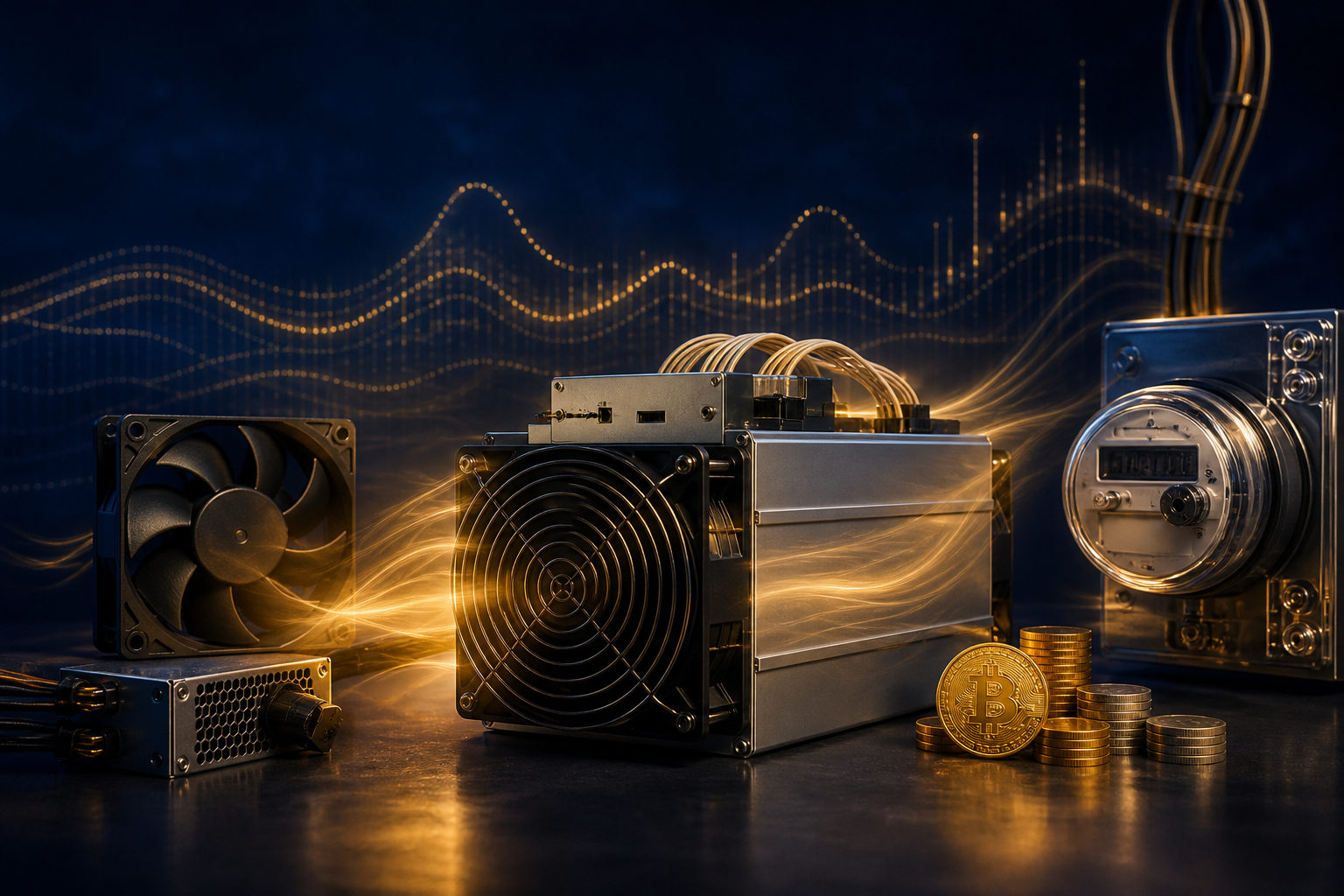
How much money can you make from mining bitcoins? There is no fixed answer. Your result depends on hardware efficiency, electricity cost, mining pool terms, and bitcoin price moves, and many people run into costs long before they see meaningful profit.
A simple way to picture mining is to imagine a nonstop bookkeeping contest. The Bitcoin network is a public ledger, and miners compete to add the next page. The miner that solves the required computation first gets the right to package transactions into a block and may receive the block reward plus transaction fees, but the competition is constant and the payout is never guaranteed.
What bitcoin mining actually does
People often describe mining as if a machine simply "creates" bitcoin out of nowhere. That misses the point. Bitcoin mining is the process of committing computing power to secure the network and compete for the right to add new blocks.
Bitcoin began with the genesis block in January 2009 and uses proof of work. A new block is produced about every 10 minutes. Miners repeatedly perform calculations in an attempt to find a valid result under the network rules. When one succeeds, that miner can publish a new block and receive the block reward defined by the protocol, along with the transaction fees included in that block.
That means mining is not just pressing a button and waiting for money. You are providing hash power in a competitive system. More efficient machines usually give you a better chance of earning rewards over time, but a better chance is still not the same as a predictable paycheck.
The main factors that decide mining income
When people ask how much they can make, they usually want one number. Real mining does not work that way. Your outcome comes from several variables working together, and each one can change the final picture.
Hardware efficiency
Modern Bitcoin mining is generally done with specialized ASIC miners rather than ordinary home computers. The key issue is efficiency: how much useful hash power a machine can produce for the amount of electricity it consumes. A more efficient miner can stay competitive for longer, while older hardware can lose ground quickly as the network gets tougher.
The purchase price is only part of the story. Reliability matters. Cooling matters. Firmware stability matters. Noise and maintenance matter too, especially if you are thinking about running equipment outside a professional site. A machine that looks good on paper can still underperform in actual use if it spends too much time running hot or going offline.
Electricity cost
Electricity is one of the biggest ongoing costs in mining, and it is often the most underestimated one. Mining equipment needs to run continuously. If your power rate is high, the machine may still be producing bitcoin while your margin gets squeezed away in the background.
This is why the same miner can make sense in one setup and make little sense in another. Mining is not only about what machine you buy. It is also about where you run it, how stable the power supply is, how heat is managed, and whether the operating environment can support nonstop use.
Mining pool terms
Solo mining exists, but income can be extremely uneven for an individual miner, so many people join a mining pool. A pool combines the hash power of many participants and distributes rewards according to its payout rules. That usually makes earnings smoother from a timing perspective, but it also introduces pool fees and different methods of reward calculation.
Not all pools are the same. Some differ in how they handle fees, variance, payout timing, and stale shares. A steadier payment pattern can feel better, but that does not automatically mean your total net return is higher. You need to read the payout structure, not just the headline promise.
Bitcoin price and network competition
Even without quoting a live market price, one fact is unavoidable: mining rewards are earned in bitcoin, and their value in dollars changes with the market. If the bitcoin price rises, the same mined amount can look much better in dollar terms. If the price falls, the opposite happens.
At the same time, the network does not stand still. When more efficient miners come online, your own hardware can become less competitive. Mining is not a buy-once activity. It is closer to an operating business where you have to keep checking whether your machine, your power bill, and the wider network conditions still line up.
How people usually participate in bitcoin mining
If you are not just curious about the theory and actually want to know how people take part, it helps to separate the common paths. The level of control, effort, and risk is very different in each case.
- Run your own miner: You buy the machine, set up power, cooling, network access, and maintenance, and handle the operation yourself. This gives you the most control and the most responsibility.
- Use hosting: You own the hardware, but it runs in a third-party facility. This can reduce the practical burden of heat, noise, and day-to-day management, but it adds counterparty risk and service costs.
- Join a pool: This is usually paired with self-run or hosted hardware. The goal is to reduce payout volatility, not to create guaranteed profit.
You may also come across cloud mining offers. These are often marketed as an easy shortcut because you do not need to buy or manage hardware directly. The problem is that ease of entry does not remove economic risk. Before considering any such arrangement, you would need to understand exactly what you are buying, how downtime is treated, how fees are taken, and who controls the key operating assumptions. If those terms are vague, the simplicity is only on the surface.
Why mining profits are often overestimated
Mining has a powerful psychological appeal. People imagine a machine running all day and sending income back automatically. In practice, mining is a moving target shaped by hardware quality, power expenses, market price changes, and the level of competition across the network.
The first common mistake is treating theoretical output as take-home profit. A calculator may show what a machine could produce under certain assumptions, but that is not the same as what remains after electricity, hosting, pool fees, maintenance, downtime, and replacement parts.
The second mistake is ignoring operational friction. Mining hardware does not stay perfect by default. Dust builds up. Cooling can fail. Network interruptions happen. Firmware issues can reduce performance. Small interruptions add up, and they often eat away at returns without attracting much attention.
The third mistake is making a payback estimate only during optimistic market conditions. When sentiment is strong, it is easy to assume the future will stay friendly. Machines do not become more efficient because the market feels good. If price weakens, power costs rise, or competition increases, a setup that once looked workable can become unattractive fast.
There is also a structural issue many beginners miss: halvings. Bitcoin is designed to halve the block subsidy about every 4 years, or every 210,000 blocks. The halving years so far have been 2012, 2016, 2020, and 2024. That changes the reward structure over time and puts even more pressure on efficiency, costs, and fee income. Any estimate that ignores this is incomplete.
What to calculate before you spend anything
If you are seriously evaluating mining, start with your own cost sheet rather than someone else's revenue claim. The order matters. Ask what you must spend and what can go wrong before asking what you might earn.
- Hardware cost: miner, spare parts, power setup, cooling changes, and any supporting equipment.
- Operating cost: electricity, hosting, pool fees, maintenance, and the cost of downtime.
- Stability: whether you can keep the machine online, cool, and connected consistently.
- Exit plan: what happens if the machine becomes outdated or the economics worsen.
- Local rules: whether your location has restrictions related to power use, noise, business activity, or taxes.
For home users, these points are especially important. Heat and noise are not minor details. A miner that sounds manageable in theory can be hard to live with in a normal residential setting, and a setup that looks cheap at the start can become frustrating if your environment is not built for continuous operation.
FAQ
Can you still make money mining bitcoin today?
Possibly, but it depends on your full setup rather than a simple yes-or-no answer. Hardware efficiency, electricity cost, uptime, and pool terms all shape whether the operation makes economic sense for you.
Is bitcoin mining at home realistic?
It can be done, but home mining has practical limits. Noise, heat, power load, and connection stability often become bigger issues than beginners expect.
Does joining a mining pool mean higher profit?
Not necessarily. A pool usually smooths the timing of payouts, but fees and payout rules affect your net result. More regular income is not the same as more total income.
Can a normal PC mine bitcoin?
In principle, any computing device can attempt the process. In reality, ordinary computers are not competitive against specialized ASIC hardware, so the result is usually not meaningful from an earnings perspective.
How should I judge whether mining is worth it without using a fixed profit number?
Start with your own costs and operating conditions, then compare them with live bitcoin price data and current miner specifications from reputable tools. The useful question is not whether someone else made money, but whether your setup has enough margin to absorb bad conditions.
If you want a practical next step, write down the miner model you are considering, the power cost you would actually pay, the site conditions, the pool fee structure, and your exit plan before checking live market tools. If any of those pieces are still unclear, you do not yet have a sound basis for answering "how much money can I make from mining bitcoins" for your own case.
Disclaimer: This article is for informational and educational purposes only and is not investment, financial, or legal advice. Crypto assets are highly volatile and you could lose your entire investment. Do your own research and decide carefully.