
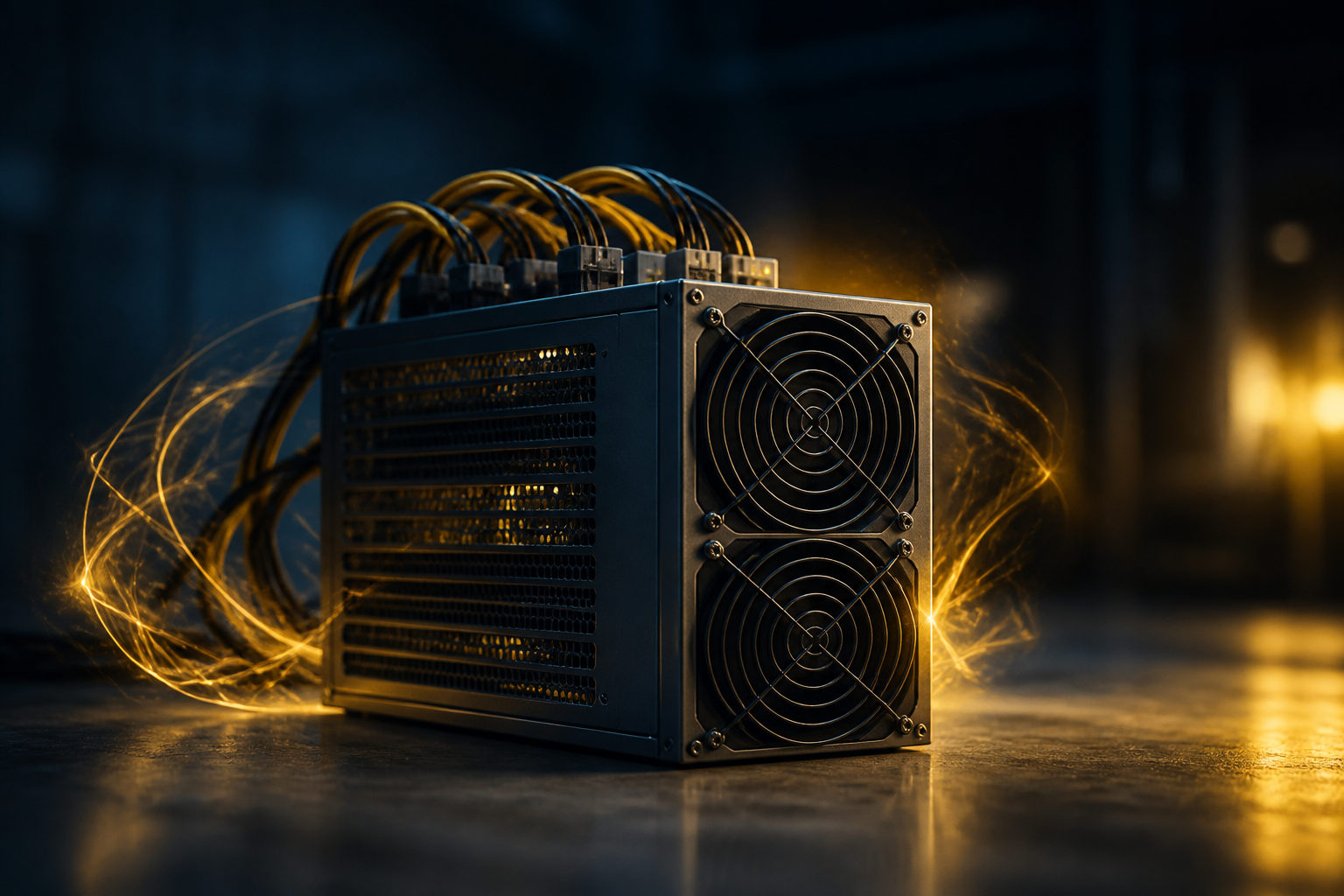
A bitcoin miner does not have one fixed power draw. The answer depends on the machine, its efficiency, how long it runs, the cooling setup, and whether you mine at home or through a hosted arrangement.
Why bitcoin mining uses so much electricity
Think of bitcoin mining as a nonstop bookkeeping race. Machines across the network keep making guesses, trying to find a valid result that lets a new block be added to the blockchain. The miner that succeeds gets the block reward and a share of transaction fees tied to that block.
That process requires specialized hardware performing hash calculations again and again. When the chips stay under heavy load for long periods, electricity use becomes a built-in operating cost. A miner is not like a laptop that idles between tasks; it is usually meant to run continuously.
Bitcoin produces a new block about every 10 minutes, so the race keeps going all day. If the machine is on, it is drawing power to stay competitive. That is the starting point for any realistic answer to the question of electricity use.
There are three different ways to ask the same question
People often ask how much power a bitcoin miner uses, but they may be mixing together three separate ideas: instant power draw, total electricity consumed over time, and whether the full setup is affordable to keep running. Those are related, but they are not identical.
| Layer | What it means | What changes it |
|---|---|---|
| Instant power draw | How much electricity the machine pulls while running | Model, chip design, frequency settings, cooling behavior |
| Total consumption | How much electricity it uses over a day or longer | Runtime, throttling, shutdowns, connection stability |
| Operating burden | Whether the setup is practical to keep active | Electricity price, ventilation, maintenance, extra equipment |
This matters because two miners can both be described as “power hungry” for different reasons. One may have a high draw at the wall, while another may become expensive because it needs extra cooling or cannot stay stable in a warm room.
There is also a gap between the miner itself and the full environment around it. Fans, exhaust systems, power conversion losses, and room cooling can all add to the final electricity bill. For home users, those supporting demands often become obvious before anything else.
What determines a bitcoin miner’s electricity use
Machine generation and chip efficiency
Bitcoin mining today is mainly done with ASIC hardware, which is built for one narrow task. Different generations of ASIC miners can vary a lot in efficiency. A newer machine may use electricity more effectively, which is why older units can fall out of favor even if they still function.
Runtime and operating settings
A miner does not always run in one fixed mode. Some operators adjust frequency or power profiles to control temperature or improve stability. If a machine overheats, disconnects, or restarts often, real-world electricity use can differ from what a spec sheet suggests.
Cooling and airflow
Mining turns electricity into computation and heat at the same time. Poor airflow, dust, and high ambient temperature can force fans to work harder and can trigger thermal limits. If the room needs extra cooling, the miner’s direct draw is only part of the story.
How you participate
A home setup raises practical questions about outlets, noise, heat, and household tolerance. A hosted setup shifts attention toward power terms, facility conditions, and maintenance quality. Joining a mining pool does not reduce the machine’s electricity use, but it does change how rewards are shared over time.
What most beginners should evaluate before buying hardware
Many newcomers start with the narrow question of how much electricity one bitcoin miner uses. The broader question is whether they have the right conditions to run one in the first place. Power is only one part of the decision.
| Way to participate | Power-related challenge | Best fit |
|---|---|---|
| Single miner at home | Outlet capacity, heat buildup, loud noise | People who want direct hands-on experience |
| Hosted miner | Need to check power terms, maintenance, and downtime handling | Owners who do not want to manage the environment themselves |
| Mining pool | Does not lower electricity use; only smooths reward distribution | Miners who want less variance in payouts |
| Holding bitcoin directly | No hardware electricity burden at all | People interested in exposure without running equipment |
If your main goal is simply to gain exposure to bitcoin, learning about wallets, custody, and buying methods may be more useful than buying mining hardware. Mining is closer to running a specialized hardware operation than casually owning a digital asset.
Bitcoin has a supply cap of 21 million coins, and new issuance comes from mining. The block subsidy halves about every 4 years, or every 210,000 blocks, with halving years including 2012, 2016, 2020, and 2024. That structure makes efficiency and electricity cost central to a miner’s decision about whether to keep a machine online.
How to judge whether a miner is “too power hungry”
Do not rely on a single headline specification. The right way to judge electricity use is to combine hardware efficiency, room conditions, power cost, and the operational burden of keeping the machine stable.
| View | What to check | Common mistake |
|---|---|---|
| Hardware | Power specification, efficiency, stability | Looking at raw hash output without considering power use per unit of work |
| Environment | Ventilation, temperature, power delivery, noise tolerance | Assuming a normal room can support long-term mining |
| Costs | Electricity rate, added cooling, repairs, downtime | Treating the utility bill as the only expense |
| Operations | Network uptime, dust cleaning, fault handling | Thinking the miner can run unattended for long periods |
A miner with high draw is not automatically a bad choice if it converts electricity into useful work more efficiently than an older machine. On the other hand, a cheap second-hand unit can become impractical quickly if it burns too much power for the performance it delivers.
FAQ
Can I run a bitcoin miner at home?
You can, but the real test is not just buying the machine. You need suitable power delivery, strong airflow, and a high tolerance for noise and heat inside the space.
Does joining a mining pool reduce power consumption?
No. A mining pool changes how rewards are distributed among participants. The machine still performs the same type of work, so its electricity use does not drop just because it is connected to a pool.
Why do people give very different answers about miner power use?
They may be talking about different things. One person might mean the miner’s direct draw, another might include cooling and support equipment, and a third may be blending in local electricity cost.
How can I check a miner’s real electricity use?
Start with the manufacturer’s power information, then compare it with a meter at the wall or a hosting dashboard if the machine is off-site. Room temperature, fan behavior, and power conversion losses can all change the result.
Can a normal computer still mine bitcoin?
For bitcoin, serious mining is centered on specialized ASIC machines. A standard computer lacks the efficiency needed for this kind of competition, so the electricity it uses is usually hard to justify.
Before you price any machine, write down four things: your electricity rate, your cooling options, your tolerance for noise, and who will handle failures. Those points will tell you more about whether bitcoin mining is realistic for you than any marketing line on a product page.
Disclaimer: This article is for informational and educational purposes only and is not investment, financial, or legal advice. Crypto assets are highly volatile and you could lose your entire investment. Do your own research and decide carefully.