
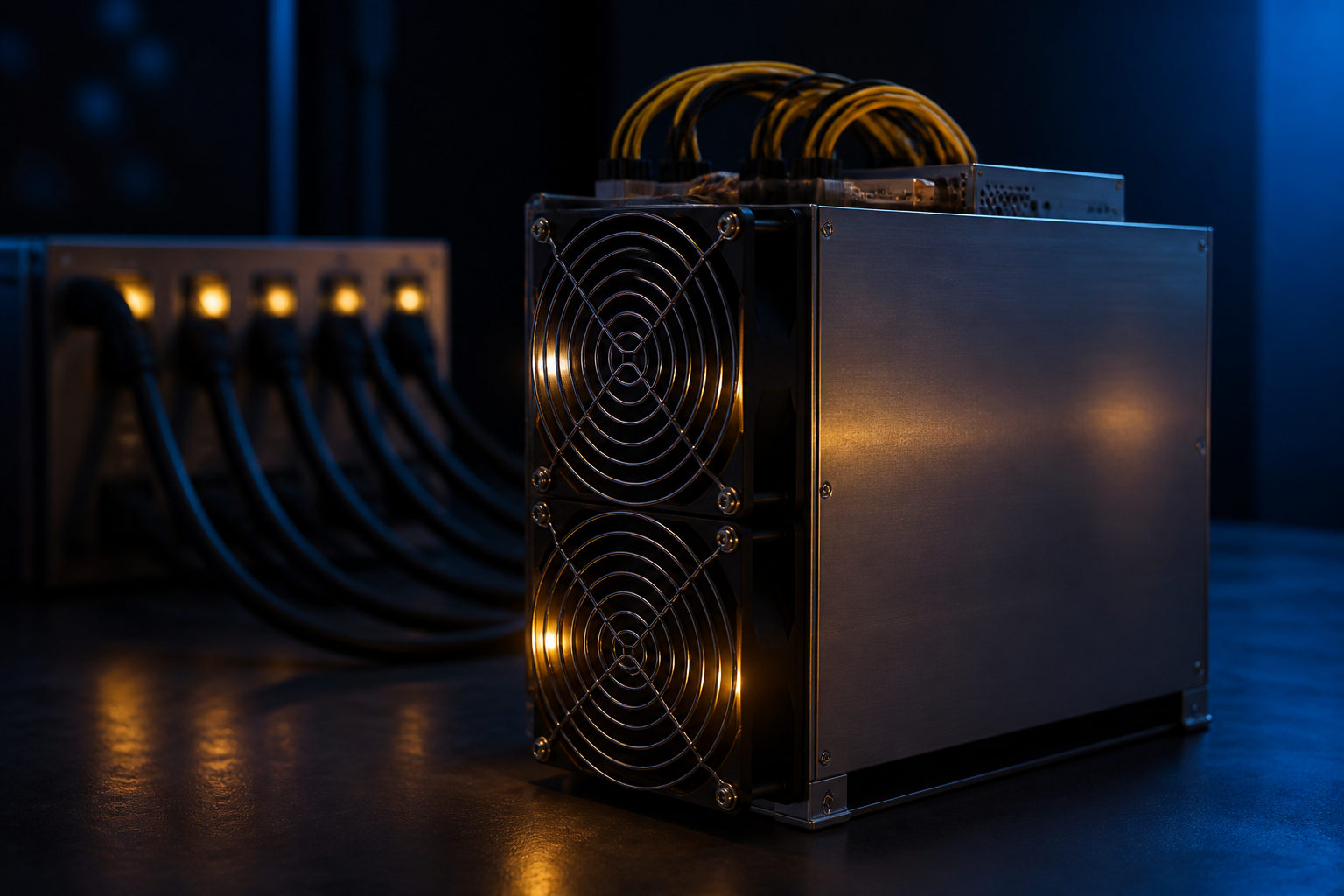
Bitcoin mining uses a lot of electricity, but there is no single fixed number that answers the question for every case. The power draw depends on the mining hardware, the cooling setup, the size of the operation, and how the miner takes part in the network.
Why Bitcoin mining uses electricity at all
A simple way to think about Bitcoin mining is to picture a nonstop bookkeeping contest. The network needs participants to gather transactions into blocks, and miners compete to win the right to add the next block to the chain. That competition is what drives electricity use.
Mining hardware keeps running calculations over and over, trying to find a valid result before someone else does. The machine itself consumes power, but that is only part of the story. Power supplies, fans, ventilation, and other supporting systems also need electricity while the equipment is running.
Bitcoin produces a new block about every 10 minutes, so the contest repeats all day and all night. The energy use is tied to the proof-of-work model: miners spend real-world resources to make rewriting the ledger expensive and difficult.
Why there is no one-size-fits-all answer
When people ask how much power Bitcoin mining uses, they may be talking about very different things. One person might mean a single machine in a garage. Another might mean a warehouse full of miners. Someone else may be asking about the entire Bitcoin network. Those are three separate questions.
| Scope | What it refers to | Main variables |
|---|---|---|
| Single miner | Power draw of one machine while operating | Chip efficiency, settings, cooling conditions |
| Mining site | Total electricity for multiple machines plus support equipment | Number of units, ventilation, power losses |
| Bitcoin network | Combined long-term consumption from global competition | Miner participation, hardware turnover, electricity prices |
Another source of confusion is the gap between rated power and real operating cost. A manufacturer spec sheet may describe the miner itself, yet actual electricity use can end up higher once you include cooling and power delivery losses. In a warm environment, support systems can become a meaningful part of total consumption.
That is why copying someone else's setup from a forum or video often leads to bad assumptions. The same model of miner can behave differently depending on room temperature, airflow, dust, firmware settings, and the stability of the local power supply.
The main factors that shape mining power use
Hardware efficiency
Mining is highly sensitive to efficiency. Two machines can both mine Bitcoin, yet one may need much less electricity for a similar level of work. Newer hardware is often built to improve performance per unit of power, which is one reason older machines can become hard to justify in places with expensive electricity.
Cooling design
Mining machines generate constant heat, and that heat has to go somewhere. Air-cooled systems are common and easier to understand, but they can bring noise and thermal limits. More advanced cooling methods may handle heat better, though they add complexity and can shift where the electricity is spent rather than making it disappear.
Scale of operation
A home miner and a professional site do not face the same power picture. A small setup may seem simple, but even one machine can stress household wiring, create persistent noise, and add heat to a room. Large sites can spread some costs across many units, yet they also need more planning for ventilation, maintenance, and distribution of power.
Electricity price and power quality
Electricity cost is one of the most practical filters in mining. A machine that looks acceptable on paper may still be uneconomic if local power is expensive. Supply quality matters too: unstable power, repeated outages, and voltage issues can cut runtime or lead to extra wear on equipment.
| Factor | How it affects electricity use | Common mistake |
|---|---|---|
| Miner efficiency | Better efficiency lowers power needed for the same amount of work | Looking only at purchase price |
| Cooling | Support systems can raise total site consumption | Ignoring fans, ventilation, or air conditioning |
| Scale | Larger setups need more supporting infrastructure | Multiplying single-unit figures without adjustment |
| Electricity price | Changes whether continuous operation makes sense | Assuming good hardware solves every cost problem |
| Power quality | Poor supply can reduce uptime and reliability | Focusing only on the miner itself |
What this means for people thinking about mining
For most readers, the useful question is not a global headline number. It is whether a specific way of mining makes sense in their own situation. The answer changes depending on whether you run a machine at home, place hardware in a hosted facility, join a mining pool, or buy exposure through a contract-based product.
| Participation method | Who bears the power cost | What to examine closely | Main trade-off |
|---|---|---|---|
| Run your own miner at home | You do | Electricity price, wiring, noise, heat | Maximum control, maximum day-to-day friction |
| Host hardware at a facility | Usually built into hosting fees | Fee structure, downtime handling, transparency | Less hassle at home, more reliance on the operator |
| Join a mining pool | The machine owner still pays for power | Payout rules, stability, reporting | Smoother reward distribution, same hardware power draw |
| Buy a cloud or contract product | Indirectly passed through by the provider | Contract terms, delivery, exit conditions | Less direct involvement, more counterparty risk |
Home mining is often misunderstood because people focus on the miner and forget the environment around it. The machine may fit on a shelf, yet the real issues can be noise, heat buildup, and whether the circuit can safely support a sustained load. Those problems are practical, immediate, and easy to underestimate.
Hosting moves those issues away from your home, but it introduces a new question: how much do you trust the operator? A mining pool can smooth the randomness of block rewards, though it does not reduce the electricity consumed by your hardware. Contract-based products can look simple on the surface, but the power cost has only been pushed into the provider's side of the agreement.
Why power use matters beyond the electric bill
High electricity use is not just a technical detail. For miners, it is a core operating cost that keeps showing up as long as machines stay online. Even a well-chosen device can become hard to run if cooling, site conditions, or local electricity rates work against it.
There is also a broader debate around Bitcoin mining and energy use. Supporters argue that proof of work ties network security to real economic cost, which makes attacks more expensive. Critics question whether that level of energy consumption is justified. Whatever side someone takes, the key point is the same: electricity is central to how Bitcoin mining functions.
If you are evaluating whether to take part, avoid treating power use as a vague background issue. Break it into separate pieces: miner draw, cooling demand, electrical infrastructure, and expected runtime. That gives a much clearer view than searching for a single universal number.
FAQ
Can a regular home computer mine Bitcoin?
In theory, any machine that performs the required calculations can take part. In practice, Bitcoin mining is highly specialized, and ordinary home computers are not competitive on efficiency, cooling, or sustained operation.
Does joining a mining pool reduce power consumption?
No. A mining pool changes how rewards are shared and can reduce payout volatility for participants, but it does not change how much electricity your hardware uses while running.
Why do people report different power use for the same miner model?
Model names do not tell the whole story. Settings, room temperature, airflow, dust buildup, power supply condition, and firmware choices can all change real operating behavior.
Does cloud mining avoid the electricity problem?
It only moves the issue out of sight. The power cost still exists somewhere in the provider's operation, and you need to understand how those costs are reflected in the contract and the service terms.
What should I check first if I want to estimate my own risk?
Start with your electricity price and the physical space where the machine would run. After that, look at hardware efficiency and cooling needs, because those factors shape whether the setup is manageable at all.
If you want a realistic answer to how much power Bitcoin mining uses in your case, treat it as a system question rather than a single-device question. Separate the miner, the cooling, the site, and the operating schedule, then examine each cost on its own before you decide whether to proceed.
Disclaimer: This article is for informational and educational purposes only and is not investment, financial, or legal advice. Crypto assets are highly volatile and you could lose your entire investment. Do your own research and decide carefully.