
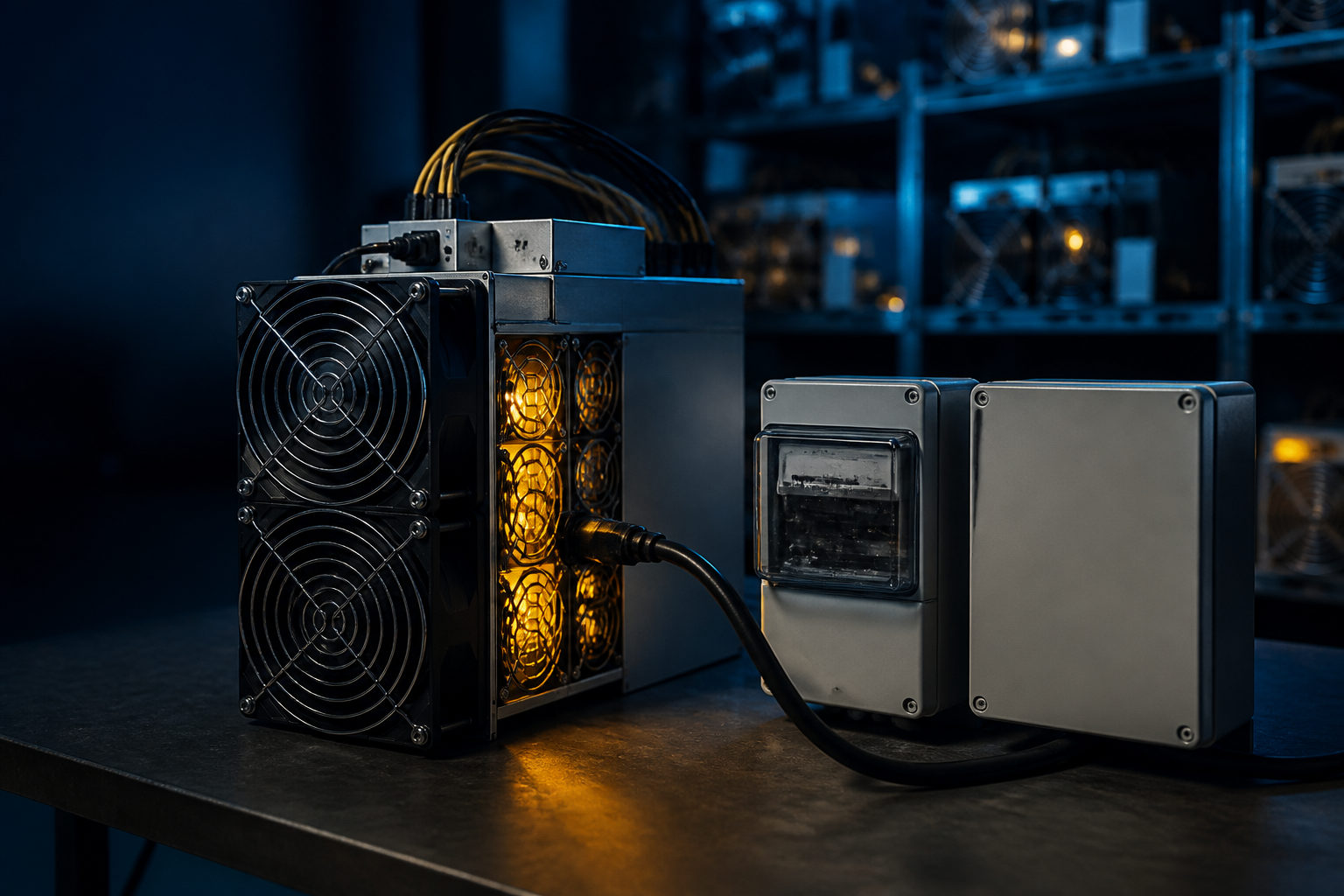
How much power do you need to mine bitcoins? The short answer is that it depends on how you take part. If you run your own ASIC miners, power use is driven by machine wattage, hours online, unit count, and cooling. If you buy cloud mining contracts, you do not see the household power draw, but the electricity cost is still baked into the fee structure.
Why bitcoin mining uses so much electricity
A simple way to picture mining is to think of it as a nonstop bookkeeping race. The Bitcoin network produces a new block about every 10 minutes, and miners keep running hash calculations to find a valid result under the current difficulty setting. The winner gets the chance to add transactions to the block.
That race is what creates constant power demand. Mining hardware does not work in short bursts like many consumer devices. It keeps trying new hashes around the clock, so electricity use rises with machine power, total operating time, and the number of units you run.
This also explains why casual guesses often miss the mark. People may ask one simple question about power, but the real answer sits inside a system that includes the miner, the power supply, the cooling plan, the room temperature, and the network connection.
The main factors that decide power needs
To estimate mining power demand, you need to separate a few moving parts. Looking at the miner alone gives an incomplete picture because wall power draw can be higher than what people imagine from the computing chips by themselves.
| Factor | What it affects | Why it matters |
|---|---|---|
| Miner wattage | Base power draw per unit | Higher wattage means more electricity consumed during continuous operation |
| Runtime | Daily and monthly energy use | Mining is usually a long-hour activity, so uptime has a direct effect on total consumption |
| Number of machines | Total site load | Adding units scales power demand, heat output, and electrical stress |
| Power supply losses | Actual draw from the wall | The socket-side number can exceed the compute-side figure |
| Cooling equipment | Extra electricity use | Fans, ventilation, and air conditioning can add a large overhead |
| Ambient temperature | Cooling burden and stability | Hotter rooms require more effort to keep equipment running properly |
For beginners, this is the key shift in thinking: the question is not just how much electricity one miner uses on paper. The better question is how much power the full setup needs once it is actually installed and kept online.
Your mining method changes the answer
People often use the phrase bitcoin mining as if everyone is doing the same thing. In practice, home mining, hosted mining, and cloud mining come with very different power responsibilities. The amount of electricity you personally need to supply depends on which route you choose.
| Method | Do you directly supply power? | Main responsibility | Common trade-off |
|---|---|---|---|
| Home mining | Yes | Power, cooling, noise control, networking, maintenance | Full control, but full operational burden |
| Hosted mining | Indirectly | Choosing a provider and understanding the fee structure | You avoid home setup issues, but still pay for energy through service costs |
| Cloud mining | No | Reviewing contract terms and risk exposure | No household power demand, but low visibility into real operating costs |
| Mining through a pool | Depends on where the hardware sits | Sharing hash power and receiving distributed rewards | A pool helps smooth reward distribution; it does not reduce machine power draw |
That last point matters because many new users confuse pools with efficiency gains. Joining a mining pool can change how rewards are shared, but it does not make your ASIC use less electricity. The hardware still runs at its normal power profile.
Home mining is where the gap between theory and reality becomes obvious. A miner may fit in the room physically, yet the room may still be unsuitable because of heat buildup, fan noise, dust, or electrical limits on the circuit.
Do not count only the miner; count the whole operating environment
If you want a realistic answer to the power question, include every part of the setup that must stay on for the miner to function well. Bitcoin mining is a continuous process, and weak support systems can leave you with poor performance while the equipment still consumes plenty of electricity.
- Electrical capacity: outlets, cables, breakers, and household wiring need to handle a sustained high load safely.
- Cooling path: if hot air cannot leave the room, the miner may throttle, error out, or stop, even though power is still being used.
- Noise tolerance: high-speed fans can make home mining hard to live with long before the electric bill arrives.
- Stable internet: a miner needs to stay connected to submit work to a pool or other service.
- Maintenance time: dust, airflow issues, firmware trouble, and power irregularities need attention.
In other words, electricity demand is tied to infrastructure. The practical burden comes from running a hot, loud, always-on machine in a place that may have been designed for normal household appliances instead.
How to estimate whether a setup is realistic
You do not need a perfect model to make a useful decision. A better approach is to check the setup in order, from the hardware itself to the room it will run in, then to the local power price. That sequence helps you avoid buying equipment first and discovering later that the site cannot support it.
| Step | What to check | What can go wrong if skipped |
|---|---|---|
| Identify the hardware | Confirm that it is a dedicated Bitcoin ASIC | You may assume a regular PC can compete effectively |
| Read the power specification | Check the machine's stated consumption | You may underestimate real-world electricity demand |
| Inspect the electrical setup | Look at circuits, outlets, breakers, and cable quality | Trips, overheating, or safety problems can appear |
| Review the cooling plan | Map airflow, ventilation, and dust control | Heat can reduce stability and lower effective performance |
| Include support equipment | Add fans, air conditioning, and networking gear | The total load may be much higher than the miner alone suggests |
| Apply local electricity pricing | Estimate ongoing operating pressure | A setup may be technically possible but economically hard to justify |
There is another point that beginners often miss: mining power need is not a one-time question. It is a steady-state question. You are asking whether your location can support continuous operation, not whether the machine can switch on for a quick test.
If your goal is only to understand the scale, remember this: bitcoin mining is usually a sustained, high-load use case. It should not be compared with occasional home electronics use.
FAQ
Can a home computer mine bitcoin?
It can participate in hashing in a technical sense, but Bitcoin mining is dominated by dedicated ASIC machines. A normal desktop is not competitive on efficiency, so its electricity use does not translate well into meaningful mining performance.
How much electricity does one bitcoin miner use per day?
That depends on the exact machine and how long it runs. Without a model and its power rating, no precise number would be reliable, and a serious estimate should also include cooling and power-supply overhead.
Does joining a mining pool lower power consumption?
No. A mining pool changes how hash power is grouped and how rewards are shared. It does not change the physical power draw of your hardware.
Does cloud mining mean I do not need to think about electricity?
You do not need to provide household electricity yourself, but the cost of power is still part of the business model. The question shifts from your meter reading to whether the contract explains fees, terms, and operating risk clearly.
What should I check before trying to mine at home?
Start with electrical capacity and heat removal, then look at the miner. Many home setups fail at the room and wiring level before hardware specs even become the main issue.
Before you buy anything, place the target machine, your electrical capacity, your cooling plan, and your local electricity price in one checklist. If one part clearly does not fit, the setup is not ready yet.
Disclaimer: This article is for informational and educational purposes only and is not investment, financial, or legal advice. Crypto assets are highly volatile and you could lose your entire investment. Do your own research and decide carefully.