
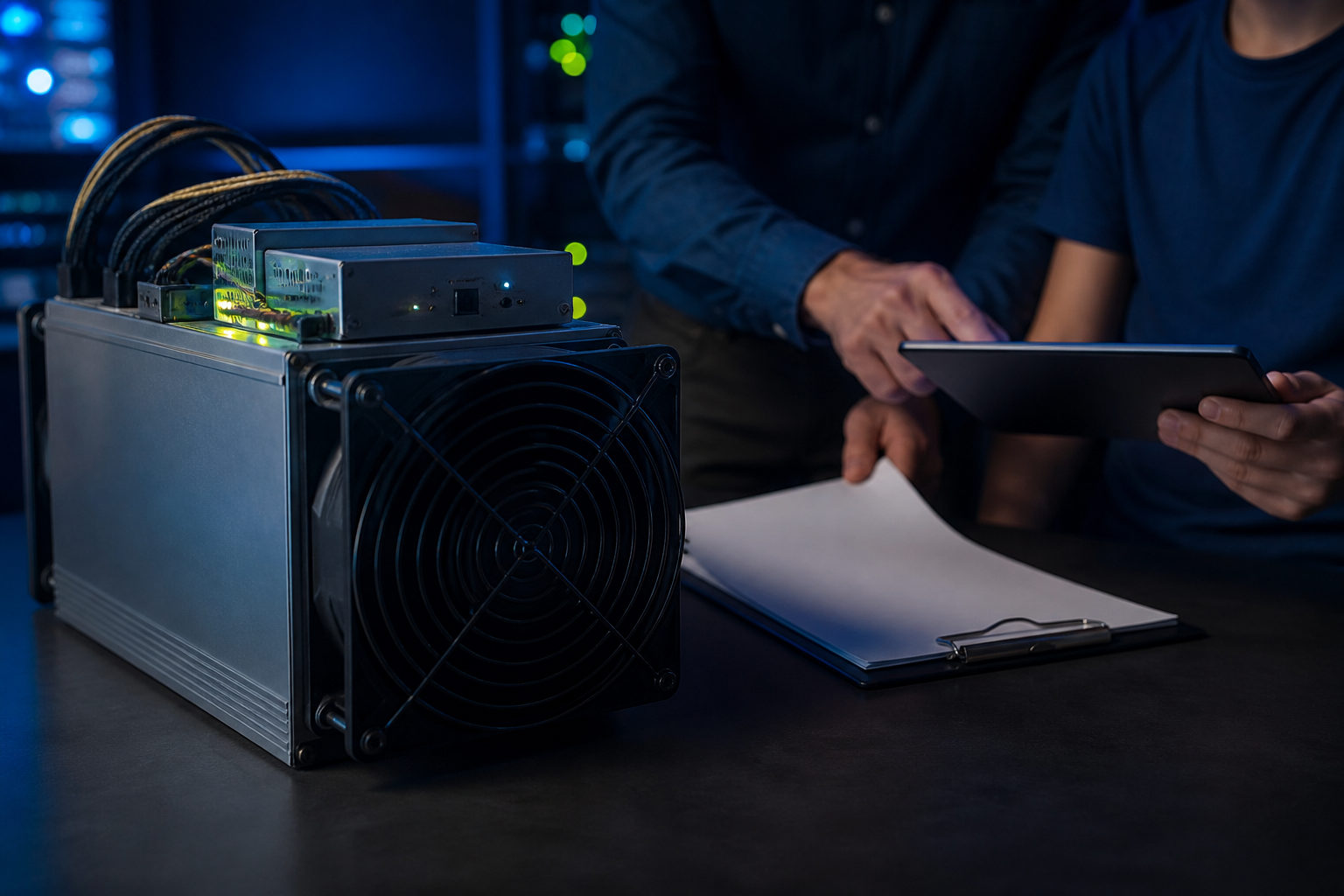
There is no built-in minimum age in the Bitcoin protocol, but real-world mining usually depends on whether an adult can handle equipment, power, space, contracts, and payment accounts.
Think of mining as a bookkeeping race
A simple way to picture Bitcoin mining is as an ongoing race to write the next page of a public ledger. Transactions gather on the network, miners use computing power to search for a valid result, and the miner that finds one first gets the chance to add a new block to the blockchain under the network rules.
That is why the protocol itself does not care how old you are. It checks whether the work is valid, not whether the operator is an adult, a teenager, or someone learning with a parent nearby. Once mining moves from protocol rules to real life, though, age can matter because buying hardware, paying electricity bills, renting space, or accepting service terms may require legal capacity.
No age rule in the protocol, but practical barriers are real
People asking how old do you have to be to mine bitcoin are often asking two different things at once. One is whether Bitcoin itself sets an age limit. The other is whether a person can actually run mining equipment in a lawful and sustainable way.
For the first question, the answer is straightforward: the network does not set a minimum age. If your machine can run, your software can connect, and your hardware can submit work, you can participate at the protocol level.
The second question is where most of the friction appears. A minor may understand mining very well and still be unable to buy a machine alone, sign a hosting agreement, pay utility costs, or open the kind of account a service provider wants for payouts. In many cases, the barrier is not Bitcoin. It is the set of rules around property, contracts, and household responsibility.
| Area | Age limit? | Where the limit usually comes from |
|---|---|---|
| Bitcoin protocol | Usually no | The network validates work and block rules |
| Buying hardware | Sometimes | Payment, contracts, warranty obligations |
| Mining hosting | Often | Service terms, identity checks, billing |
| Home mining | Depends | Electricity use, noise, heat, household consent |
| Mining pool account | Varies | Platform rules, payout method, compliance checks |
So the better answer is this: Bitcoin mining has no universal age gate in code, but most people still need an adult or guardian if they are not old enough to manage the surrounding obligations on their own.
Learning mining and running mining are not the same thing
If your goal is education, age is a much smaller issue. You can study what a block is, how hashing fits into proof of work, why mining difficulty adjusts, how mining pools divide tasks, and why miners compete to package transactions. That knowledge is useful even if you never power on a mining machine.
If your goal is actual participation, the path changes. Some people place machines at home. Some join a pool with their own hardware. Some buy hardware and put it in a hosted facility run by a third party. Each route has a different set of practical demands.
| Way to participate | What you need first | Who it fits best |
|---|---|---|
| Study the process | Basic learning materials, software awareness, network basics | People who want to understand the system first |
| Mine at home | Hardware, steady power, cooling, internet, suitable space | People who control their setup and can manage the environment |
| Join a pool | Hardware, pool settings, payout arrangement | People who want to contribute hash power steadily |
| Use hosting | Hardware purchase, hosting contract, billing account | People without a place to run machines themselves |
For a minor, the most realistic setup is often supervised participation. A parent or guardian handles the contract side and household approval, while the younger person learns configuration, watches performance, and understands how the mining process works. That is very different from operating independently.
The hard part is often cost and environment, not age
Many beginners imagine Bitcoin mining as installing a program and letting a computer run in the background. In practice, serious Bitcoin mining is tied to specialized hardware rather than an ordinary home computer. A standard computer can still help you learn the basics, but it is not the same as entering the real competition.
Then come the ongoing demands. Mining equipment uses electricity continuously, creates heat, and can produce heavy fan noise. It also needs maintenance. Dust, unstable power, poor ventilation, and downtime all affect operation. If you live in an apartment, a dorm, or a shared house, these limits can stop a plan before age becomes the main issue.
The network rules also shape the economics of participation. Bitcoin began with the genesis block in January 2009 after Satoshi Nakamoto published the 2008 white paper titled Bitcoin: A Peer-to-Peer Electronic Cash System. New blocks appear about every 10 minutes, and the block subsidy halves about every 4 years, or every 210,000 blocks. Past halving years are 2012, 2016, 2020, and 2024. You do not need profit figures to see the point: mining is a long-term operational activity, not a casual app install.
| Practical issue | What it looks like | Why it matters to a beginner |
|---|---|---|
| Electricity | Continuous power use and circuit load | Determines whether a setup can run steadily |
| Cooling | Heat buildup and ventilation needs | Poor handling can reduce stability |
| Noise | Persistent fan sound | Can affect family members or neighbors |
| Maintenance | Cleaning, troubleshooting, downtime response | Requires regular attention |
| Competition and rules | Halvings, hardware turnover, stronger rivals | Changes how sensible a setup may be |
If you are young and still interested, start with the right questions
Before looking at mining machines, ask who would be legally responsible for the setup. Where would the hardware go? Who would approve the power use? Who would deal with support issues, billing, and any service agreement? Those answers matter more than enthusiasm.
After that, separate curiosity from commitment. If you want to learn how Bitcoin works, spend time on the structure of blocks, proof of work, mining pool logic, wallet addresses, and why the smallest unit is 1 satoshi, or one hundred millionth of 1 BTC. If you want to run hardware, move only after the environment, responsibility, and costs are clear.
For many younger readers, staying in the learning phase is the smarter move. It builds understanding without locking you into a noisy, power-hungry system that someone else may need to authorize anyway.
FAQ
Can a minor mine Bitcoin alone?
At the protocol level, the network does not check age. In real life, though, buying hardware, paying for electricity, signing hosting terms, and setting up payout arrangements often require a parent, guardian, or another adult to take responsibility.
Can I mine Bitcoin with a regular computer?
A regular computer is useful for learning the ideas and seeing how mining software is configured. For actual Bitcoin mining competition, people usually rely on specialized hardware rather than an everyday desktop or laptop.
Does joining a mining pool remove the age issue?
No. A mining pool changes how hash power is coordinated and how rewards are shared, but it does not remove account rules, payout requirements, or contract terms set by the service.
What should I learn before thinking about mining hardware?
Start with blocks, hashing, proof of work, difficulty adjustment, and the role of mining pools. Once those pieces make sense, it becomes much easier to judge whether running hardware is realistic for your situation.
If I cannot host equipment at home, is mining still an option?
It may be possible through a hosted setup, but that usually adds contracts, billing arrangements, and service terms. If you are young and do not control those decisions, learning the system first is usually the more practical route.
If you are trying to decide whether you are old enough to mine Bitcoin, do not focus only on age. Check who can take legal responsibility, where the machine would run, and how power and heat would be managed. Those three answers usually tell you more than a number of years.
Disclaimer: This article is for informational and educational purposes only and is not investment, financial, or legal advice. Crypto assets are highly volatile and you could lose your entire investment. Do your own research and decide carefully.