
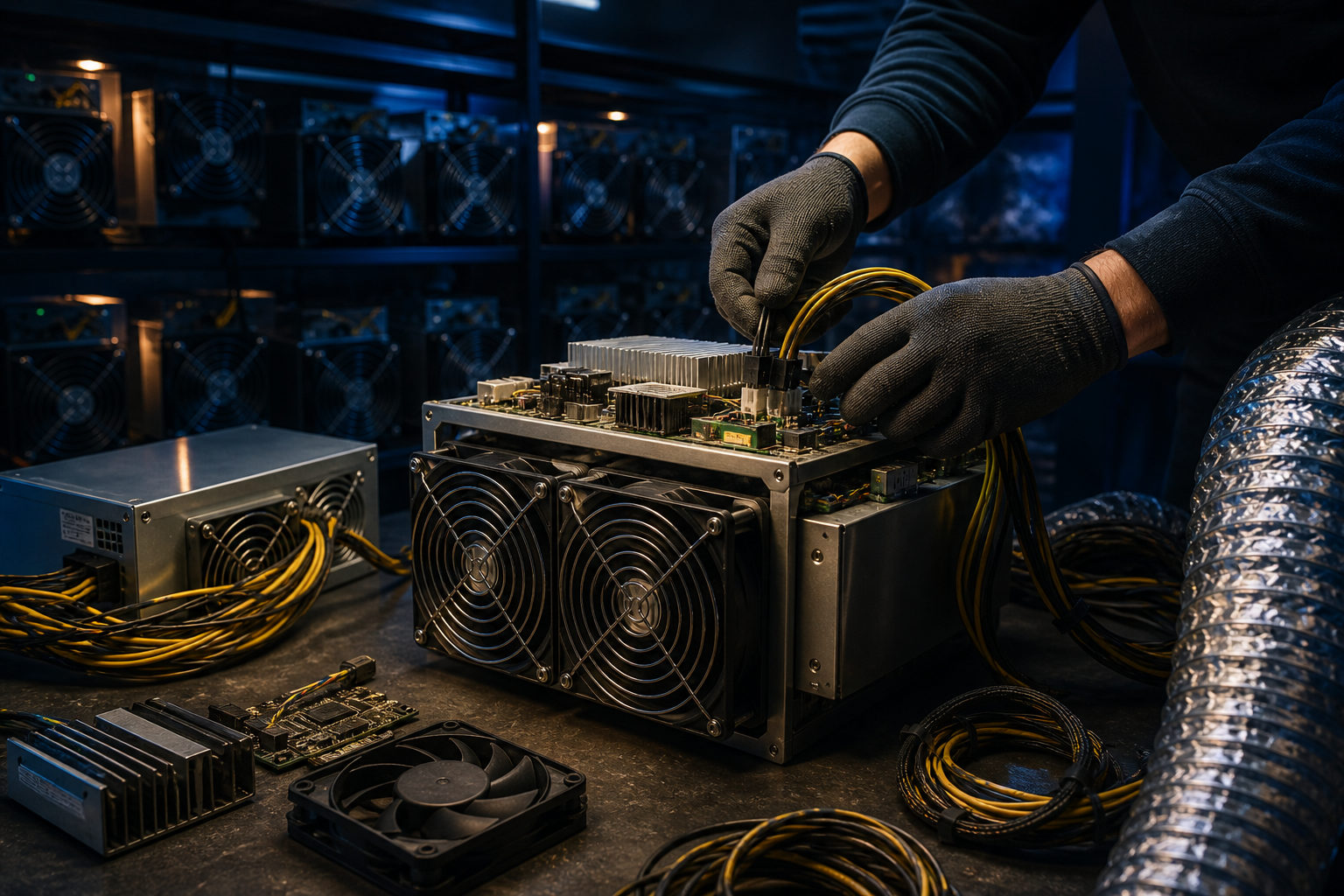
How to build a bitcoin miner has a short answer: for Bitcoin today, this usually means setting up an ASIC-based mining system with stable power, cooling, networking, a mining pool, and a wallet, not just assembling a normal PC.
Many beginners picture mining as a custom desktop project. They imagine buying parts, installing software, and letting the machine do the rest. That framing misses the real point. Bitcoin mining is closer to entering a nonstop bookkeeping race where machines across the network compete to produce the next valid block under shared rules.
Your machine is not working in isolation. It is competing in a proof-of-work system where miners keep trying huge numbers of possible inputs until one of them produces a valid result. Roughly every 10 minutes, a new block is found. That means a miner has to do more than power on and connect to the internet. It has to run reliably, stay cool, avoid downtime, and submit work through the right setup.
What a Bitcoin miner actually does
Bitcoin launched from the genesis block in January 2009, after the 2008 white paper, Bitcoin: A Peer-to-Peer Electronic Cash System, introduced the design under the name Satoshi Nakamoto. The system needs a way to decide who gets to add the next block without relying on a central operator. Proof of work is the mechanism that makes this possible.
A miner does not "dig" for coins in a physical sense. It performs repeated computations in an attempt to find a valid block hash under current network rules. A simple way to think about it is a public contest where everyone is trying different combinations as fast as possible. When one miner finds a valid result, it broadcasts the block, and other nodes verify it.
This is why the question of "how to build a bitcoin miner" cannot be answered with a parts list alone. The machine is part of a wider operating environment. Hardware type, cooling, electrical safety, network stability, and software configuration all affect whether the miner can participate in a useful way.
Why building a Bitcoin miner is not the same as building a PC
People often mix up two different ideas. One is building a computer that can run mining-related software. The other is building or deploying a machine that can realistically mine Bitcoin under current conditions. For Bitcoin, the second idea is the relevant one.
Mining on the Bitcoin network has become highly specialized. In practice, this means ASIC miners are the standard hardware class for actual participation. ASIC stands for application-specific integrated circuit. These machines are built for one narrow job: performing the computations needed for Bitcoin mining as efficiently as possible.
That has an important consequence for beginners. If your plan is to gather spare PC parts, add a gaming GPU, and call it a Bitcoin miner, you are solving the wrong problem. A modern Bitcoin mining setup is usually an ASIC deployment project, not a home desktop build in the usual sense.
So when people ask how to build a bitcoin miner, the practical tasks usually include the following:
- Choose the hardware route: buy a complete ASIC miner or source equipment and deploy it yourself.
- Prepare the electrical environment: the machine is designed for sustained load, so stable power matters.
- Plan cooling and airflow: heat is a constant issue in mining operations.
- Deal with noise: miners are often much louder than consumer electronics.
- Set up networking: a stable connection matters more than headline bandwidth.
- Join a mining pool: many individual miners use pools rather than mining alone.
- Create a wallet: payouts need to go to a Bitcoin address you control.
The main components of a workable setup
ASIC hardware
The core of a Bitcoin mining setup is the ASIC miner itself. These units are usually more integrated than ordinary PC builds. In many cases, the owner is not designing boards or selecting a processor and graphics card. The owner is deploying a specialized machine, powering it, connecting it to the network, and configuring pool and payout settings.
If you are looking at used hardware, focus on operating condition rather than sales language. Mining equipment often runs under sustained load for long periods. Fans, power supplies, control boards, and thermal performance all matter. A machine that powers on is not automatically a machine that runs well.
Power and electrical safety
This is one of the biggest reality checks for new miners. A Bitcoin miner is not like a laptop that idles most of the day. It is built to run continuously under heavy load. Because of that, the real bottleneck may not be the machine model at all. It may be your room, your circuit capacity, your sockets, your extension setup, or your tolerance for a device that runs for long stretches without rest.
It is better to evaluate the site before buying equipment. If the electrical environment is not suitable for sustained operation, the safe decision is to stop there or consider hosted deployment instead. Guesswork is a bad fit for mining hardware.
Cooling, dust, and placement
Heat management is not optional. Miners generate steady heat, and air-cooled models can be very noisy. A bedroom, a sealed cabinet, or a poorly ventilated corner is usually a poor place to run one. Dust, humidity, and restricted airflow can make the machine less stable over time.
Placement deserves as much thought as hardware selection. You need a clear intake and exhaust path, regular cleaning, and a realistic view of the noise level. Some people can configure a miner in minutes and still end up with a setup that is unusable in daily life because the room gets too hot or the sound becomes hard to tolerate.
Network and management access
Bitcoin miners do not need extraordinary bandwidth, but they do need stable connectivity. Frequent disconnects can interrupt work submission and make the setup harder to manage. A local management interface is also part of the job. You need to be able to check whether the miner is online, whether the fans are normal, and whether any errors are showing up.
This leads to a common misunderstanding: a miner that turns on is not the same thing as a miner that is operating well. Useful mining is about stable, observable runtime over long periods.
A practical step-by-step path for beginners
If you want to build a Bitcoin mining setup from scratch, the best first move is not shopping. It is defining what you are trying to achieve. Someone who wants to learn mining mechanics needs a different approach from someone who wants to run hardware for an extended period.
- Define the goal: are you learning how Bitcoin mining works, or do you want to operate real hardware on an ongoing basis.
- Study the ASIC route first: for Bitcoin, this is usually the relevant hardware path.
- Check the site: look at power, airflow, ambient heat, noise tolerance, and internet stability.
- Set up a wallet: make sure you have a Bitcoin wallet address that you control.
- Pick a mining pool: many small operators use pools to combine work and receive distributed payouts under pool rules.
- Configure the miner: enter the pool server details, worker settings, and payout-related information.
- Monitor the first run: watch temperatures, fan behavior, uptime, and connection status.
- Build a maintenance routine: clean dust, inspect airflow, and pay attention to unusual sounds or repeated restarts.
None of these steps are hard to describe. The harder part is keeping the system reliable after the first day. Many mining setups do not fail at the moment of installation. They become troublesome later because heat builds up, dust collects, cables loosen, or the location turns out to be a poor match.
Ways to participate besides keeping a miner at home
Not everyone who searches this topic really wants a machine running in a spare room. In many cases, the real question is how to take part in Bitcoin mining in a practical way. There are several broad paths.
- Self-hosting: you buy the hardware, place it yourself, and handle power, cooling, noise, and maintenance.
- Hosting: you own the machine, but it runs at a specialized site that provides infrastructure and basic operational support.
- Learning-only setup: you focus on understanding proof of work, pool structure, and miner configuration without treating it as an operating business.
There is no single correct choice for everyone. The right option depends on whether you care more about hands-on learning, operational control, convenience, or avoiding the headaches of heat and noise at home.
The economic reality most beginners miss
The biggest blind spot is often not the technology. It is the ongoing cost structure and operating burden. Building a Bitcoin miner is not just about buying a machine. It also means dealing with electricity, cooling, noise, downtime risk, cleaning, repairs, and the time needed to keep everything running.
Bitcoin itself has a supply cap of 21 million coins. Its smallest unit is the satoshi, and 1 satoshi is one hundred millionth of 1 BTC. The network also follows a halving schedule, with a halving roughly every 4 years, or every 210,000 blocks. Known halving years include 2012, 2016, 2020, and 2024. Those rules matter because miners operate inside a competitive system that changes over time. A machine that seems acceptable at one point may become less attractive later as conditions shift.
There is also a basic lifestyle question. Can your location handle the heat. Can your electrical setup handle sustained demand. Can the people around you handle the sound. Many guides explain where to enter pool settings, but they spend too little time on whether the physical environment is suitable in the first place.
It also helps to keep expectations grounded. A Bitcoin miner is not a passive income box that automatically prints money. It is specialized equipment participating in open competition under fixed protocol rules. Reliability, operating conditions, and maintenance discipline matter as much as the machine itself.
FAQ
Can I mine Bitcoin with a PC I build myself
You can study the process with ordinary hardware and related software, but that is different from running a setup that is practical for Bitcoin mining today. In real-world terms, Bitcoin mining is generally associated with ASIC hardware rather than a standard desktop build.
Is it realistic to run a Bitcoin miner at home
It can be possible in some locations, but the setup has to match the environment. Power quality, electrical safety, ventilation, heat, noise, and internet stability all matter before the machine even starts doing useful work.
Do I need to join a mining pool
Not in a strict sense, but many individual miners use pools because pools combine contributions from many machines and distribute results according to their rules. For beginners, this is often the more practical way to take part.
Is buying a used Bitcoin miner a good idea
It can lower the upfront barrier, but it also adds uncertainty. Wear, aging fans, thermal issues, and unknown operating history can turn a cheap machine into a maintenance problem.
What is the difference between a miner and a wallet
A miner performs the work needed to participate in block production. A wallet stores the keys that let you receive and manage Bitcoin. They serve different purposes, so it makes sense to set up the wallet first and keep control of it yourself.
If you are ready to act, start with a written checklist for power, cooling, noise, space, and internet stability. If any one of those is unclear, pause before buying hardware. That single step prevents more mistakes than reading another list of miner settings.
Disclaimer: This article is for informational and educational purposes only and is not investment, financial, or legal advice. Crypto assets are highly volatile and you could lose your entire investment. Do your own research and decide carefully.