
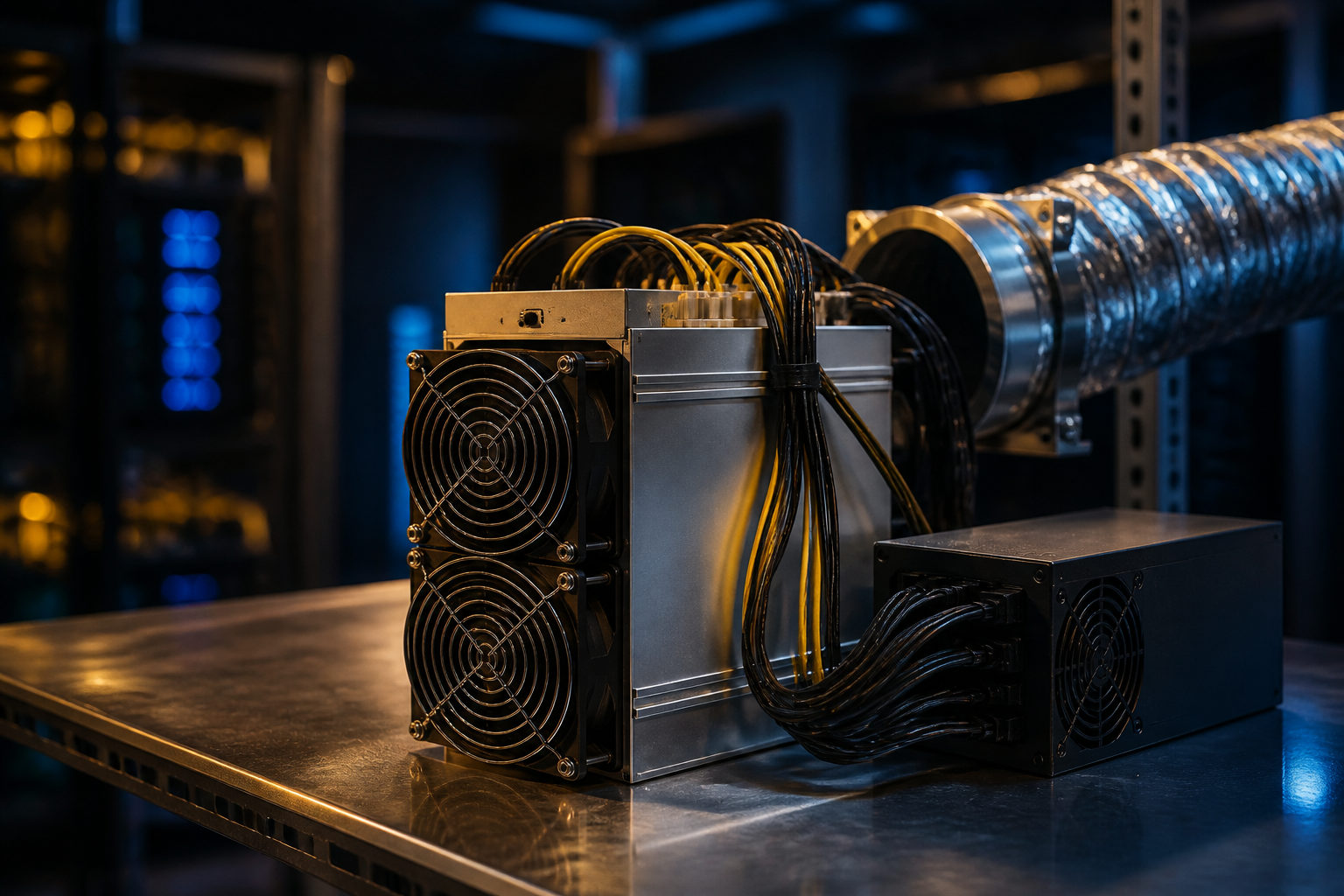
To build a bitcoin mining rig, start with the environment, not the shopping cart: power, cooling, noise, network stability, and your day-to-day ability to maintain the machine matter as much as the hardware.
What bitcoin mining is actually doing
A simple way to picture bitcoin mining is to think of it as an ongoing bookkeeping race. New transactions are waiting to be grouped into blocks, and miners compete to find a valid result that lets them publish the next block to the network.
This process is called proof of work. The bitcoin network produces a block about every 10 minutes, and miners repeatedly compute hashes until one of them finds a result that meets the protocol rules. Once other nodes verify that block, it becomes part of the chain and the ledger moves forward.
Bitcoin began with the genesis block in January 2009. Its supply is capped at 21 million coins, and the block subsidy is reduced on a schedule that cuts in half about every 4 years, or every 210,000 blocks. The halving years that have already occurred are 2012, 2016, 2020, and 2024. Those rules shape miner competition because hardware efficiency and operating costs matter more over time.
That leads to the first reality check for beginners: modern bitcoin mining is highly specialized. In practice, people mine bitcoin with ASIC machines, built for this specific task. A standard desktop CPU or gaming GPU is not a practical way to compete on the bitcoin network today.
Before you build, choose how you want to participate
Many people search for how to build a bitcoin mining rig when what they really mean is, “Can I run one myself?” The answer depends less on tutorials and more on your physical setup. Mining hardware runs continuously, throws off a lot of heat, and produces sustained noise. If your room, wiring, ventilation, or building rules are a poor fit, the project may become frustrating very quickly.
There are three common paths. One is home or private self-hosting, where you run the miner in a space you control. Another is hosting, where the machine is placed in a professional facility that handles power, networking, and routine on-site support. The third option is to pause before buying anything and map out the operating constraints first.
Self-hosting gives you direct control. You can inspect the machine yourself, make changes quickly, and keep the hardware physically nearby. The tradeoff is that you are responsible for everything: line safety, airflow, dust, outages, resets, and the simple fact that loud equipment changes the feel of a living space. Hosting removes much of that friction, but it adds dependence on a third party, so contract terms and service clarity become a major part of the decision.
If your goal is just bitcoin exposure, buying bitcoin and operating a miner are very different activities. Holding bitcoin is an asset decision. Running a miner is an equipment and operations decision that comes with ongoing maintenance work.
The hardware you actually need
People often imagine “building a rig” as if it were similar to assembling a custom PC. For bitcoin, the core compute device is usually already built. What you are really building is a reliable operating setup around it.
- ASIC miner: This is the main machine that performs the hashing work. When comparing models, efficiency and long-run stability are more useful than marketing headlines alone.
- Compatible power supply: Some miners ship with one, others require a specific match. Power compatibility is a basic requirement, and it is worth checking before the machine arrives.
- Electrical capacity and protection: This part is easy to overlook. A bitcoin miner is a continuous high-load device, so outlets, breakers, cabling, and the broader circuit plan need to match that reality.
- Network connection: The miner must stay online to submit work to a mining pool. Bandwidth usually is not the issue; uptime and stability are.
- Cooling and airflow plan: The machine will move hot air constantly. You need to know where cool air comes in, where hot air exits, and whether that hot air will cycle back into the room.
- Noise control: In many home settings, sound becomes the problem before temperature does. Distance, acoustic separation, and airflow design all affect how manageable the setup feels.
- Basic maintenance supplies: Dust cleaning tools, spare cables, labels, and a simple way to track machine status save time later when something goes wrong.
That distinction matters. With bitcoin mining, the miner itself is only one piece of the system. The room, the power path, and the cooling design determine whether the machine can keep working without constant trouble.
How to set up a bitcoin mining rig step by step
Check the location first
Start with placement. The miner needs room to breathe, and the path for intake and exhaust air should be obvious before you plug anything in. Avoid cramped enclosures, damp spots, and areas where dust builds up quickly. If you plan to run more than one machine, think about how the exhaust from one unit will affect the others.
Prepare the electrical side carefully
Verify that the circuit and outlet arrangement fit a device that will run for long stretches without much rest. Clean cable routing helps with safety and future maintenance. If you are setting up multiple machines, label cables and machine positions from the start. It sounds minor, but it makes troubleshooting much easier.
Connect power and network
Once the placement and electrical plan are ready, connect the miner to power and to a stable network source. Wired networking is usually the cleaner choice for reliability. At this stage, your goal is not speed; it is a stable connection that does not drop unexpectedly.
Access the management interface
After the machine is online, it will usually appear on your local network, where you can reach its admin interface. That is where pool information, worker identification, and network settings are entered. Interfaces differ across manufacturers, but the workflow is similar: get the miner recognized, point it to the correct pool endpoints, and confirm that it begins submitting work.
Join a mining pool
Most individual miners join a pool because solo mining with one machine has a very low chance of finding a block on its own. A pool combines hashpower from many participants and distributes proceeds according to its rules. When comparing pools, look for clear payout policies, stable service, useful monitoring data, and alerting that tells you when a machine goes offline.
Watch the machine after startup
The first stretch after boot matters more than many beginners expect. A miner can appear fine at first and still run into trouble once heat starts building. Watch for repeated disconnects, unusual fan behavior, unstable hash reporting, and signs that airflow is weaker than expected. Those are early clues that the room setup may need work.
Build a maintenance routine
Mining hardware does better with regular attention than with occasional panic checks. Dust accumulation, loose connections, obstructed airflow, and power irregularities can all shorten uptime. A basic routine of inspection, cleaning, and status review helps catch small issues before they turn into longer downtime.
The cost reality behind any mining rig
Any useful guide on how to build a bitcoin mining rig has to deal with costs, even without quoting returns. The machine itself is only the starting point. Your real operating picture includes electricity, ventilation changes, noise mitigation, repair access, spare parts, delivery logistics, and lost time when a machine is down.
Electricity is usually the biggest long-term variable. The same miner can feel manageable in one setup and completely impractical in another, depending on power cost and cooling conditions. Ambient temperature also changes the experience because hotter spaces put more pressure on fans and airflow planning.
Repairs deserve attention early, not after the first fault. Mining machines run hard for long periods, so fans, control components, and power-related parts can fail. Think through what happens if the unit stops hashing: can you diagnose the issue yourself, do you have local repair options, and how quickly can the machine get back online?
This is where many first-time buyers misjudge the project. They compare miner specs closely, then treat the operating environment as an afterthought. In practice, the environment is what determines whether ownership stays manageable.
Common mistakes beginners make
One common mistake is treating a bitcoin miner like a regular computer. It has a different purpose, a different acoustic profile, and different cooling demands. General PC habits do not transfer neatly.
Another is focusing on the machine while ignoring the room. A strong miner on paper still struggles if the air path is poor, the circuit is unreliable, or the network drops often enough to interrupt pool submissions.
Some beginners also skip monitoring. Without alerts, a machine can sit offline much longer than you think, especially if you are not checking the pool dashboard regularly.
There is also a planning mistake that shows up early: people assume a machine that powers on is ready for permanent use. A short test is easy. Stable operation over time is the hard part.
FAQ
Can I run a bitcoin miner at home?
Yes, if your space can handle the heat, noise, and electrical load. For many people, the main obstacle is not setup complexity but whether the machine fits the room and daily living conditions.
Do I need a mining pool for one machine?
In most cases, yes. A single miner working alone has a very small chance of finding a block, so pools are the standard way for individuals to participate.
Can I build a bitcoin mining rig from a normal PC?
You can run software on a normal PC, but that does not make it a practical bitcoin miner. Bitcoin mining today is dominated by ASIC hardware designed for that specific workload.
How often do I need to check the miner?
You do not need to stand beside it all day, but you do need regular monitoring. Temperature, fans, connectivity, and pool status should all be reviewed on a routine basis or through alerts.
What should I evaluate before deciding whether mining makes sense?
Focus on hardware efficiency, power conditions, airflow quality, repair options, and downtime risk. If you want the live bitcoin price, check a major market data site, but price alone does not tell you whether your setup is workable.
If you are ready to start, make a checklist for location, power, and exhaust airflow before choosing a miner model. That order saves time, avoids bad purchases, and gives you a much clearer view of what operating a bitcoin mining rig really involves.
Disclaimer: This article is for informational and educational purposes only and is not investment, financial, or legal advice. Crypto assets are highly volatile and you could lose your entire investment. Do your own research and decide carefully.