
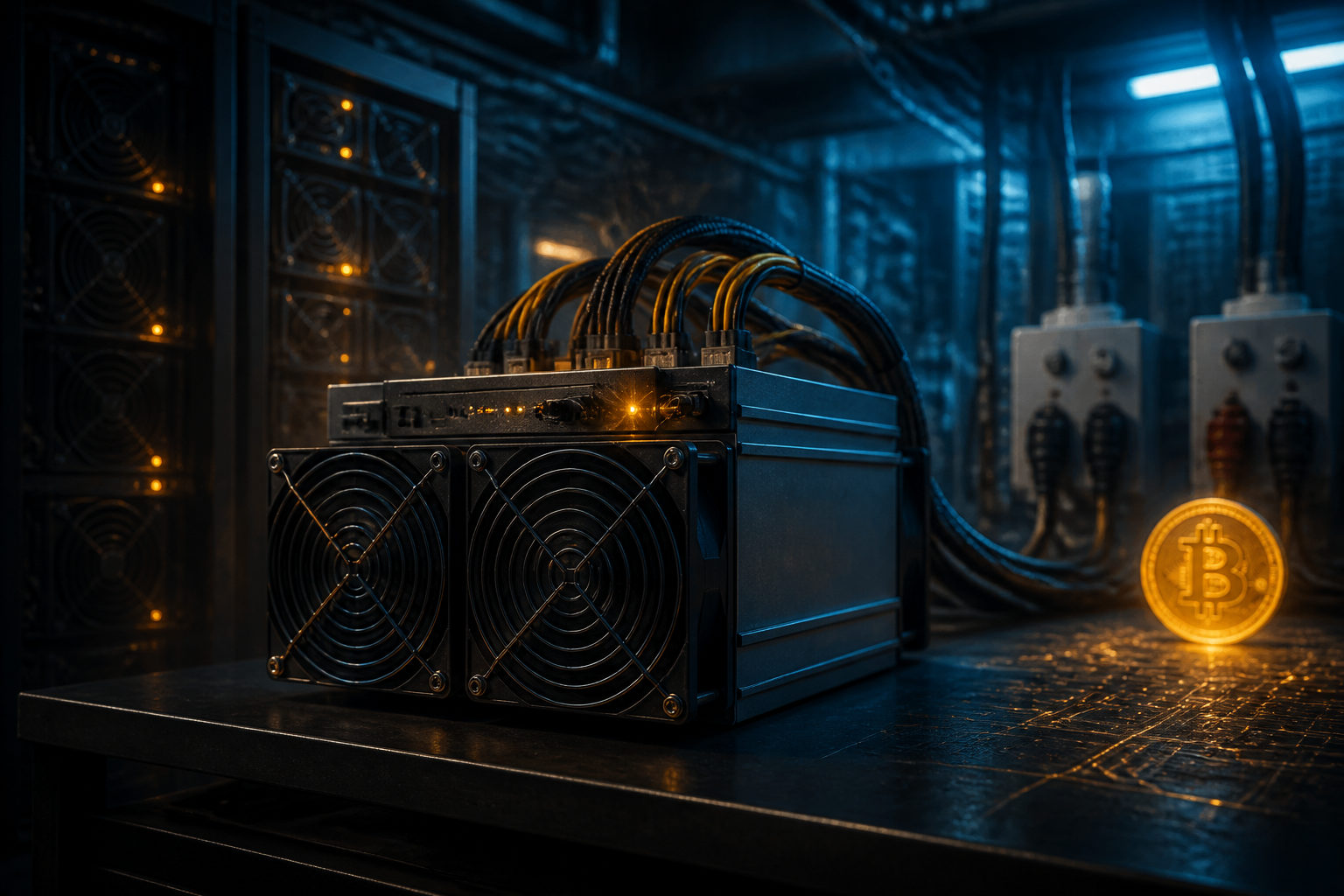
To get bitcoins from mining, you need to participate in Bitcoin’s block-validation race. If your machine, or the mining pool you join, helps produce a valid block under network rules, you can receive a share of the block reward and transaction fees.
That sounds simple, but the practical side is much harder than the phrase “mine Bitcoin” suggests. Mining is not a button that prints coins. It is a competitive process built around computing power, specialized hardware, electricity, cooling, uptime, and secure custody once coins are paid out.
What Bitcoin mining actually does
A useful way to think about Bitcoin mining is a bookkeeping contest. The Bitcoin network is a public ledger. New transactions need to be grouped into blocks, and the network needs a rule-based way to decide who gets to add the next block without trusting a central operator.
Mining is that process. Miners perform repeated calculations under Bitcoin’s proof-of-work system. When a miner finds a valid result first, that miner earns the right to add a new block to the blockchain. In return, the block can include a reward defined by the protocol, along with transaction fees attached to the transactions inside that block.
Bitcoin began with the genesis block in January 2009. Its creator used the name Satoshi Nakamoto, though that identity remains unknown. The network produces a new block about every 10 minutes, and the block subsidy is cut roughly every 4 years, or every 210,000 blocks. Halving years so far include 2012, 2016, 2020, and 2024.
This is why people say they “get bitcoins from mining.” They are not creating coins outside the system. They are receiving coins according to Bitcoin’s rules for securing and extending the chain.
How miners get paid in practice
If you want to understand “how do you get bitcoins from mining,” it helps to separate the network-level answer from the personal one. At the network level, a valid block can carry a reward. At the personal level, your actual payout depends on how you participate.
Solo mining
With solo mining, you run your own hardware and compete directly against the rest of the network. If your machine finds a valid block before everyone else, the block reward and fees go to you. The idea is straightforward, but the chance of success depends on your share of total network hash power.
For most individuals, that means the wait between successful blocks can be very long. You may run hardware for a long time without finding one yourself. That makes solo mining more of a specialist or ideological route than a common path for new participants.
Pool mining
Most people who mine Bitcoin do so through a mining pool. A pool combines the computing power of many miners and distributes payouts according to each participant’s contributed work. Instead of waiting for your own machine to find a block, you receive smaller, more regular payouts when the pool finds blocks.
This is the most common answer to the question of how to get bitcoins from mining as an individual today. You contribute hash power, the pool coordinates the work, and your share is paid out under the pool’s reward system. The exact method differs from one pool to another, so reading the payout rules matters.
What you need to receive payouts
Mining rewards do not usually sit on the machine itself. You normally need a Bitcoin wallet address where payouts can be sent. A pool account may show your balance, but long-term control depends on whether you hold the wallet keys or recovery credentials in a secure way.
It also helps to know the unit system. Bitcoin can be divided into very small amounts, and the smallest unit is the satoshi. One satoshi equals one hundred millionth of a BTC. Because of that, pools can account for small shares of work even when they do not pay out every moment.
Ways to participate in Bitcoin mining
There is more than one way to join the process, but the practical differences are large. Before thinking about returns, think about the structure of participation.
Run your own hardware at home or on-site
This is the most direct route. You buy specialized mining hardware, connect it to power and the internet, configure your software or firmware, and either mine solo or connect to a pool. It gives you more direct control, but it also means you handle noise, heat, maintenance, and downtime yourself.
For many people, these physical issues are the first real barrier. Bitcoin miners are not quiet office machines, and they are not well suited to every home or apartment setup.
Use a hosted mining setup
Some participants place their machines in a facility operated by a third party. The host handles power, cooling, and day-to-day operation, while the user owns the hardware or has a contractual claim over it. This can remove some of the practical burden, but it adds trust and contract risk.
You need clarity on equipment ownership, maintenance responsibility, outages, fee structure, and withdrawal rights. If any of those points are vague, the arrangement deserves extra caution.
Join a mining pool
A pool is not a separate kind of hardware. It is the coordination layer that tells your machine what work to do and then splits proceeds according to the pool’s rules. Even if you own and run your own miner, many users still join a pool because it smooths the payout pattern.
That smoother pattern does not remove business risk. Pool fees, payout thresholds, server reliability, and account security still affect the outcome.
What determines whether mining is realistic for you
People often focus on the phrase “get bitcoins,” but the harder question is whether mining is workable under your conditions. Several factors decide that.
- Hardware type: Bitcoin mining today is centered on specialized ASIC miners rather than general-purpose home computers.
- Electricity cost: Power is one of the biggest operating costs. The same machine can make far more sense in one location than another.
- Cooling and noise: Mining equipment generates heat and sound during continuous operation.
- Uptime: If your machine is offline, it is not contributing work. Unstable power or internet reduces effective output.
- Network difficulty: Mining is competitive. Conditions do not stay fixed.
- Wallet security: Coins received from mining still need proper custody. If you lose access to the wallet, the fact that you mined them does not help.
This is the reality check many beginners need. Bitcoin mining is not a casual side feature built for anyone with a laptop. It is a competitive infrastructure activity. If you ignore operating conditions, the idea can look much easier than it is.
A practical step-by-step path for beginners
If you still want to try mining, the best first move is not to buy hardware immediately. Start with the decision process.
- Define your goal: Are you learning how Bitcoin works, or are you trying to acquire bitcoin through mining over time? Those are different goals.
- Set up a wallet first: Make sure you can receive, back up, and recover bitcoin safely before any payout arrives.
- Choose a participation model: Decide between solo mining, pool mining, or a hosted setup based on your technical ability and operating environment.
- Check the physical setup: Confirm power, ventilation, cooling, internet stability, and space constraints.
- Read pool rules carefully: Look at payout methods, fees, thresholds, and account protection features.
- Separate access controls: Do not treat a pool login as the same thing as secure wallet custody. They serve different purposes.
Many mistakes happen after a user gets the basics half right. A person may connect a machine correctly but leave wallet backup unfinished. Another may mine through a pool for convenience, then keep funds there longer than intended. Mining only solves the earning side. It does not solve custody for you.
Common misconceptions about getting bitcoins from mining
One common mistake is thinking mining means “buy a machine and wait.” In reality, mining is an ongoing operation. Hardware has to stay online, pool settings have to remain correct, and your wallet setup has to be secure.
Another mistake is assuming any service labeled cloud mining or managed mining is equal to direct participation. Sometimes it may involve real hardware access and clear terms. Sometimes it may not. If equipment ownership, fee treatment, and payout logic are not transparent, caution is warranted.
A third mistake is overlooking the difference between learning and earning. Mining can be a great way to understand how Bitcoin secures its ledger. That does not mean every beginner should expect it to be the best path to accumulate bitcoin.
FAQ
Can a normal person still get bitcoins from mining?
Yes, but participation is not frictionless. In practice, success depends on hardware, electricity, cooling, uptime, and the payout rules of the pool or hosting arrangement you use.
Can I mine Bitcoin with a regular home computer?
In theory, any computing device can attempt work under the protocol. In practice, Bitcoin mining is dominated by specialized machines, so a standard home computer is generally not a useful setup for competitive mining.
Do I get full block rewards if I join a mining pool?
No. In a pool, you usually receive a share based on the work you contribute and the pool’s payout method. The full block reward belongs to the pool collectively before distribution.
Where do mined bitcoins go after payout?
They are typically sent to a Bitcoin wallet address you specify, either directly or after being credited inside a pool account first. You should understand who controls the wallet and how recovery works before using it.
Is mining the only way to get bitcoin?
No. People also acquire bitcoin by buying it on exchanges or by accepting it as payment. Mining is distinct because you are earning bitcoin by contributing computing power to the network’s security and block production process.
If you are deciding whether mining fits your situation, the most useful next step is to compare your power setup, cooling options, hardware access, wallet security plan, and pool terms before spending money on equipment.
Disclaimer: This article is for informational and educational purposes only and is not investment, financial, or legal advice. Crypto assets are highly volatile and you could lose your entire investment. Do your own research and decide carefully.