
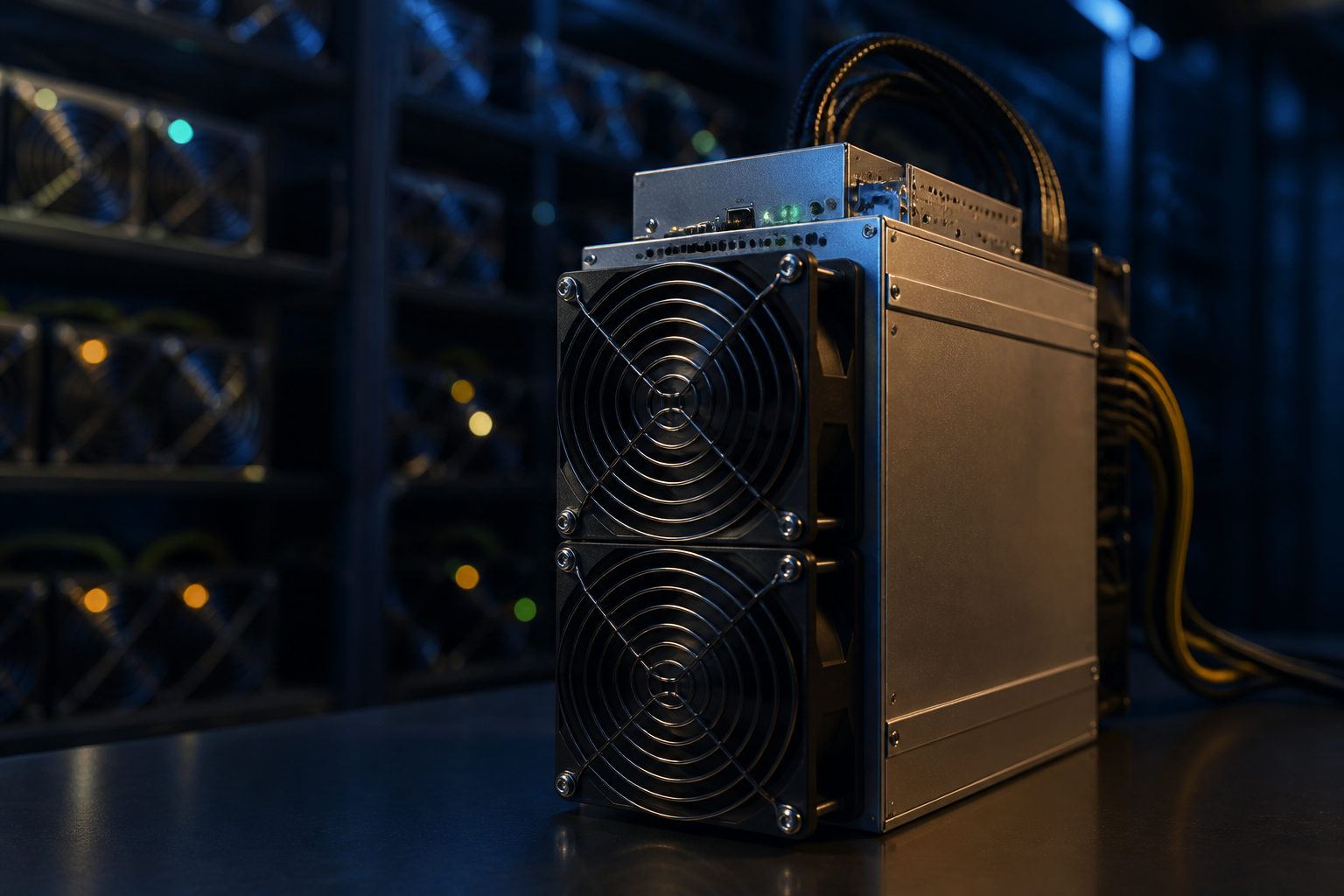
To get into bitcoin mining, start by understanding the block race and the real operating costs. Buying hardware before that is how most beginners make expensive mistakes.
What bitcoin mining actually does
Bitcoin mining is best understood as a competition to record transactions. Participants use computing power to try to assemble a valid block and add it to the blockchain under the network's rules.
That process is tied to network security, not just coin creation. Bitcoin began with the genesis block in January 2009, and the system uses proof of work to decide which miner earns the right to publish the next block. On average, a new block is produced about every 10 minutes.
A few basic rules shape every mining decision. Bitcoin has a fixed supply cap of 21 million coins, and the block subsidy changes through halving events that occur about every 4 years, or every 210,000 blocks. The widely cited halving years are 2012, 2016, 2020, and 2024, so anyone entering mining needs to think in terms of long-term protocol rules, not just today's hardware catalog.
The main ways people enter bitcoin mining
For most people, the old idea of mining bitcoin on a regular home computer is no longer the practical starting point. Modern participation usually revolves around specialized mining machines, mining pools, and an environment that can support continuous operation.
| Path | Who it suits | Main benefit | Main hurdle |
|---|---|---|---|
| Run your own miner at home | People who want direct control | Hands-on experience with setup and monitoring | Noise, heat, power, and space can become a problem fast |
| Host a miner through a facility | People without a suitable location | Part of the physical maintenance is handled off-site | You must review service terms and payout rules carefully |
| Join a mining pool | Most beginners | Smoother distribution of results than mining alone | You need to understand fees, account settings, and payout methods |
| Study first and wait | People with limited budget or limited technical comfort | Time to learn before committing money | No direct operating experience yet |
A mining pool is often the most realistic entry point. In simple terms, a pool combines the computing power of many miners and distributes results according to its own rules. This does not remove risk, but it can reduce the extreme variance a solo miner would face.
If you want to run hardware yourself, day-to-day operations matter more than many newcomers expect. Stable internet access, proper configuration, restart behavior after outages, and the ability to read a management panel all affect whether your setup can keep running without constant surprises.
Costs and constraints beginners often miss
People usually ask about profit first, but the better question is whether the operating model fits their situation. Bitcoin mining is closer to managing a high-load hardware system than making a passive purchase.
| Cost or constraint | What to check | Typical beginner mistake |
|---|---|---|
| Electricity | Local power rates, circuit capacity, and reliability | Focusing on machine price and ignoring ongoing power expense |
| Cooling | Room temperature, airflow path, and heat removal | Treating a home room like a server room |
| Noise | Living conditions, neighbors, and placement options | Assuming the machine will sound like an ordinary PC |
| Maintenance | Dust cleaning, firmware settings, restarts, and troubleshooting | Thinking plug-and-play means set-and-forget |
| Capital planning | Hardware budget, spare parts, and downtime tolerance | Spending the full budget on the first purchase |
| Service risk | Pool terms, hosting contracts, and withdrawal procedures | Reading marketing claims but skipping the actual rules |
Home setups are where beginners most often underestimate reality. A bitcoin miner is designed for sustained heavy operation, so the heat and sound profile is very different from a normal desktop computer. The question is not only whether it powers on, but whether your space can handle that load safely and consistently.
Downtime is another issue people tend to dismiss at first. If your machine keeps stopping because of unstable internet, overheating, dust, or power interruptions, the gap between expectation and actual performance becomes obvious very quickly. Before spending money, ask yourself whether you are prepared to act like an equipment operator rather than only an asset buyer.
A practical order for getting started
If you decide to move forward, sequence matters. A small test and a clear checklist usually teach more than rushing into a large purchase.
| Step | What to do | Why it matters |
|---|---|---|
| Learn the basics | Understand blocks, hash power, pools, wallets, and proof of work | Prevents confusion about what mining is |
| Assess your location | Check power, cooling, internet quality, and noise tolerance | Shows whether self-hosting is even realistic |
| Research hardware types | Separate specialized bitcoin miners from general-purpose computers | Avoids buying equipment that does not fit the job |
| Choose a participation model | Decide between home operation, hosting, or waiting | Aligns the plan with your actual constraints |
| Review mining pools | Compare fee structure, payout rules, and dashboard features | Reduces confusion after setup |
| Prepare a wallet | Create a receiving address and store backup information safely | Makes sure distributions can be received under your control |
| Run a limited test | Watch stability, temperature, noise, and connection behavior | Validates your setup in the real world |
One point deserves special attention: experience from other cryptocurrencies does not always carry over well. For bitcoin mining, the practical discussion usually centers on specialized ASIC hardware rather than general graphics cards, so your research should match the network you actually want to join.
Wallet preparation should also happen early, not as an afterthought. Any mining distribution needs to go to an address you control, and that means thinking about backups, access management, and basic operational security before your machine is up and running.
FAQ
Can an individual still get into bitcoin mining today?
Yes, but the environment is much more specialized than it used to be. A beginner now has to deal with hardware selection, operating conditions, and maintenance rather than assuming a regular computer is enough.
Is joining a pool better than mining alone for a beginner?
For most newcomers, a pool is the more practical path. It can smooth out distribution over time, though you still need to read the fee model and payout terms carefully.
Can I run a bitcoin miner at home?
Sometimes, but it depends on your power setup, airflow, and tolerance for noise. Many home users run into issues with heat, sound, or unstable connectivity before they run into a problem with the machine itself.
What do I need before I start mining bitcoin?
You need a realistic participation plan, suitable hardware for that plan, stable internet access, and a wallet to receive distributions. If you will manage the machine yourself, basic troubleshooting ability is part of the package.
How is mining different from just buying bitcoin?
Buying bitcoin is mainly about acquisition and storage. Mining adds an operating layer: power, hardware management, uptime, environment control, and service-provider terms all become part of the decision.
If you are serious about getting into bitcoin mining, make a simple checklist before you shop: power, cooling, internet stability, available time, noise tolerance, and willingness to handle equipment problems. If that list does not look workable, keep researching before you buy anything.
Disclaimer: This article is for informational and educational purposes only and is not investment, financial, or legal advice. Crypto assets are highly volatile and you could lose your entire investment. Do your own research and decide carefully.