
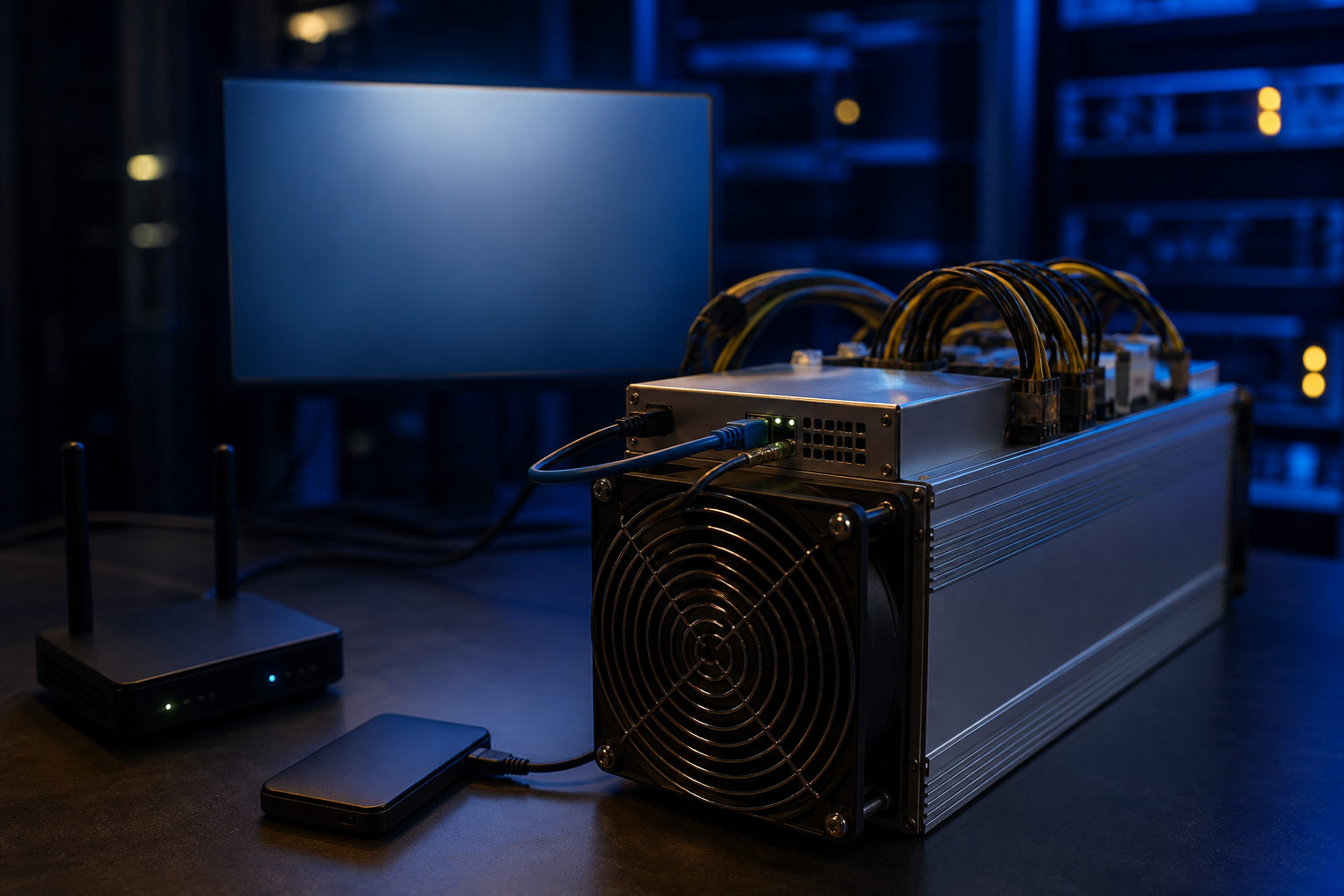
To join a Bitcoin mining pool, you connect your mining hardware to a shared pool so your hash power works with other miners, and the pool distributes results according to its payout rules.
What a Bitcoin mining pool actually does
A simple way to picture Bitcoin mining is to think of it as a nonstop bookkeeping race. Miners across the network compete to produce the next block. The Bitcoin network creates a new block about every 10 minutes, and miners are trying to find a valid result before others do.
For one miner running alone, the main issue is variance. A machine can stay online for a long time and still fail to find a block on its own. A mining pool groups hash power from many participants, assigns work, tracks each miner’s contribution, and then shares payouts under a stated method. That is why pools became the standard route for smaller operators.
This point matters because beginners often confuse a pool with a wallet or with a place that holds their coins. A pool is mainly a coordination layer for mining work and payout accounting. Your job is to provide hash power; the pool handles task distribution and records what your machines submit.
What you need before you join
You cannot join a Bitcoin mining pool with a regular computer and expect it to function as a real Bitcoin mining setup. In practice, you need dedicated mining hardware that can run the required algorithm, a stable internet connection, reliable power, and a Bitcoin wallet address for payouts.
| Requirement | Why it matters | If it is missing |
|---|---|---|
| Mining hardware | Provides the hash power that does the work | You cannot mine Bitcoin in a practical way |
| Power setup | Keeps machines running consistently | Frequent outages reduce uptime |
| Internet connection | Lets the miner communicate with the pool | High latency or drops can lead to more rejected work |
| Bitcoin wallet | Receives pool payouts | Wrong address settings can disrupt payment |
| Pool account | Lets you manage miners and review stats | It becomes hard to monitor or troubleshoot |
The wallet choice deserves attention. You need to know who controls the receiving address and how the backup works. If you use a custodial service, check whether it accepts mining payouts and whether there are restrictions. If you use a self-custodied wallet, protect the recovery phrase or keys offline. The pool can send funds to your address, but it cannot restore your wallet if you lose control of it.
There is also a practical reality that many new users miss. Joining a pool does not remove the cost side of mining. Electricity, hardware wear, cooling, fan noise, maintenance, and downtime still shape the outcome. A pool helps smooth the randomness of solo mining; it does not make the business side disappear.
How to choose a mining pool
Many pools can accept your miner, but they are not all the same. When comparing them, start with payout structure, stability, and account management tools. Those points affect daily operation far more than a polished homepage.
| Factor | What to check | Why it affects you |
|---|---|---|
| Payout method | How the pool measures and distributes your contribution | Changes payout timing and variance |
| Fee policy | Whether the pool charges service fees or extra conditions | Affects what reaches your wallet |
| Server stability | Whether the pool has suitable endpoints for your connection | Shapes latency, rejection rate, and uptime |
| Dashboard tools | Alerts, worker grouping, account controls | Makes troubleshooting easier |
| Payout threshold | Whether there is a minimum before payment is sent | Affects how often you receive funds |
| Transparency | How clear the records and accounting pages are | Helps you verify pool activity against your miner data |
The payout method is the first thing to read carefully. Different pools use different accounting models for miner contributions. You do not need to memorize every variation, but you should know whether you are choosing a method that feels steadier day to day or one that depends more on the pool’s short-term block performance.
Stability is next. A miner can appear to be running fine on its own screen while still sending work poorly because of latency, a bad server choice, or a configuration error. A pool with a clear dashboard and useful alerts saves time because it shows problems before they turn into long periods of bad performance.
Step-by-step: how to join a Bitcoin mining pool
The exact labels vary by pool, but the flow is usually the same: open an account, set a payout address, create worker names, copy the pool connection settings, enter them into the miner, then verify that shares are being accepted.
- Create your pool account
Register the account and finish the security basics first. Set up login protection, notification options, and any payout controls the pool offers. You will rely on this dashboard often, so this step is not something to skip.
- Add your Bitcoin payout address
Enter the wallet address that should receive payouts and check it carefully. A surprising number of problems come from address mistakes rather than mining issues.
- Create worker names or subaccounts
Pools usually ask you to name each miner. If you run more than one machine, use a naming pattern that reflects location or device grouping so you can identify an offline unit quickly.
- Copy the pool connection details
The pool will provide a server address, a port, and worker credentials. In many cases, the worker password field is just a connection parameter, not your account login password. Mixing those up is a common beginner error.
- Open the miner control panel and enter the settings
Log in to the miner’s management page, add the primary pool details, and set a backup pool if the machine supports it. That backup matters because it keeps the machine from sitting idle if the main endpoint fails.
- Save, start, and watch the first results
After applying the configuration, let the miner connect and then review the pool dashboard. Look at online status, reported hash rate, rejected shares, and alerts before you focus on payout history.
| Step | Main action | Common mistake |
|---|---|---|
| Account setup | Create account and secure it | Leaving protection settings incomplete |
| Payout setup | Add a Bitcoin address | Entering the wrong address |
| Worker setup | Name each machine | Using vague names that make tracking hard |
| Pool config | Enter server, port, and worker data | Using the account password in the worker field |
| Startup | Run the miner and confirm connection | No backup pool configured |
| Verification | Check shares, uptime, and dashboard data | Watching payouts only and missing setup errors |
The cost reality behind pool mining
Many people searching for how to join a Bitcoin mining pool are really asking whether connecting to a pool will make mining worth it. There is no clean answer without looking at costs. A pool reduces variance for miners who would otherwise mine alone, but it does not pay your electricity bill, replace worn hardware, manage airflow, or fix downtime.
If you run machines where you live, heat and fan noise can become a daily issue. If you use a hosted setup, then the questions shift toward maintenance quality, power handling, and how quickly problems are addressed. Those operating conditions matter as much as the pool you choose.
| Real-world factor | What it affects | What to ask yourself |
|---|---|---|
| Electricity cost | Ongoing operating expense | Can you support it over time |
| Cooling and noise | Machine stability and living conditions | Is home operation realistic |
| Downtime and repair | Effective uptime | Do you have a maintenance plan |
| Connection quality | Share acceptance quality | Is your network steady enough |
| Pool rule changes | Payout experience and account workflow | Can you keep up with operational updates |
If your goal is to understand how Bitcoin mining works, joining a pool can be a useful hands-on way to learn. If your goal is profit, you need to evaluate the operating side with the same care as the technical side.
FAQ
Can an individual still join a Bitcoin mining pool?
Yes. Mining pools exist so individual miners and smaller operators can combine hash power instead of mining alone. The real barrier is usually hardware, power, networking, and maintenance, not account eligibility.
Can I join a Bitcoin mining pool without a miner?
In standard pool mining, no. A pool expects actual hash power from your device. If a service says you can join without hardware by sending money and letting them “mine for you,” that is a different model from direct pool participation.
Is a mining pool account the same as a Bitcoin wallet?
No. A pool account is for managing machines, checking worker status, and setting payout preferences. A wallet is where your Bitcoin is received and controlled.
Why is my miner online but the pool is not showing steady hash rate?
Common causes include the wrong server address, a bad port, unstable internet, incorrect worker credentials, or a hardware problem. Check the miner logs first, then compare them with the pool dashboard to narrow the issue down.
Should I connect to several pools at once?
Most miners are better served by using one main pool and one backup pool. That setup protects against endpoint failures without adding unnecessary complexity at the start.
How do I know whether the pool is paying according to its rules?
Read the pool’s records pages, payout history, and accounting explanations, then compare them with your machine uptime and worker data. A clear dashboard is far more useful than marketing claims.
Before you connect anything, verify four items: your miner model, your Bitcoin payout address, the pool’s payout rules, and the quality of your power and internet setup. That short checklist prevents many of the mistakes that trip up first-time miners.
Disclaimer: This article is for informational and educational purposes only and is not investment, financial, or legal advice. Crypto assets are highly volatile and you could lose your entire investment. Do your own research and decide carefully.