
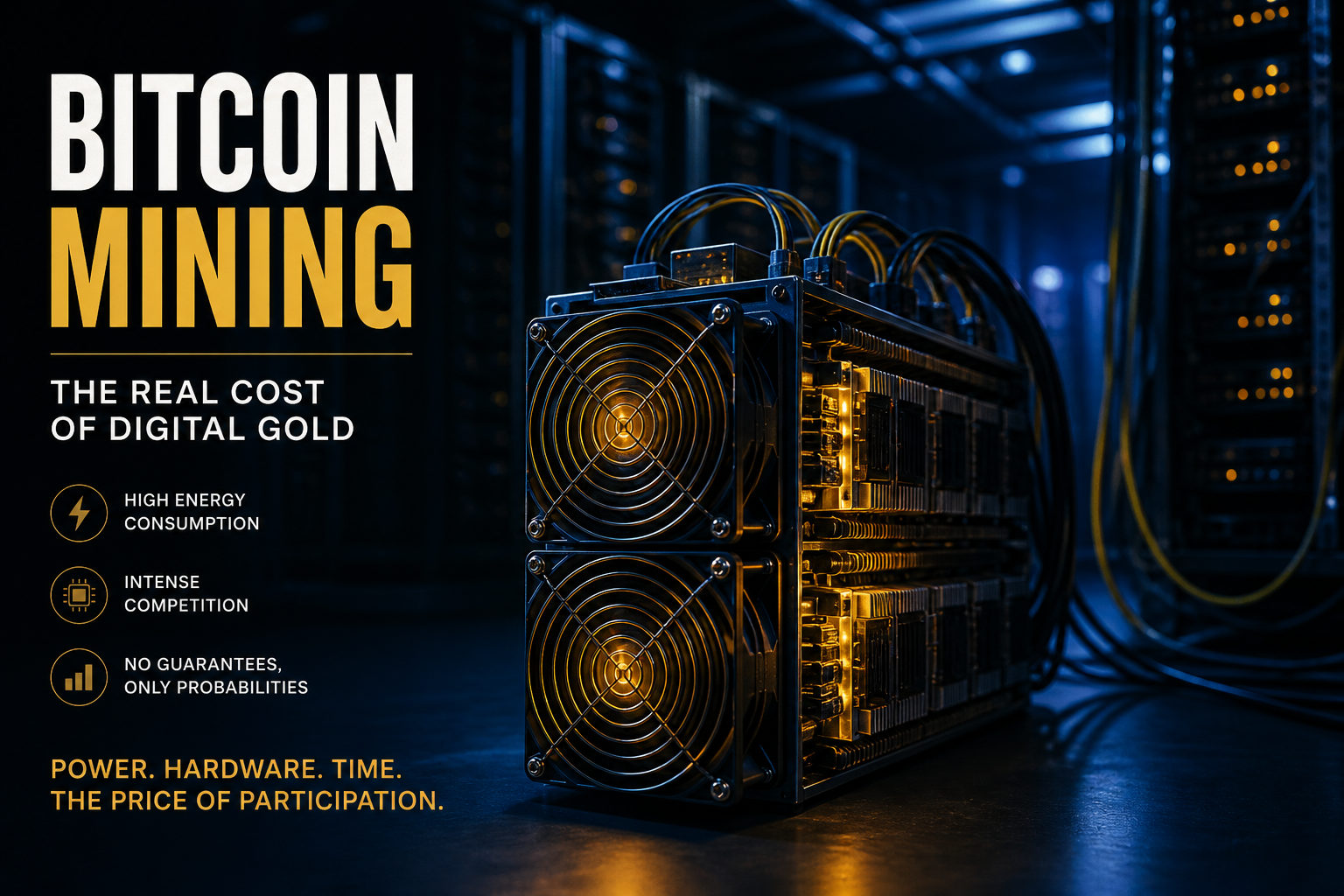
Bitcoin mining does not create coins out of thin air. It is a competition to add new blocks to the blockchain, and profit depends on equipment, electricity, and operating discipline.
What bitcoin mining actually does
A simple way to picture the system is to think of a shared public ledger. New transactions wait to be confirmed, and miners group them into a block, then compete to make that block accepted by the network.
People call this process mining because participants spend real resources in exchange for a chance at a block reward and transaction fees. It is not a button inside an app that prints bitcoin on demand, and it is not a shortcut to automatic income.
Bitcoin started with the genesis block in 2009 January, has a maximum supply of 21 million coins, and produces a block about every 10 minutes. The block subsidy is cut in half about every 4 years, or every 210,000 blocks, which is why new supply slows over time.
Why it is a bookkeeping race, not free coin creation
If you want a practical analogy, miners are entering a nonstop contest to solve a network-approved puzzle first. The winner gets to broadcast a valid block, and the rest of the network checks whether it follows the rules.
The point is not that the answer has some direct business value. The point is that the miner proves it committed computing power. That cost is what helps protect the chain, because anyone trying to rewrite records would need to commit enormous resources as well.
This is where many beginners get the wrong idea. When people search for “how to make bitcoins mining,” they often imagine a simple setup that steadily generates coins. In reality, mining is a probability game shaped by hardware efficiency, uptime, heat control, and the rules of the pool you join.
What you need before trying bitcoin mining
Specialized hardware
For most people, mining bitcoin with a normal home computer is not competitive. The network uses proof of work, and dedicated mining machines usually have a major advantage over general-purpose hardware.
Buying a machine is only the first step. Noise, cooling, dust, maintenance, and failures all matter once a device runs for long periods. A spec sheet may look attractive, but stable operation is what determines whether the setup works in practice.
Electricity and a workable location
Electricity is one of the first things serious miners examine. A setup can look fine on paper and still fail as a business decision if power costs are high or the location cannot handle heat and ventilation.
Stable power matters too. If equipment keeps going offline, restarting, or throttling under heat, the gap between expected output and real output can become painful. That is one reason mining is much more than owning hardware.
Mining pools
Solo mining is possible, but many participants choose a mining pool because it smooths out the reward pattern. A pool combines the work of many miners and distributes proceeds according to its own payout method.
Before joining one, it helps to review fees, payout rules, transparency, uptime, dashboards, and withdrawal conditions. Marketing language is not enough. If the rules are hard to understand, that is already useful information.
Wallets and security
Any bitcoin you receive from mining needs a wallet address under your control or one managed by a service you trust. Either way, backups, strong passwords, and two-factor authentication should be treated as basic practice.
New miners sometimes focus only on receiving coins and ignore storage risk. That split matters. Earning bitcoin and keeping bitcoin safe are two different jobs.
How people try to make money from bitcoin mining
Most searches around how to make money mining bitcoin come down to one question: can mining still be profitable. The honest answer is yes for some operators, but it is not simple, and it is not easy passive income.
Miner revenue usually comes from block rewards and transaction fees. Whether any profit remains after that depends on several moving parts working together:
- Power cost: one of the biggest ongoing expenses.
- Machine efficiency: more efficient hardware can stay competitive longer.
- Network difficulty: tougher competition can reduce your share of rewards.
- Bitcoin price moves: the market value of mined coins can change the result.
- Operations: downtime, overheating, and repair delays can eat into returns.
- Pool terms: payout models affect volatility and cash flow.
A common mistake is to assume that receiving bitcoin from mining means you are making money. That is not the right test. Mining acts more like a capital-heavy operating business where cost control can matter as much as the amount of bitcoin received.
What a realistic path looks like for beginners
If your goal is to understand the process, start small and learn the moving parts first. Set up a wallet, read how confirmations work, and study a mining pool dashboard so you know what hash rate, rejected shares, and offline status mean.
If your goal is to judge viability, break the decision into plain questions. Do you have access to manageable electricity costs. Can your location handle noise and heat. Do you know how you would deal with hardware issues. If those answers are weak, buying equipment first can be an expensive way to learn.
Another point often missed is that cloud mining or hosted plans are not the same as running your own machine. The contract terms, fees, and risks can be very different. If the structure is hard to follow, staying out may be the better move.
FAQ
Can I mine bitcoin with a regular PC
You can try, but that does not mean it is practical. In most cases, a normal PC is unlikely to compete well, and the power bill plus hardware wear may become obvious before any meaningful result appears.
Can bitcoin mining still make money
It can, but the answer depends on electricity, machine efficiency, pool terms, uptime, and market conditions. It is better viewed as an operating business than a hands-off side hustle.
Is solo mining a good idea for one person
It is possible, though the reward pattern can be highly uneven. Many smaller participants prefer pools because the payout flow is usually more predictable.
Do mined coins go straight to a bank account
No. Mining rewards are usually sent to a wallet address first. Converting bitcoin into fiat is a separate step and comes with its own platform, fee, and security choices.
Should a beginner buy a miner before learning the basics
Usually no. It makes more sense to learn how block rewards, halvings, pool payouts, wallets, and electricity costs fit together before spending money on equipment.
If you want to evaluate mining seriously, write out five checklists for hardware, electricity, location, pool terms, and wallet security. That step will save more bad decisions than rushing into a machine purchase.
Disclaimer: This article is for informational and educational purposes only and is not investment, financial, or legal advice. Crypto assets are highly volatile and you could lose your entire investment. Do your own research and decide carefully.