
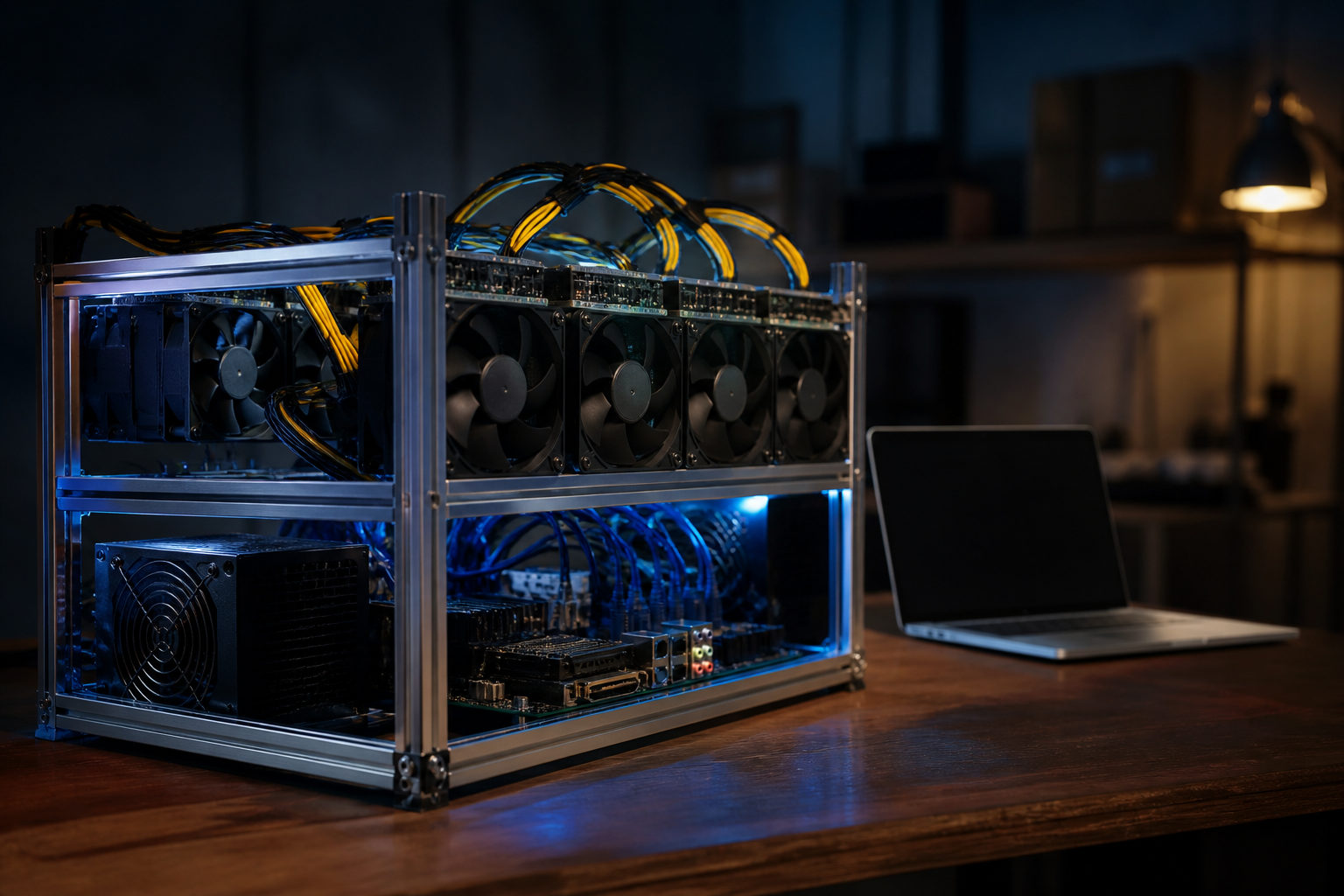
How to manually mine bitcoin? You can set up your own hardware and join the block-finding race, but most people will not mine a block alone with a normal home computer. The practical path is to understand the process, choose the right setup, and judge costs before buying anything.
Think of mining as an open bookkeeping race
Bitcoin needs participants to collect pending transactions and package them into new blocks. Mining is the competitive process used to decide who gets to add the next block to the chain. The winner is the miner whose machine finds a valid result under Bitcoin's rules.
This system is called proof of work. In simple terms, mining hardware keeps changing part of the block data and hashing it again and again until the output matches the network target. Because many miners are doing the same thing at once, the contest is about sustained computing power, not about clicking a start button.
Bitcoin produces a block about every 10 minutes, and the network adjusts mining difficulty as total hash power changes. That is why learning how to manually mine bitcoin is less about a secret trick and more about understanding a specialized, nonstop competition.
What “manual” bitcoin mining usually means
When people ask about manual mining, they usually mean building and managing the setup themselves instead of handing everything to a hosted service. That includes choosing a wallet, selecting hardware, configuring connections, deciding whether to mine solo or through a pool, and checking the machine after it goes live.
It also helps to separate four related activities that often get mixed together. Solo mining means you run hardware and wait for your own setup to find a block. Pool mining means your machine contributes hash power to a group and receives payouts based on contribution. Hosted mining means someone else runs the equipment for you. Running a node means validating blocks and transactions without directly mining them.
| Method | What you handle | Best for | Main limit |
|---|---|---|---|
| Solo mining | Hardware, power, cooling, maintenance, and block variance | People who want maximum control | You may wait a very long time to find a block |
| Pool mining | Your own machine plus pool connection and account settings | People who want steadier participation | You must trust and understand pool rules |
| Hosted mining | Choosing a provider and monitoring service terms | People without a suitable location | Less direct control over daily operation |
| Running a node | Verifying the chain and storing a local copy | People focused on validation and privacy | No direct mining payout |
The parts you need to set up yourself
If you want to try the process hands-on, start with a wallet. Mining rewards or pool payouts need somewhere to go, and that means you need a bitcoin address you control. If you do not understand where the coins will be received and who holds the private keys, you are not ready for the hardware step.
Next comes the hardware reality. Bitcoin mining today is built around specialized machines made for this task. A normal desktop or laptop can run software, but that is very different from having a setup that can compete in the network. For most learners, this is the point where theory and practice split apart.
Then there is the environment around the machine. Mining hardware runs continuously, so stable power matters. Cooling matters just as much, since heat affects performance and reliability. Network quality matters too, because a machine that drops offline cannot contribute useful work.
| Setup part | What to do | Common mistake |
|---|---|---|
| Wallet | Create a receiving address and protect your private keys | Buying equipment before planning custody |
| Hardware | Choose equipment designed for Bitcoin mining | Assuming a regular PC is enough |
| Mining software or device panel | Enter pool details or solo settings correctly | Confusing node software with mining software |
| Network | Keep a stable connection for submitted work | Ignoring disconnects and latency |
| Maintenance | Watch temperature, fan status, restarts, and uptime | Turning it on and never checking again |
Software roles should be kept clear. A full node helps you validate the blockchain independently. Mining configuration tells your machine where to send its work. You can use both, but they solve different problems.
A realistic path for beginners
For most people, the sensible route is gradual. Learn how wallets work. Understand what a node does. Read how pool accounts, worker settings, and payout rules are structured. Only after that should you decide whether owning and operating hardware fits your budget, living space, and tolerance for noise and heat.
If you join a mining pool, read the pool terms closely before connecting a machine. Focus on how shares are counted, how payouts are handled, what security options exist for the account, and what data you can verify from the dashboard. A setup is easier to manage when you understand the rules before the machine starts sending work.
Your physical location can be the deciding factor. Mining machines generate steady noise and heat, which can be hard to manage in an apartment or shared home. Even a technically correct setup can become impractical if the room, ventilation, or power arrangement is poor.
| Path | Difficulty | Control | Expected stability | Good goal |
|---|---|---|---|---|
| Learn nodes first, mining later | Medium | High | Fairly steady | Understanding how Bitcoin works |
| Start with a pool | Medium | Medium | More consistent participation | Learning real mining workflow |
| Go straight to solo mining | High | Very high | Highly uneven | Maximum independence |
| Use hosted mining | Low to medium | Lower | Depends on provider | Reducing onsite maintenance |
Why cost reality matters more than the tutorial
Knowing how to manually mine bitcoin does not mean it makes sense for you to do it. The decision is shaped by equipment cost, electricity, cooling, space, noise, internet reliability, downtime risk, and the time needed for upkeep. Missing even one of those factors can lead to a bad decision.
Bitcoin mining is now a specialized field with strong advantages for larger operators. They can manage machines, power, airflow, and maintenance at a scale that home users usually cannot match. A beginner can still learn a lot by participating, but learning the workflow is not the same as having a favorable operating position.
Security should be built in from the start. Keep wallet recovery information offline. Protect your pool account with stronger sign-in settings. Do not expose the mining device control panel to an unsafe network. The key points to defend are your payout address, account access, and machine control.
FAQ
Can I mine bitcoin at home by myself?
You can participate from home, but that does not mean you will find a block on your own. For most people, home mining is more realistic through a pool than through solo mining.
Can a regular computer mine bitcoin?
A regular computer can run software related to Bitcoin, but that is different from mining competitively. In practice, Bitcoin mining relies on specialized hardware rather than standard consumer machines.
Is running a node the same as mining?
No. A node verifies and stores blockchain data, while mining competes for the right to add a new block. Both support the network, but they play different roles.
If I join a pool, am I still mining myself?
Yes. Your machine still provides the work. The difference is that block-finding variance is shared across a group, and payouts are tied to your contribution instead of waiting for your own setup to find a block.
What should I learn before buying mining hardware?
Start with wallet control, private key handling, the purpose of a node, and pool payout rules. Once those pieces make sense together, it becomes much easier to judge whether owning hardware is practical in your situation.
If you want to test this hands-on, begin with a wallet you control, learn how a node and a mining pool differ, and inspect your space for power, heat, noise, and maintenance demands before committing to equipment.
Disclaimer: This article is for informational and educational purposes only and is not investment, financial, or legal advice. Crypto assets are highly volatile and you could lose your entire investment. Do your own research and decide carefully.