
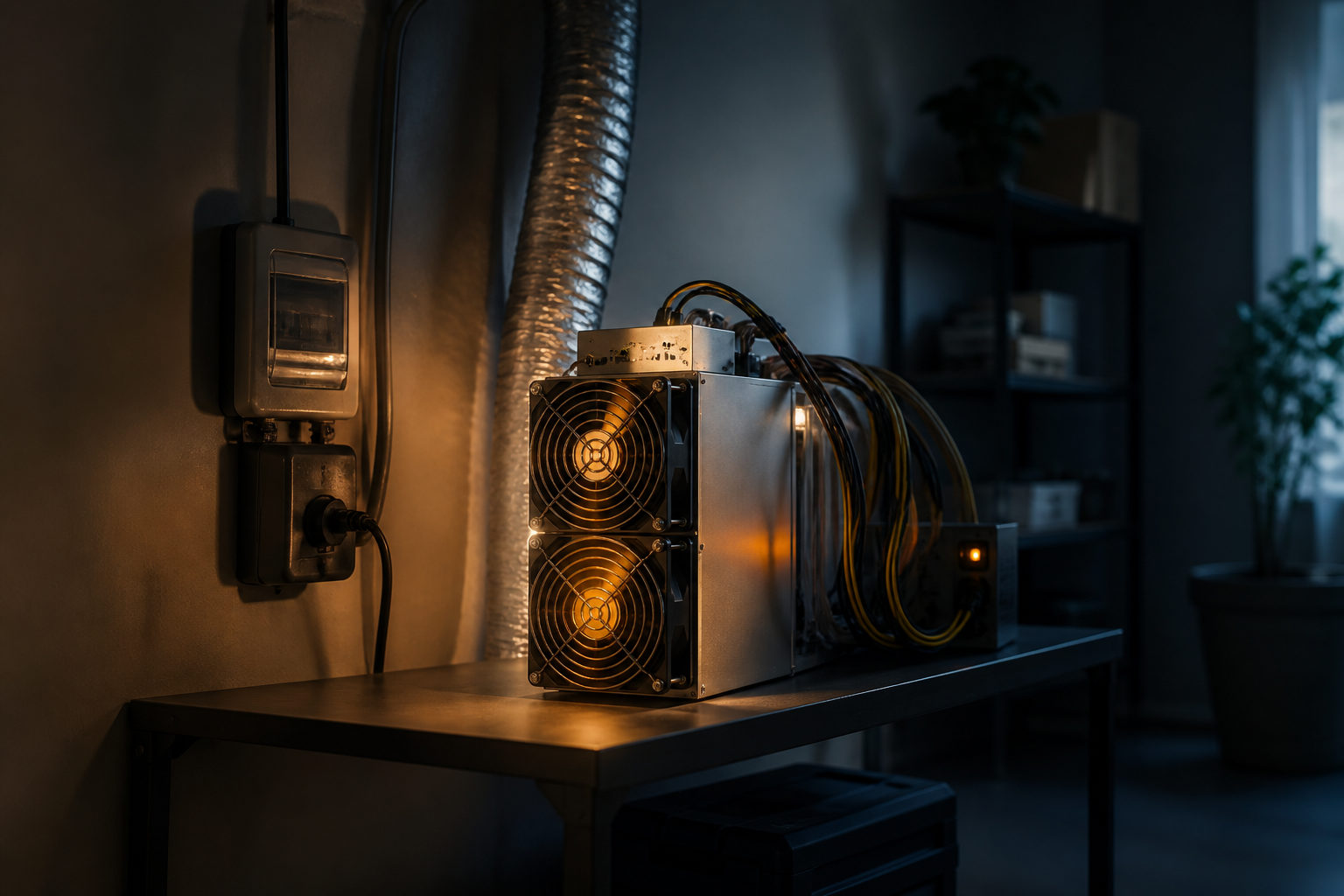
How to mine bitcoin at home comes down to one thing: running specialized hardware in Bitcoin’s block race. At home, the real question is not just how to start, but whether your power setup, cooling, noise tolerance, and maintenance habits can support it.
What home bitcoin mining actually means
A simple way to picture Bitcoin mining is to think of it as a nonstop bookkeeping contest. Miners compete to package transactions into a valid block, and the one that meets the network rules first gets the right to add that block to the blockchain and receive the block reward plus transaction fees.
Bitcoin began with its genesis block in January 2009 and uses proof of work. The network produces a block about every 10 minutes, and mining difficulty shifts with overall competition, so home miners are not competing with a few hobbyists. They are up against large fleets of purpose-built machines.
What you need before mining bitcoin at home
When people search for how to mine bitcoin at home, they often focus on apps and setup screens first. In practice, the hard part starts earlier with physical constraints inside the house or apartment.
Dedicated hardware
For Bitcoin, home mining usually means an ASIC miner rather than a desktop PC. General-purpose hardware can still help you learn the basics, but it is not the standard route for serious participation because efficiency gaps are too wide.
Stable electricity
Mining hardware runs for long stretches and needs dependable power. If the same circuit already handles air conditioning, kitchen appliances, or other heavy loads, adding a miner can create safety issues, unstable operation, or shutdowns.
Cooling and airflow
Heat is one of the first realities new miners meet. A miner placed in a closed room can raise temperatures fast, and weak airflow can lead to throttling, error messages, or downtime.
Noise tolerance
Home mining is rarely quiet. Fan noise can be disruptive in bedrooms, offices, or shared living spaces, which is why many people rethink the plan after they understand what daily operation feels like.
Reliable internet and monitoring
Bitcoin mining does not need huge bandwidth, but it does need a stable connection. You also need a way to check machine status, pool connection, temperatures, and error logs so you notice problems before they drag on.
Common ways to participate from home
There are two main ways to approach home Bitcoin mining: solo mining or joining a mining pool. Both involve real mining, but they handle variance very differently.
Solo mining
Solo mining means your machine competes on its own. If you find a block, the reward is yours, but for a home miner the wait can be very long and the outcome can feel highly uneven.
Pool mining
A mining pool combines the work of many miners and distributes payouts according to its rules. For most home users, this is the more practical path because it smooths out the randomness that comes with mining alone.
Why cloud mining is a separate category
Some people treat cloud mining as the same thing as mining bitcoin at home, but it is not. Buying a contract from a provider is different from owning, running, and controlling your own hardware, so contract terms, fee structures, and counterparty risk matter a lot.
How to get started step by step
If you still want to learn how to mine bitcoin at home, it helps to move in order rather than buying equipment first. A careful setup reduces mistakes that are expensive and annoying later.
- Set your goal: Decide whether you want to learn how mining works, experiment with hardware management, or try to participate over a longer period. Your goal shapes what trade-offs you can live with.
- Check your home setup: Review your electricity costs, circuit capacity, ventilation, available space, and whether the people around you can tolerate the sound and heat.
- Choose hardware carefully: Do not look only at advertised hash rate. Efficiency, stability, service options, and replacement parts all matter.
- Prepare a wallet: Set up a Bitcoin wallet where you control the keys so mined bitcoin can be received under your own control.
- Select a mining pool: Compare payout methods, withdrawal rules, interface quality, and operational transparency before connecting your machine.
- Test before full runtime: Start with observation. Watch temperatures, fan behavior, pool connection, and error rates before leaving the machine running for long periods.
- Maintain the setup: Dust buildup, loose cables, power issues, and firmware updates all affect uptime, so regular checks are part of the job.
The costs people tend to underestimate
Many guides explain how to mine bitcoin at home as if setup were the main hurdle. For most households, the harder part is running the operation day after day without turning the home into an uncomfortable machine room.
- Electricity cost: This is the first filter for whether a machine makes sense to keep on.
- Living-space impact: Heat, dust, and constant fan noise change the feel of a room quickly.
- Time cost: Machines need attention. Connections fail, temperatures rise, and hardware can stop without warning.
- Hardware aging: Mining gear does not stay attractive forever. Competition changes, and old machines lose appeal.
- Legal and compliance issues: Rules around electricity usage, equipment operation, and crypto activity differ by location, so it is smart to check local requirements first.
FAQ
Can I mine Bitcoin at home with a regular PC?
You can use a regular computer to understand the process, but it is not the usual choice for actual Bitcoin mining. Dedicated miners are built for this job, and the gap is large.
Do I have to join a mining pool?
No, but many home miners do. Pool mining usually makes the experience easier to manage because the results are less erratic than solo mining.
How often does Bitcoin mining go through a halving?
Bitcoin goes through a halving about every 4 years, or every 210,000 blocks. The halving years so far are 2012, 2016, 2020, and 2024.
Do I need to buy bitcoin before I start mining?
No. You do not need to own bitcoin first, though you do need a wallet, a workable home setup, and a clear understanding of the costs and risks.
Where can I check the live bitcoin price before deciding to run a miner?
You can check major market data sites or exchanges for the live price. That said, the decision to run hardware should also account for electricity cost, machine condition, and pool terms rather than price alone.
If you plan to try this, start with your circuits, airflow, wallet security, and monitoring routine before you think about nonstop operation. That order saves trouble.
Disclaimer: This article is for informational and educational purposes only and is not investment, financial, or legal advice. Crypto assets are highly volatile and you could lose your entire investment. Do your own research and decide carefully.