
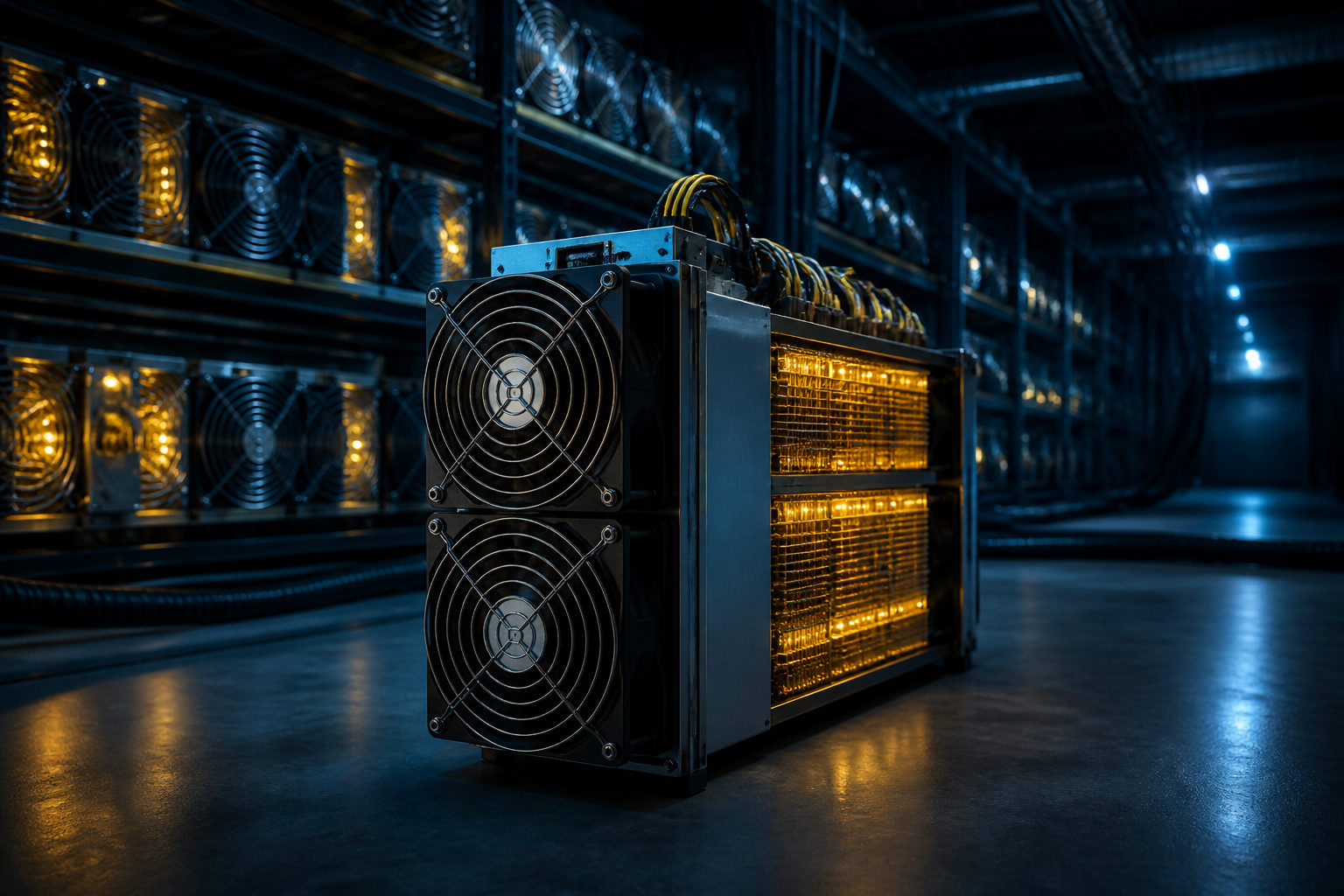
How to mine Bitcoin comes down to one idea: you use computing hardware to join a race for block production, and the winner of that round gets the block accepted by the network and may receive rewards plus transaction fees.
What Bitcoin mining actually means
Bitcoin mining does not mean digging coins out of the ground. It means competing to add the next block of transactions to a public ledger that anyone in the network can verify.
A simple way to picture it is a bookkeeping contest. Many participants try to package pending transactions into a valid block, and they keep changing part of the block data while running repeated hash calculations until one result fits the network target.
That system is called proof of work. Checking a valid result is easy for the network, but finding one first takes sustained computing effort, which is why the ledger can stay open without relying on a single operator.
How the process works: hash power, difficulty, and block timing
Bitcoin began with the genesis block in January 2009. Since then, new blocks have been added at roughly 10-minute intervals, forming the chain of blocks that gives the system its name.
The network adjusts mining difficulty so block production stays relatively steady even as more or fewer machines join. If total hash power rises, it becomes harder for any single machine to find a valid block.
There is also a fixed issuance design. Bitcoin has a maximum supply of 21 million coins, and the block subsidy halves about every 4 years, or every 210,000 blocks. Halving years so far include 2012, 2016, 2020, and 2024.
That matters because mining is not only about knowing what to do. It is also about whether your setup can compete under current difficulty and reward conditions.
Main ways people mine Bitcoin today
If you are asking how to mine Bitcoin, the first practical answer is that a normal home computer is usually not enough for serious participation. Modern Bitcoin mining is generally done with specialized hardware built for this one task.
Solo mining
Solo mining means you run your own hardware and point it directly at the network. If your setup finds a valid block, the reward is tied to your operation rather than shared across a group.
The trade-off is variance. Without major hash power, a solo miner may wait a long time before seeing any real result.
Mining through a pool
A mining pool combines the hash power of many participants. When the pool finds blocks, rewards are distributed according to each miner's contribution under the pool's rules.
For most individuals, this is the more common route because it smooths out the waiting time. It does not make your machine stronger, but it does reduce the all-or-nothing effect of mining alone.
Cloud mining and why caution matters
Some services offer cloud mining, where users pay for a contract instead of buying hardware. The pitch sounds simple, but the risks can be hard to judge from the outside.
Contract terms may be opaque, operating details may be limited, and counterparty risk is real. If you cannot clearly explain how the service works, what fees apply, and who controls the equipment, stepping back is the safer move.
What you need before you start
Anyone searching for how to mine Bitcoin should think beyond the miner itself. Mining is a full setup, not a single download.
- ASIC hardware: Specialized Bitcoin mining machines are the standard choice today.
- Electricity: Power cost and supply stability are central to whether a setup can keep running.
- Internet access: A stable connection helps avoid downtime and missed work.
- Cooling and noise planning: Mining hardware runs hot and can be loud, which makes home use difficult for many people.
- A Bitcoin wallet: You need a wallet to receive payouts, whether you mine solo or through a pool.
- Basic operational skill: That includes monitoring the machine, reading status panels, updating firmware, and spotting fake tools or phishing attempts.
The cost reality many beginners miss
People often ask how to mine Bitcoin when the deeper question is whether mining makes sense for them. The answer depends less on the basic process and more on the cost structure around it.
Hardware purchase cost is only one part of the picture. Electricity, cooling, maintenance, pool fees, uptime, physical space, and equipment aging all shape the outcome.
Another common mistake is treating mined Bitcoin as automatic profit. Mining gives you Bitcoin, but your overall result still depends on operating costs, market conditions, and how you manage the asset after you receive it.
That is why mining should be viewed as an operating business decision, not just a button you press in software.
You do not need to mine to get Bitcoin
If your real goal is simply to own Bitcoin, mining is only one path. Some people choose direct purchase, some prefer gradual accumulation, and others receive Bitcoin through business activity that supports it.
This distinction matters. Running miners is closer to managing hardware, energy, and uptime. Holding Bitcoin as an asset is a different decision entirely.
FAQ
Can I mine Bitcoin at home as a beginner?
You can try, but home mining often runs into issues with electricity cost, noise, heat, and space. For many beginners, the setup burden is larger than expected.
Can I mine Bitcoin with a regular PC?
A regular computer can take part in calculations, but it is usually not competitive against ASIC miners. It is better for learning the concept than for running a serious mining plan.
Is joining a pool better than mining alone?
For many individuals, yes, because a pool makes results more consistent over time. You give up the solo all-or-nothing model in exchange for shared distribution.
What does it mean to mine one Bitcoin?
For most individuals, it does not mean a machine suddenly produces a full coin in one event. More often, it means payouts accumulate over time until they add up to that amount.
Do I need a wallet before I start mining?
Yes. You need a wallet that can receive Bitcoin, and you need to secure the recovery details or private keys properly.
Check this before spending money
Decide first whether you want to learn how mining works or run equipment for the long term. Then review electricity, cooling, noise, internet reliability, and wallet security before you buy hardware or join any pool.
Disclaimer: This article is for informational and educational purposes only and is not investment, financial, or legal advice. Crypto assets are highly volatile and you could lose your entire investment. Do your own research and decide carefully.