
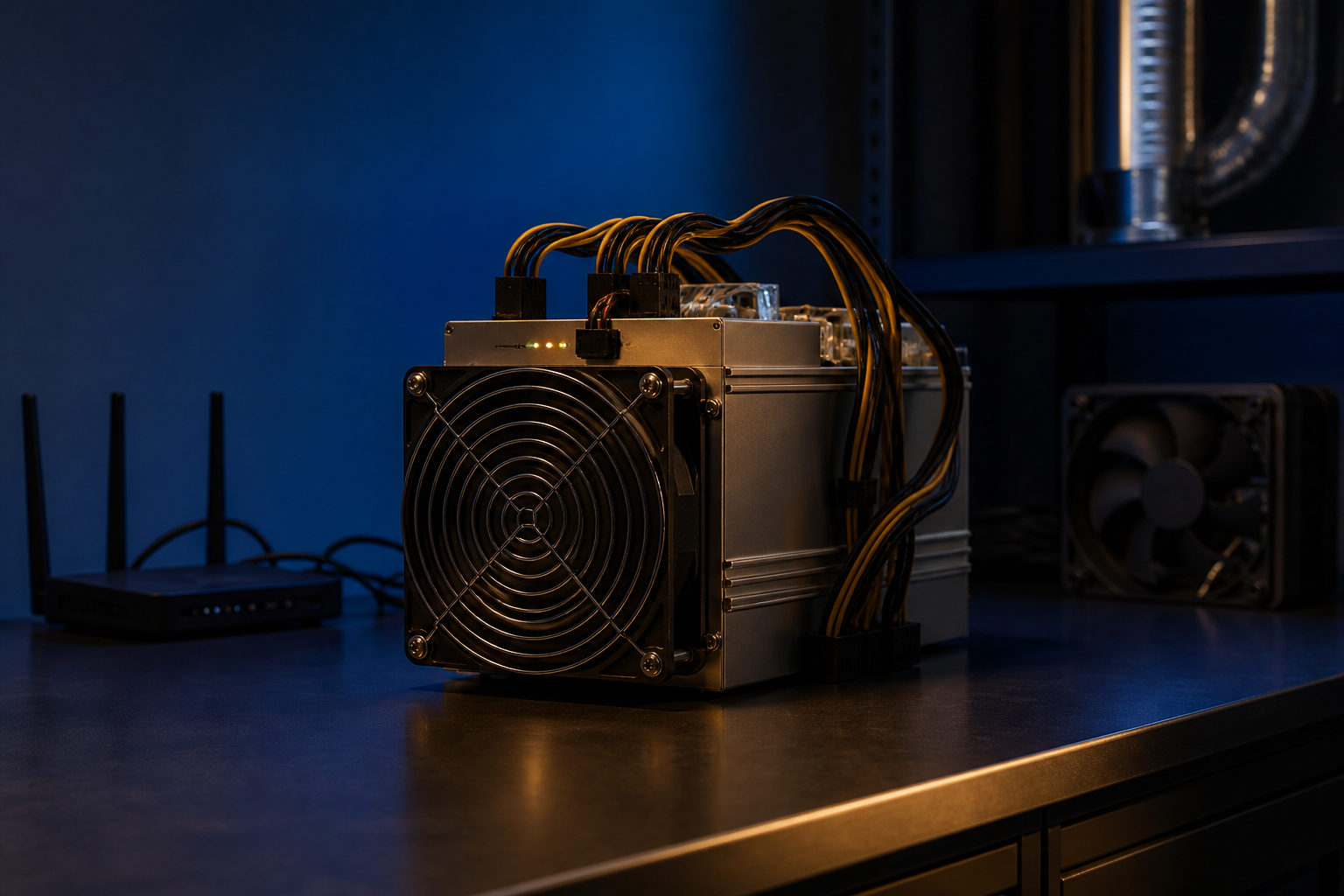
Solo mining Bitcoin means running your own node and mining hardware so you compete for blocks directly instead of joining a pool. You can set it up, but the real challenge is not the wiring step; it is keeping hardware, networking, power, and monitoring stable over time.
What solo mining Bitcoin actually means
A simple way to picture Bitcoin mining is to treat it like a nonstop bookkeeping contest. The network needs new blocks to confirm transactions, and miners keep trying calculations until someone finds a valid result that lets a block be added to the chain.
In solo mining, you do not point your machine at a pool that combines many miners and splits rewards by its own rules. You run the process yourself. If you find a block, the block reward goes to an address you control. If you do not, there is no pool payout smoothing the wait.
That setup has two separate parts. The mining machine does the hash work, while your Bitcoin node validates network data, stays in sync, and serves the block templates your miner works on. Without your own node, most people are not really talking about full solo mining.
What you need before you start
Many beginners start by shopping for a machine first. In practice, it makes more sense to check whether you can support a long-running mining environment before you buy anything. Solo mining is limited by far more than the device itself.
| Requirement | Purpose | What to verify |
|---|---|---|
| ASIC miner | Performs Bitcoin mining calculations | Make sure it is built for Bitcoin mining, can run continuously, and has workable cooling and noise conditions |
| Bitcoin full node | Validates blocks and transactions, stays synced with the network | Check that you can keep it online, maintain the system, and provide enough storage |
| Stable internet connection | Keeps the node synced and allows timely block communication | Watch for dropouts, router issues, and firewall rules that block required traffic |
| Reliable power | Supports sustained hardware operation | Confirm circuit safety, steady supply, and a location suitable for long high-load use |
| Cooling and noise management | Affects hardware life and day-to-day usability | Check airflow, heat removal, and whether the environment can tolerate the sound |
| Wallet address | Receives block rewards if a block is found | Use an address you control and back it up before running long term |
If your goal is to learn how Bitcoin mining works, focus first on how a node and miner interact. If your goal is long-term operation, you also need a realistic plan for power, heat, maintenance, and failure handling.
How to set up solo mining Bitcoin
Full solo mining usually means configuring the node side first, then the miner side, then testing that both can talk to each other correctly. Menu names vary by device and software version, but the logic is mostly the same.
| Step | What to do | Key point |
|---|---|---|
| Prepare a host for the node | Use a computer or server that can stay online for long periods | A node that sleeps, reboots often, or drops off the network creates confusion later |
| Install Bitcoin Core | Run a full node and let it sync the blockchain | Do not judge mining setup health before node sync is complete |
| Enable the required mining interface | Allow the miner to request work from your node | Set access controls carefully instead of exposing broad permissions |
| Set the payout address | Direct any block reward to a wallet you control | Verify the address and backup process before leaving the system unattended |
| Connect the ASIC miner | Enter your node or proxy details in the miner dashboard | Make sure you are not accidentally pointing to a mining pool |
| Test communication | Check whether the miner receives work and the node responds correctly | Rule out local network and authentication issues first |
| Monitor the system | Watch temperature, logs, disconnects, and abnormal behavior | The worst case is a machine that appears active but is doing ineffective work |
A common mistake is assuming that buying a miner and entering an address is enough. If the backend still comes from a pool server, you are still pool mining even if you changed a few settings on the machine.
Another frequent problem appears when people connect the miner before the node is fully ready. Then every issue looks the same from the outside. You may think the miner is faulty when the real cause is an unsynced node, blocked network traffic, or bad credentials.
What matters on the node side
Your node must stay synced with the Bitcoin network and deliver valid block templates on a steady basis. If the system sleeps, the storage becomes unstable, or network rules block needed communication, the miner may keep running while doing nothing useful.
Security matters here too. Solo mining involves local interfaces, authentication details, and network access between machines. If you open everything for convenience, you create avoidable risk.
What to check on the miner side
The miner dashboard usually shows work source details, status messages, and some form of submission record. Labels differ by brand, but the question is simple: is the machine actually getting work from your own setup, and is it submitting results without repeated failure?
Logs are often more useful than the main status screen. In mining, many failures are partial rather than total. A machine may look active while disconnecting often, overheating, or wasting time on bad configuration.
Solo mining vs pool mining
The main difference is not just who finds a block. It is how control, variance, and technical responsibility are handled. A pool combines many miners and distributes payouts by its own method, while solo mining leaves the entire outcome in your hands.
| Category | Solo mining | Pool mining |
|---|---|---|
| How you participate | You run your own node and compete directly for blocks | You contribute hash power to a pool that coordinates the work |
| Reward pattern | Highly uneven; long dry periods are possible, with full block reward only if you find a block | Usually smoother because payouts are shared by pool rules |
| Technical demand | Higher; you need to understand nodes, networking, permissions, and troubleshooting | Lower; setup is often limited to entering pool details |
| Control | Higher; you control the node and the workflow | Lower; you follow the pool's process |
| Operational burden | Higher; all faults and monitoring are your responsibility | Lower; much of the complexity sits with the pool |
If you want to study how Bitcoin block production works in practice, solo mining is useful. If you want a simpler path to connecting hardware, pools are easier for most users.
Cost reality and common bad assumptions
The biggest mistake is treating solo mining as a one-time setup project. Buying hardware is only the opening move. After that come power costs, cooling needs, noise handling, replacement parts, system upkeep, and your own time spent monitoring and fixing problems.
You also need a realistic view of competition. Bitcoin mining is a global contest. Running a solo setup at home does not remove that pressure, and it does not make outcomes easier just because the system is under your own control.
| Common assumption | Why it fails | Better way to think about it |
|---|---|---|
| An ASIC alone is enough for solo mining | It ignores the node and communication layer | The miner is only the compute side; full solo mining also needs a working node setup |
| Solo mining must be more profitable | It ignores long waiting periods and uneven outcomes | Solo mining gives autonomy, not guaranteed better results |
| Any home connection is fine | It ignores heat, noise, and circuit limits | The physical location strongly affects whether the setup can run safely and steadily |
| Once configured, it runs itself | It ignores disconnects, overheating, and bad submissions | Mining needs ongoing checks rather than one-time installation |
Before you commit, decide what you are actually trying to achieve. Learning the mechanics of Bitcoin mining is one goal. Building a serious long-running environment is another, and it demands much more planning.
FAQ
Can one person really mine Bitcoin solo?
Yes, one person can set up solo mining and compete for blocks directly. The hard part is that results depend on your share of total network competition, hardware stability, and how consistently the system stays online.
Do I need to run my own full node for solo mining?
If you want the setup to count as true solo mining, running your own node is the standard approach. It gives you control over validation, block templates, and the path your miner uses to submit work.
Can I use a regular computer to mine Bitcoin by myself?
A regular computer can be useful for running a node, learning the setup process, and understanding the network. It is not the normal choice for modern Bitcoin mining competition, which usually relies on dedicated ASIC hardware.
Why do many miners still choose pools?
Pools reduce technical friction and smooth out reward variance. For people who do not want to maintain a node, manage interfaces, and troubleshoot connectivity, that trade-off is easier to live with.
Should I buy a miner first if I only want to test the process?
Usually no. A better first step is setting up the node, learning sync behavior, understanding wallet configuration, and checking that your local network works the way you expect.
Before spending money, make a checklist for power, cooling, network stability, node maintenance, and wallet backup. If any of those items are still vague, keep planning before you buy hardware.
Disclaimer: This article is for informational and educational purposes only and is not investment, financial, or legal advice. Crypto assets are highly volatile and you could lose your entire investment. Do your own research and decide carefully.