
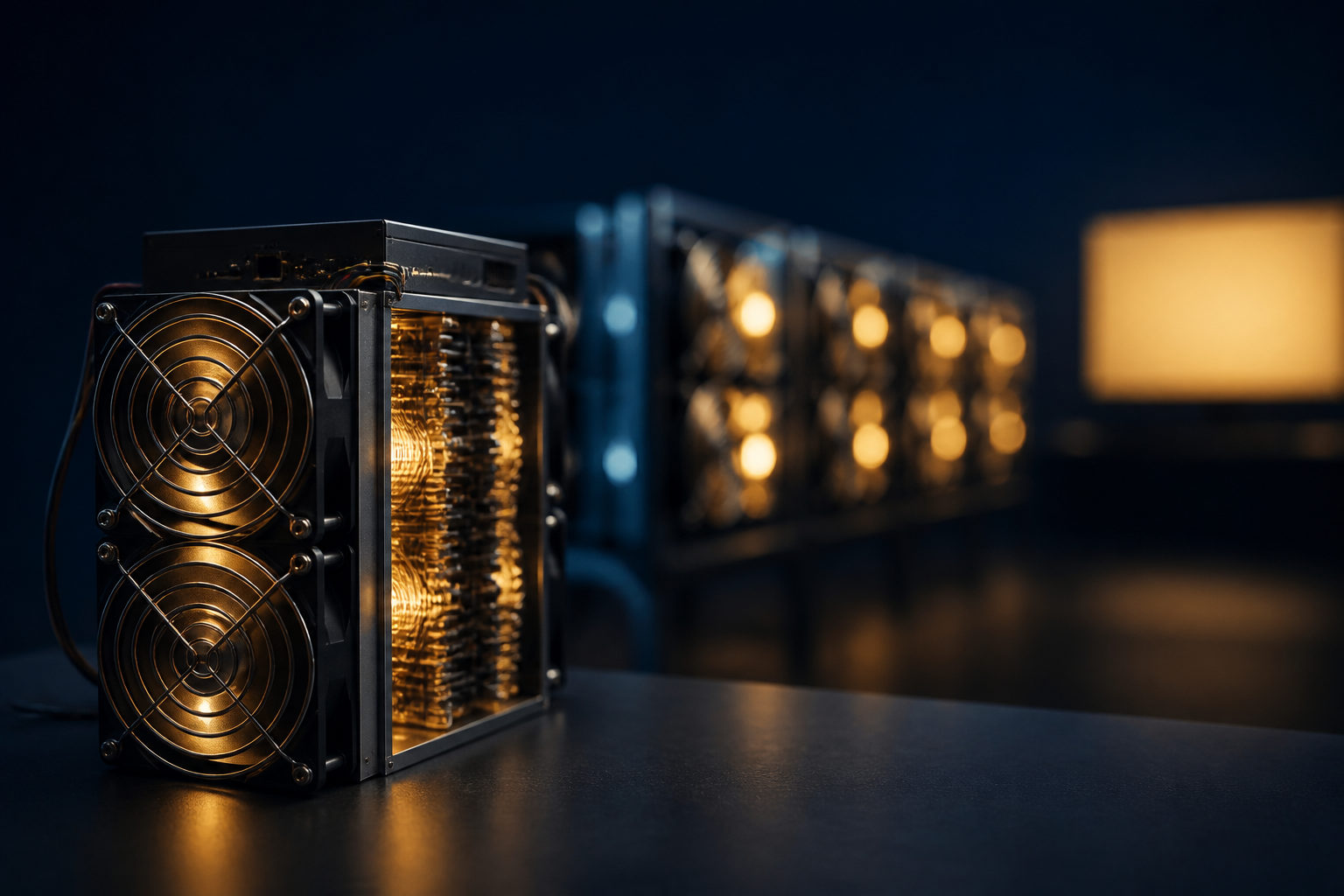
How to start farming bitcoins begins with one key idea: you are joining an open record-keeping race, not pressing a button that prints money. Miners compete to add valid blocks to the Bitcoin blockchain, and a beginner’s first job is to decide whether running hardware, joining a pool, or skipping mining entirely makes sense.
What “farming bitcoins” really means
People often say farming bitcoins, but for Bitcoin the more accurate term is mining. The network needs participants to verify transactions, package them into blocks, and secure the chain through computation. You can think of it as a nonstop contest where everyone is trying to solve the same puzzle under the same rules.
That contest serves a purpose. It lets Bitcoin operate without a central bookkeeper, and it makes rewriting the ledger expensive and difficult. Bitcoin produces a new block about every 10 minutes, and new coins enter circulation through the block reward. That reward is cut roughly every 4 years, or every 210,000 blocks, which is why mining becomes increasingly tied to hardware efficiency, electricity costs, and operational discipline.
Bitcoin also has a fixed maximum supply of 21 million coins. That cap is one reason mining is often misunderstood by newcomers: the process is not about creating unlimited new units, but about competing for a shrinking issuance schedule while helping the network stay synchronized.
Choose your path before you look at machines
Many beginners search how to start farming bitcoins and jump straight to hardware lists. That usually leads to the wrong decision, because the first question is not which miner to buy. The first question is what you actually want out of Bitcoin.
| Approach | Best for | What you handle yourself | Main trade-off |
|---|---|---|---|
| Run your own ASIC miner | People with suitable space, power, and time for maintenance | Hardware setup, electricity, cooling, networking, monitoring | High noise, heat, and ongoing operating demands |
| Join a mining pool | Individuals who want mining exposure with less payout variance | Hardware plus pool connection and account setup | You still carry equipment and power costs |
| Use hosted mining | People who cannot run equipment at home | Vendor selection, oversight, wallet setup | Counterparty and service risk |
| Buy BTC directly | People who want Bitcoin ownership, not mining operations | Purchase, storage, wallet security | No participation in block production |
If you live in a normal apartment or house, the first constraints are usually practical ones: noise, airflow, dust, and power delivery. Mining hardware runs continuously, generates substantial heat, and depends on a stable internet connection. A setup that looks simple on paper can fail fast if the room, wiring, or ventilation cannot support long operating hours.
For most individuals, pool mining is the more common route. A single machine working alone has very low odds of finding a block on its own, so pools combine many miners’ hashpower and distribute rewards according to pool rules. That can make results less erratic, but it does not remove your electricity bill, repair needs, or dependence on a third party.
The practical setup sequence for beginners
If you decide to move forward, the safest way to begin is to check conditions in order instead of learning by buying first. Bitcoin mining is a stack of dependencies. If one layer fails, the rest of the plan becomes expensive frustration.
| Step | What to verify | Why it matters |
|---|---|---|
| Define your goal | Learning the system, running a long-term setup, or simply getting BTC | Your goal determines whether mining is even the right route |
| Check power | Stable supply, circuit capacity, tolerance for continuous load | Without reliable power, uptime suffers immediately |
| Assess the environment | Heat exhaust, noise, airflow, dust, and room placement | Home settings often fail at this stage |
| Select hardware | Bitcoin-specific ASIC equipment and serviceability | General-purpose computers are usually not suitable |
| Pick solo or pool | Your tolerance for variance and your comfort with pool terms | This changes how rewards are received |
| Prepare a wallet | Receiving address, backups, seed phrase or private key storage | Mined BTC needs a secure destination |
| Run a test phase | Connection stability, temperatures, fan behavior, error handling | Early testing reveals weak points before full operation |
On the hardware side, Bitcoin mining today is built around ASICs, which are machines made for one purpose. A regular desktop or laptop may help you learn concepts, but it is generally not the tool for competing on the Bitcoin network. Newcomers also tend to underestimate the support pieces around the miner: power supply quality, cables, shelving, airflow direction, dust control, and what happens after a power outage or dropped connection.
Your wallet setup should happen early, not at the end. If you join a pool, you will usually need a receiving address for payouts. Make sure you understand the difference between a wallet and a mining device: the miner contributes hashpower, while the wallet stores the BTC you receive. Those are separate jobs, and mixing them up causes preventable mistakes.
Security matters here in a very plain way. Back up your seed phrase or private keys offline, verify that your backup is readable, and keep that backup away from the machine used for daily setup. A mining rig can fail. A wallet backup error can be permanent.
The real hurdle is operating cost, not the tutorial
Most articles on how to start farming bitcoins focus on getting online. That part matters, but it is not the hard part. The harder question is whether your setup can keep running without power trouble, overheating, excessive downtime, or constant intervention.
Electricity is the first reality check because mining is continuous work. Cooling is the second. If temperatures rise too far, performance can drop and shutdowns become more likely. Noise is another issue that people regularly dismiss until the machine is actually running. In a residential setting, sound alone can make a setup impractical even if everything else technically works.
There is also the competitive side. Bitcoin adjusts mining difficulty based on network conditions, so a personal setup is entering a field that is already highly specialized. You are competing in an environment where efficiency, uptime, and disciplined operations matter every day, not just on setup day.
| Common assumption | What usually happens | Better way to think about it |
|---|---|---|
| A normal PC can mine BTC effectively | It usually cannot compete with ASIC hardware | Learn the mechanism first, then evaluate proper equipment |
| Buying a miner means the hard part is done | Ongoing power, cooling, and maintenance become the real work | Mining is an operation, not a one-time purchase |
| A mining pool removes risk | It smooths variance but does not erase costs or dependency | Read payout terms and reliability rules carefully |
| A wallet is basically the same as a miner | One stores BTC, the other performs computation | Treat storage and mining as separate systems |
If your main goal is owning Bitcoin rather than running infrastructure, buying BTC and storing it properly may be the cleaner path. Mining makes sense for people who want direct participation in block production and are prepared for the physical, electrical, and operational side of that choice.
FAQ
Can I start Bitcoin mining at home?
You can, but the answer depends more on your power, cooling, and noise situation than on software steps. Many home setups fail because the room, wiring, or daily living environment cannot tolerate continuous mining hardware.
Do I need to join a mining pool as a beginner?
No, but many beginners consider a pool because solo mining brings very uneven outcomes. A pool can make payouts more regular, though you still depend on its rules and still cover your own equipment costs.
Can I use a regular computer to farm bitcoins?
You can use one to study the concept, monitor equipment, or manage a wallet. For actual Bitcoin mining, general-purpose computers are usually not an effective long-term choice compared with ASIC hardware.
Where do mined bitcoins go?
They usually go to the wallet address you provide, often through a pool payout process if you are not mining alone. They do not appear in a bank account by default, so wallet setup and backups need attention from the start.
What if I only want BTC and do not care about mining itself?
Then mining may not be the best entry point. If ownership is the goal, direct purchase plus careful wallet security is often simpler than operating hardware.
Before you buy anything, write down your power limits, available space, tolerance for noise, time for maintenance, and reason for getting involved with Bitcoin. That checklist will tell you more about whether you should start farming bitcoins than any hardware ad or setup video.
Disclaimer: This article is for informational and educational purposes only and is not investment, financial, or legal advice. Crypto assets are highly volatile and you could lose your entire investment. Do your own research and decide carefully.