
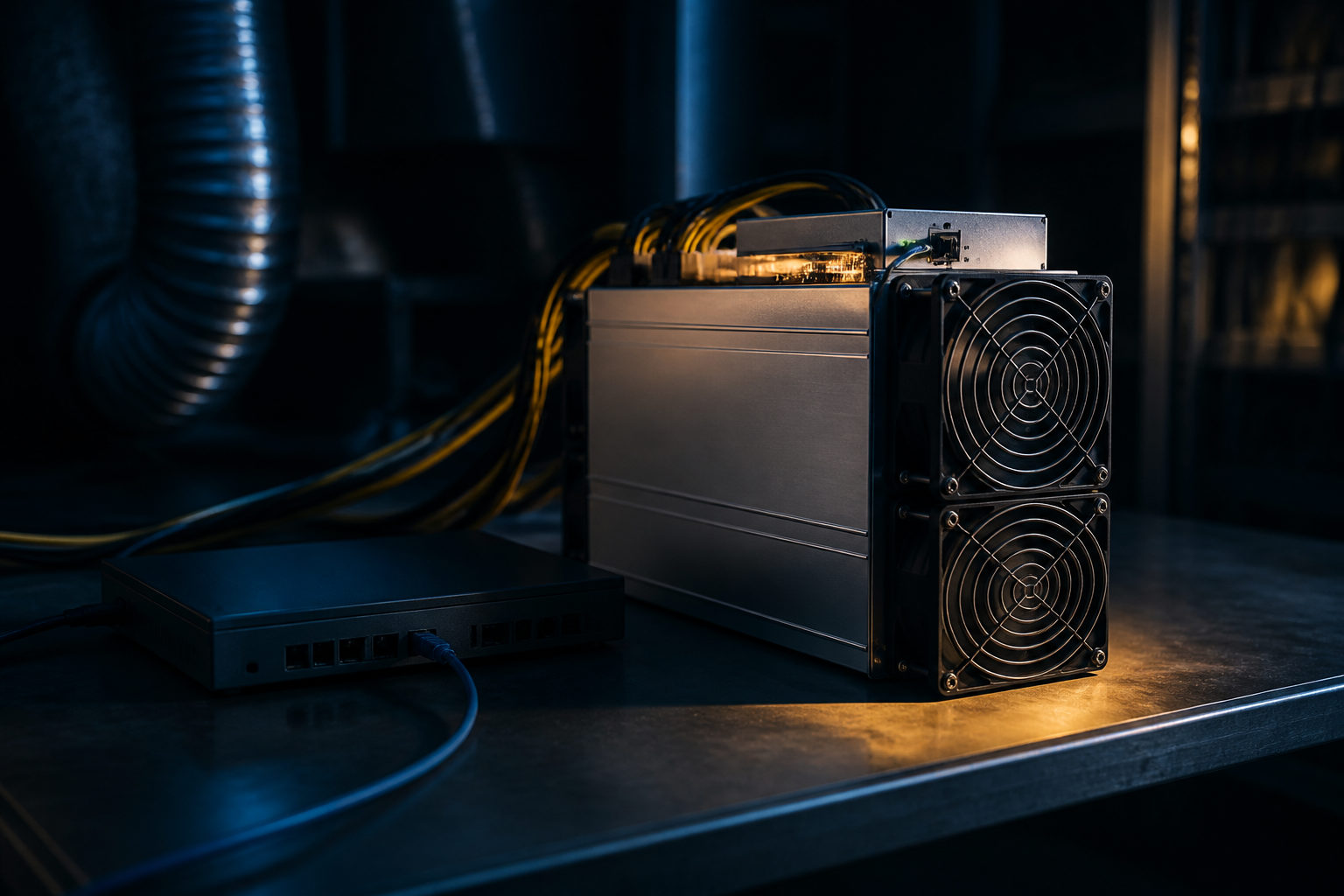
To start solo mining Bitcoin, you need to see it for what it is: a direct attempt to win block production on your own, with full control over the setup and full exposure to the costs and uncertainty that come with it.
What solo mining Bitcoin actually means
A simple way to picture Bitcoin is as an ongoing race to write the next page of a public ledger. Miners across the network keep trying to find a valid result for a new block. The first one to do so can add that block to the chain and receive the block reward plus transaction fees. When you solo mine, you are entering that race without combining your hashpower with a mining pool.
Bitcoin produces a new block about every 10 minutes, and the network adjusts mining difficulty so block production stays near that rhythm overall. For a solo miner, that matters because success is not smooth or predictable. Your machine may run properly for a long time and still find nothing. That is part of the model, not proof that the setup failed.
Many beginners miss this point. Buying a miner does not create a steady stream of output. It gives you hardware that keeps making guesses, competing against the rest of the network for a chance to find a valid block first.
Solo mining vs pool mining vs cloud contracts
| Method | What you control | How results usually feel | Main drawback | Best fit |
|---|---|---|---|---|
| Solo mining | Your hardware, node, wallet, and setup choices | Very uneven, with long dry spells possible | High technical burden and full cost exposure | People who want independence and can handle uncertainty |
| Pool mining | Usually your hardware and wallet, while the pool coordinates work | Smoother, based on your contributed hashpower | Dependence on pool rules and service quality | People who prefer steadier participation |
| Cloud contracts | Limited direct control | Depends on contract structure | Counterparty risk and weak transparency | People avoiding hardware management |
If your goal is specifically how to start solo mining Bitcoin, independence is the center of the decision. You are choosing to run your own environment, verify your own data flow, and deal with failures yourself instead of outsourcing that responsibility.
What you need before you begin
The first requirement is specialized hardware. In practice, Bitcoin mining means ASIC machines built for SHA-256. A regular desktop or laptop can help you learn how nodes, wallets, and block validation work, but general-purpose hardware is not the realistic starting point for actual solo mining.
The second requirement is stable power. Mining hardware runs under sustained load, so power quality, uptime, heat handling, and physical placement all matter. A setup that looks fine on paper can turn unreliable fast if breakers trip, airflow is poor, or temperatures stay too high.
You also need dependable networking. A solo miner has to receive fresh block data and submit work without repeated interruptions. If connectivity is unstable, the machine may appear active while contributing less effective work than expected. That gap between “powered on” and “working well” catches a lot of newcomers.
Another major piece is node infrastructure. A true solo setup usually involves running your own Bitcoin full node, syncing it, validating blocks and transactions locally, and pairing it with mining software or a bridge component that feeds jobs to the ASIC. This gives you stronger autonomy, but it also means more responsibility for installation, monitoring, updates, and troubleshooting.
Then there is wallet control. The address used for mining payouts should be one you manage yourself, and the backup process needs to be tested before you depend on it. A careful hardware setup can still fail at the asset-management layer if keys are not stored and recovered properly.
A practical path from zero to a working setup
| Step | What to do | Why it matters | Common mistake |
|---|---|---|---|
| Define your goal | Decide whether you want hands-on learning, full independence, or a home lab test | Your goal shapes the hardware and complexity you actually need | Buying equipment before you know what kind of setup you want |
| Prepare a wallet | Create and back up an address you control | You need a payout destination under your own custody | Leaving long-term payout control with a platform you barely know |
| Run a full node | Install Bitcoin node software and complete sync | Solo mining depends on local validation and current chain data | Assuming a miner dashboard alone counts as a solo environment |
| Configure mining software | Connect the node, bridge layer, and ASIC properly | The miner needs valid jobs delivered in the right format | Copying settings from someone else without checking your own network and hardware |
| Bring the ASIC online | Set networking, payout details, and monitoring items | Small configuration errors can leave a machine running badly for a long time | Powering on the machine and then ignoring temperatures and error logs |
| Maintain the system | Watch logs, cooling, firmware state, power behavior, and alerts | Solo mining is an operating process, not a one-time install | Treating downtime as minor and skipping routine checks |
If you are new, there is no need to begin with a live ASIC on day one. You can first build a learning environment around a wallet and a full node, get comfortable with sync, validation, and backups, and only then decide whether real mining hardware makes sense for your situation.
Once the machine is live, focus on a few operational signals: whether it stays connected, whether it keeps receiving fresh work, and whether hardware errors or heat issues are rising. Solo mining can fail quietly. A box full of spinning fans can still produce poor results if the software path or network path is weak.
The costs most beginners underestimate
People often think about solo mining in terms of “Can I find a block?” and stop there. A better question is whether you can keep the system running well over time. Noise, heat, dust, airflow design, cable management, replacement parts, and hands-on maintenance all become real concerns once the setup moves from theory into a physical space.
Power cost is only one layer. Hardware ages, fans wear out, uptime slips, and troubleshooting takes time. Home setups add another set of tradeoffs because the environment is usually shared with daily life. If the sound level or heat output is hard to live with, the setup may never stay online long enough to match the original plan.
Another mistake is expecting regular results from an irregular process. Bitcoin mining is extremely competitive at the network level. A solo miner can do everything right and still wait a long time without finding a block. That is a structural feature of solo mining, not an automatic sign that the machine is defective.
Who solo mining tends to suit best
| Expectation | Good fit for solo mining? | Why |
|---|---|---|
| You want direct exposure to how Bitcoin block production works | Yes | Running your own node and hardware gives you a close view of the process |
| You want predictable, even results | Usually no | Solo outcomes are naturally lumpy and uncertain |
| You are willing to handle hardware and system issues | Yes | Much of the value comes from operating the setup yourself |
| You want a set-it-and-forget-it process | Usually no | Cooling, networking, and logs all need ongoing attention |
For many people, pool mining is the more practical route because it smooths the experience. Solo mining makes more sense when control, self-verification, and the full operational path matter more to you than a steadier payout pattern.
FAQ
Can I start solo mining Bitcoin with a normal computer?
You can use a normal computer to learn node operation, wallet management, and mining basics. For real Bitcoin solo mining, though, specialized ASIC hardware is the practical standard.
Do I need to run my own full node for solo mining?
If you want the setup to be genuinely independent, running your own full node is the stronger approach. It lets you validate blocks and transactions locally instead of relying on an outside service for the core view of the chain.
Should I buy an ASIC first or build the environment first?
Building the environment first is usually the safer order. A wallet, a synced node, and basic monitoring will show you whether you are ready for the ongoing work before you commit to hardware.
Why can a miner run for a long time and still find no block?
Because solo mining competes against the full network, and results do not arrive on a regular schedule for each participant. Long periods without success can be normal, though you should still check logs, connectivity, and hardware error states.
How do I know whether solo mining or pool mining suits me better?
If full control over the node, hardware, and validation path matters most, solo mining is the closer fit. If you care more about a smoother participation experience, a pool is often the practical choice.
Before scaling anything up, build a minimum working setup that connects your wallet, node, ASIC path, and monitoring. Small test environments reveal weak points early, when they are still cheaper and easier to fix.
Disclaimer: This article is for informational and educational purposes only and is not investment, financial, or legal advice. Crypto assets are highly volatile and you could lose your entire investment. Do your own research and decide carefully.