
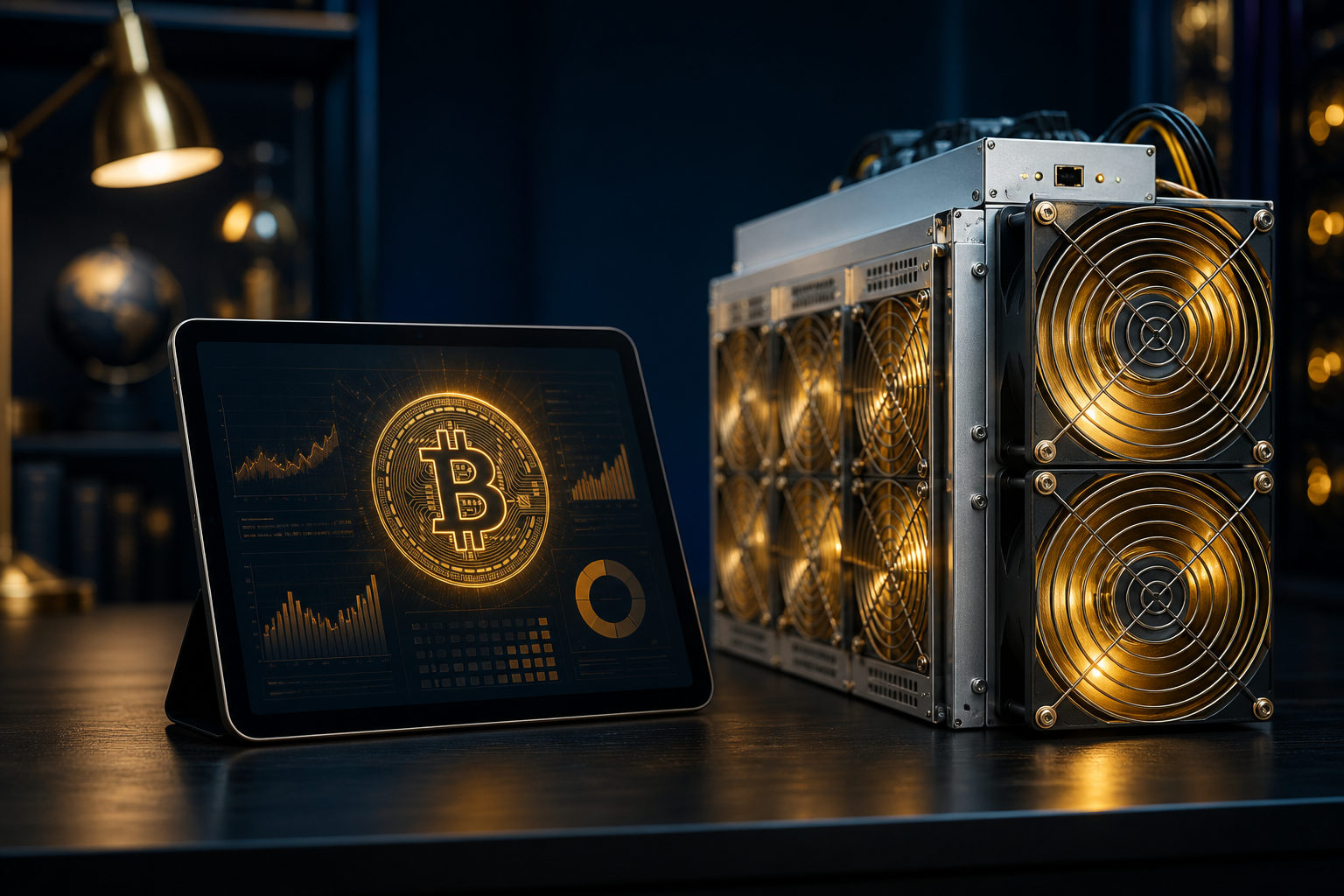
Can you mine bitcoins on an iPad? In practice, no. An iPad can be useful for checking mining dashboards, reading about Bitcoin, or managing a wallet, but it is not a realistic device for actual Bitcoin mining.
A simple way to see why is to picture Bitcoin as a nonstop bookkeeping contest. About every 10 minutes, the network produces a new block, and miners compete for the right to add that next page to the public ledger. The problem is that this contest is not about whether a device can run an app. It is about whether a machine can deliver specialized computation, keep doing it continuously, and stay competitive against dedicated hardware built for one job.
Why an iPad is not a practical Bitcoin mining device
People often hear the word “mining” and assume it means starting a program and letting a device work in the background. That idea is too loose for Bitcoin. Real Bitcoin mining means performing hash calculations under the network’s proof-of-work rules and competing with purpose-built machines across the world.
Those machines are not tablets, phones, or ordinary laptops. The devices that actually mine Bitcoin at scale are ASIC miners, which are designed for a narrow task: carrying out the specific computations Bitcoin mining requires. An iPad is built for mobility, battery life, a responsive screen, and general consumer use. Those are strengths in daily life, but they are the wrong strengths for Bitcoin mining.
That is why many claims about “mining Bitcoin on an iPad” need careful decoding. Sometimes an app only shows a mining-style interface, with moving numbers and activity screens, without contributing useful work to the Bitcoin network. Sometimes the iPad is just a remote control for a real miner or a mining account. In other cases, a service uses the word “mining” for rewards, points, or another token system that has little to do with Bitcoin’s actual mining process.
So the core issue is not whether an iPad can run something labeled as a mining app. The real question is whether the iPad itself can act as a meaningful participant in Bitcoin’s block production race. It cannot.
Bitcoin mining makes more sense when you think of a race for bookkeeping rights
To answer the iPad question properly, it helps to start with the role of mining in Bitcoin. Bitcoin was introduced in the 2008 white paper Bitcoin: A Peer-to-Peer Electronic Cash System by the creator using the name Satoshi Nakamoto, whose identity remains unknown. The genesis block followed in January 2009. Instead of trusting a single company or state to keep the ledger, Bitcoin uses open rules to decide who gets to add new records.
Those rules do two things at once. They make it hard for anyone to rewrite the ledger, and they require participants to spend real computational effort before they can earn the right to publish a block. Miners keep trying hashes until one of them finds a valid result under the network target. That process is not just about issuing new coins. It is also part of what protects the chain from easy manipulation.
Seen as a contest, the structure is straightforward:
- The blockchain is the shared public ledger.
- Miners are the contestants trying to win the next bookkeeping slot.
- Hashing is the work they perform during the contest.
- A block is the next page added to the ledger.
- The network rules decide which result is valid.
In Bitcoin’s early period, more general-purpose hardware had a path into mining. Over time, competition rose and the activity became specialized. That shift matters here. An iPad may feel powerful in normal use, yet Bitcoin mining rewards a very different kind of performance: narrow, persistent, industrial-style computation.
What “mining on an iPad” usually means in the real world
Most people do not ask this question in a vacuum. They ask it after seeing an app store listing, a social media post, or a website that talks about mobile mining, tablet mining, or cloud mining. The confusion comes from the fact that the word “mining” is used for several very different things.
Remote monitoring of real mining equipment
This is one of the most legitimate uses for an iPad in the mining space. You sign in to a mining dashboard, check whether a machine is online, review pool status, or look for warnings and downtime. In that case, the miner is doing the work somewhere else, and the iPad is simply the screen you use to watch or manage it.
Access to hosted or cloud-based services
Some companies place hardware in another location and let customers view contracts, account activity, or operational status through a tablet. Even if you use an iPad to interact with that service, you are not mining Bitcoin on the iPad itself. You are accessing someone else’s infrastructure through a mobile device.
Simulation apps or entertainment products
Other apps create the feeling of mining through animations, changing counters, and mock control panels. They may be educational, game-like, or purely promotional. None of that means the iPad is performing useful proof-of-work for Bitcoin.
Marketing that stretches the meaning of mining
Some services call check-ins, ad viewing, referral programs, or reward systems “mining.” That may be a catchy label, but it should not be confused with Bitcoin mining. If a product does not explain where the computing happens, what hardware is involved, and how the process connects to the Bitcoin network, the word is probably being used loosely.
Why dedicated miners are necessary for real Bitcoin mining
Many readers are really asking a broader question: why does Bitcoin mining require specialized hardware at all? The answer is that Bitcoin mining is a highly specialized computational task. A device is not judged by how smooth it feels in daily use. It is judged by whether it can perform the same narrow operation continuously and efficiently enough to compete.
Dedicated mining hardware has clear advantages:
- Single-purpose design: it is built around the mining task rather than general computing.
- Sustained operation: it is meant to keep working under heavy load for long periods.
- Matching power and cooling conditions: deployment takes electricity, heat, and noise into account.
- Operational control: it is easier to monitor, restart, repair, and manage in groups.
An iPad is almost the opposite. It is optimized for portability, quiet operation, touch interaction, and battery-backed convenience. That makes it great for reading, messaging, streaming, and wallet access. It does not make it suitable for constant, specialized proof-of-work computation.
Even before you think about competitiveness, there are practical limits. Tablets are not intended to function like mining rigs. Their software environment, thermal design, background behavior, and product purpose all point in a different direction. Put plainly, an iPad can help you interact with the Bitcoin ecosystem, but it cannot replace a Bitcoin miner.
If an iPad cannot mine Bitcoin, what can it do?
This is the more useful question for most beginners. Many people do not actually want to build a mining operation. They want to get involved with Bitcoin using the devices they already own. From that angle, an iPad can still be very helpful.
Learn the basics
You can use an iPad to read the Bitcoin white paper, study wallet guides, and understand how blocks, confirmations, and addresses work. It is also a good place to learn core units and concepts, including that 1 satoshi is one hundred millionth of a BTC. Getting the basics right matters more than chasing the idea of mining from a tablet.
Track network information and market tools
This article does not provide live prices, but an iPad works well for checking charting apps, block explorers, and public network information. It can also help you understand Bitcoin’s supply schedule. The maximum supply is capped at 21 million coins, and the subsidy halves about every 4 years, or every 210,000 blocks, with halving years including 2012, 2016, 2020, and 2024. Those design choices are part of the reason mining became a professionalized activity.
Manage wallets and security routines
For many users, wallet management is far more relevant than mining. A tablet can be useful for reviewing receiving addresses, confirming transaction details, and working alongside other security tools. The main focus should be protecting keys, checking addresses carefully, and avoiding fake interfaces.
Monitor mining infrastructure remotely
If you already have access to miners, a hosted setup, or pool accounts, an iPad can serve as a monitoring terminal. You can review status pages, check alerts, and confirm whether systems are online. That is a real use case, but it is very different from using the iPad as the source of mining power.
Common misunderstandings to avoid
A lot of confusion comes from mixing up “a device can run a program” with “a device can mine Bitcoin in a meaningful way.” Those are not the same thing. A few distinctions make the whole topic much clearer.
- Installing an app is not the same as mining Bitcoin. A mining label on a screen does not prove real participation in the network.
- Moving numbers do not prove useful work. Some interfaces are only visual wrappers around data, simulations, or third-party services.
- Remote control is not local computation. Managing miners from an iPad is different from mining on the iPad.
- “Mining” in another project is not automatically Bitcoin mining. The term is often stretched beyond its technical meaning.
There is also a simple economic reality in the background. Real Bitcoin mining involves hardware, electricity, cooling, maintenance, and operational risk. Even without quoting any return figures, it is clear that this is not a casual side task for a consumer tablet.
FAQ
Can an iPad run a Bitcoin mining app and count as mining?
Usually no. In most cases, the app is either a simulation, a remote dashboard, or an interface to another service rather than proof-of-work performed by the iPad itself.
Can a tablet or phone replace a Bitcoin miner?
No, not in any practical sense. Bitcoin mining depends on dedicated hardware designed for sustained, specialized computation, which is far outside the role of a consumer mobile device.
What is a better first step if I want hands-on Bitcoin experience?
Start with wallet basics, block explorers, transaction confirmation, and key security. Those are real skills you will use, and they give you a much better foundation than trying to turn an iPad into a miner.
Does cloud mining through an iPad mean I am mining on the iPad?
No. It only means you are using the iPad to access a service. If any real mining is happening, it is happening on hardware somewhere else.
What is the most useful Bitcoin-related role for an iPad?
Its best role is as an access and management device. It is well suited for reading, monitoring, wallet tasks, and checking network information, but not for doing the mining work itself.
If you want a practical rule, separate mining hardware from management hardware. An iPad is useful at the edge of the Bitcoin ecosystem, where people read, verify, monitor, and manage; it is not the machine that does the actual mining. Before trusting any product that says otherwise, check whether it explains where the computation really happens.
Disclaimer: This article is for informational and educational purposes only and is not investment, financial, or legal advice. Crypto assets are highly volatile and you could lose your entire investment. Do your own research and decide carefully.