
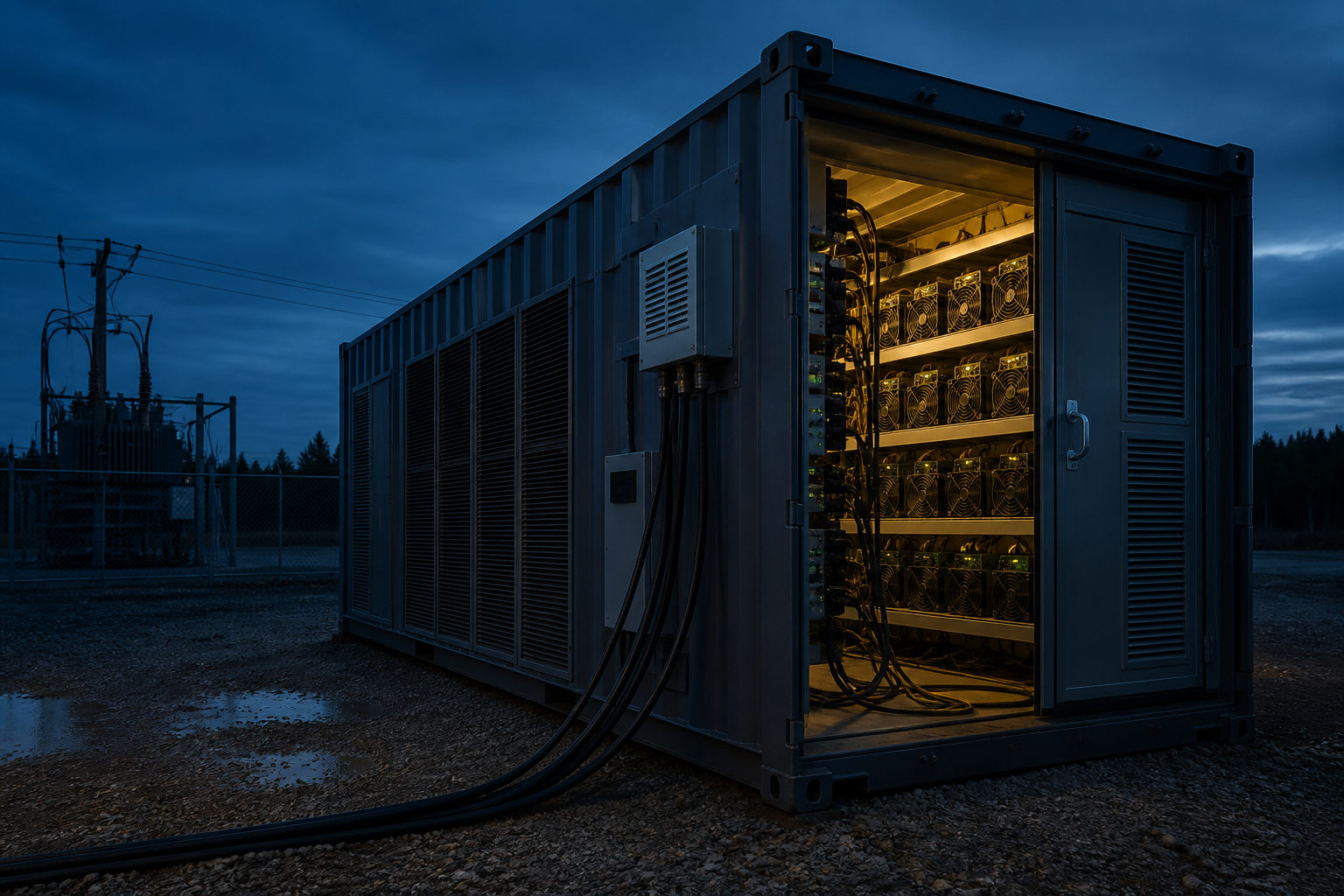
IREN is generally treated as a bitcoin miner if it operates mining machines, connects that hardware to the Bitcoin network, and competes for block rewards. The label depends on what it does, not what its name sounds like.
What “bitcoin miner” means in practice
In Bitcoin, a miner is any party that supplies computing power to the network’s proof-of-work process, whether that party is an individual, a private operator, or a public company.
Mining is a nonstop bookkeeping contest. Pending transactions are grouped into a block, and miners race to produce a valid result under Bitcoin’s rules. The winner earns the block reward and usually the transaction fees attached to that block. The current block reward is 3.125 BTC after the 2024-04-19 halving, and the reward is cut in half every 210,000 blocks, roughly every 4 years.
If IREN is running specialized mining hardware, securing power, managing cooling and uptime, and taking part in block production through solo mining or a pool, it fits the category of a bitcoin miner. If a company only holds BTC on its balance sheet, trades it, or talks about the sector, that is a different role.
Why a company can be a miner even if no single employee “finds a block” alone
Many miners join pools, combining hash power so rewards arrive more regularly and are then split under a preset method.
That structure does not change the underlying activity. A pool is still made up of miners. The company operating machines is still providing hash power to the proof-of-work system, paying for electricity, exposed to downtime, and dependent on hardware efficiency. So the useful question is whether IREN participates directly in that operating cycle.
| Test | Fits a bitcoin miner | Does not by itself make it a miner |
|---|---|---|
| Core activity | Runs mining rigs and contributes hash power | Only buys or holds BTC |
| Main inputs | Power, site operations, cooling, maintenance | Market commentary or treasury management |
| Revenue source | Block rewards and fee share | Price moves or unrelated service income |
| Main risks | Electricity cost, hardware efficiency, outages | Trading risk or portfolio risk |
Scale changes the operating model, but it does not change the definition.
The bookkeeping contest analogy: how mining really works
Bitcoin does not appoint a central server to decide who writes the next page of the ledger. Instead, miners compete. They take candidate transactions, assemble a block, and keep trying new hashes until one result satisfies the network’s difficulty target. That process is proof of work.
Bitcoin aims for a block interval of about 10 minutes. Difficulty adjusts so block production stays near that pace over time even when more machines join the network. After the 2024 halving, the reward is 3.125 BTC per block. That implies about 450 BTC of new supply per day across the entire network, based on roughly 144 blocks in a day. This is a network-wide figure, not a promise for any one person, site, or company.
Mining output is not fixed. Results depend on network difficulty, machine efficiency, pool payout rules, uptime, site conditions, and power cost. Mining is competitive production, not a vending machine.
Can ordinary people still participate?
Yes, in the sense that the protocol is open to anyone. No special status is required to join. The practical hurdle is that modern mining is equipment-heavy and cost-sensitive. Early in Bitcoin’s history, casual participation was easier. Today, serious mining usually means specialized hardware, a stable power setup, and disciplined operations.
Company-scale miners and home users do not face the same realities. A large operator has to think about site design, cooling, power contracts, machine deployment, repairs, and utilization. A small operator may care more about noise, heat, and whether local electricity costs make the setup unreasonable from day one.
| Path | Who it suits | Main hurdle | First question to ask |
|---|---|---|---|
| Buy and run your own rigs | Hands-on users | Noise, heat, power, maintenance | Can you operate reliably where you live? |
| Hosting | People without a suitable site | Trust and fee structure | Are the terms clear enough to evaluate? |
| Join a pool | Miners seeking smoother reward timing | Understanding payout methods | Does the pool model match your goals? |
| Buy BTC instead of mining | People who want price exposure only | No direct block production | Are you comfortable with a completely different risk profile? |
Bitcoin has a hard cap of 21,000,000 BTC, with issuance continuing until about 2140. As halvings continue, newly issued coins become scarcer. That makes operating efficiency more important over time.
Cost reality matters more than the label
If you are asking about IREN because you want to know whether mining is attractive, what matters is the operating burden attached to mining itself. Electricity is not optional. Cooling is not optional. Uptime is not optional. Hardware ages, breaks, and becomes less competitive as conditions change.
Calling a firm a bitcoin miner tells you it is in the business of turning power and hardware into hash power and then competing for block rewards. It does not tell you whether mining is easy, passive, or predictable.
Bitcoin began with the genesis block on 2009-01-03, and its basic issuance schedule is public and rule-based. The system does not care whether a participant is a hobbyist or a corporation. It only recognizes valid proof of work. From the network’s perspective, a miner is a miner if it contributes hash power under the rules.
FAQ
Does a company count as a miner, or is that term only for individuals?
A company can count as a miner. In Bitcoin, the term describes participation in proof of work, not whether the participant is a person or a corporate entity.
How can I tell whether a firm is really mining or just holding bitcoin?
Look for operating clues rather than branding. A real miner deals with machines, power, cooling, maintenance, and pool or site management, while a holder mainly carries BTC as an asset.
If a miner joins a pool, is it still mining?
Yes. Pooling changes how rewards are distributed, but the miner is still contributing hash power to block production and still exposed to the economics of mining.
Why not answer with a fixed number for how much a miner makes per day?
Because there is no single number that applies across setups. Output depends on changing network conditions and on local factors such as hardware efficiency, uptime, and electricity cost.
Is mining the same thing as buying bitcoin?
No. Buying BTC gives you market exposure, while mining is an operating activity built around machines, energy, and competition for block rewards.
If you want the shortest possible answer to “is IREN a bitcoin miner,” use this rule: if it runs mining hardware and competes in Bitcoin’s proof-of-work system while carrying the related power and equipment costs, then yes, it belongs in the bitcoin miner category.
Disclaimer: This article is for informational and educational purposes only and is not investment, financial, or legal advice. Crypto assets are highly volatile and you could lose your entire investment. Do your own research and decide carefully.