
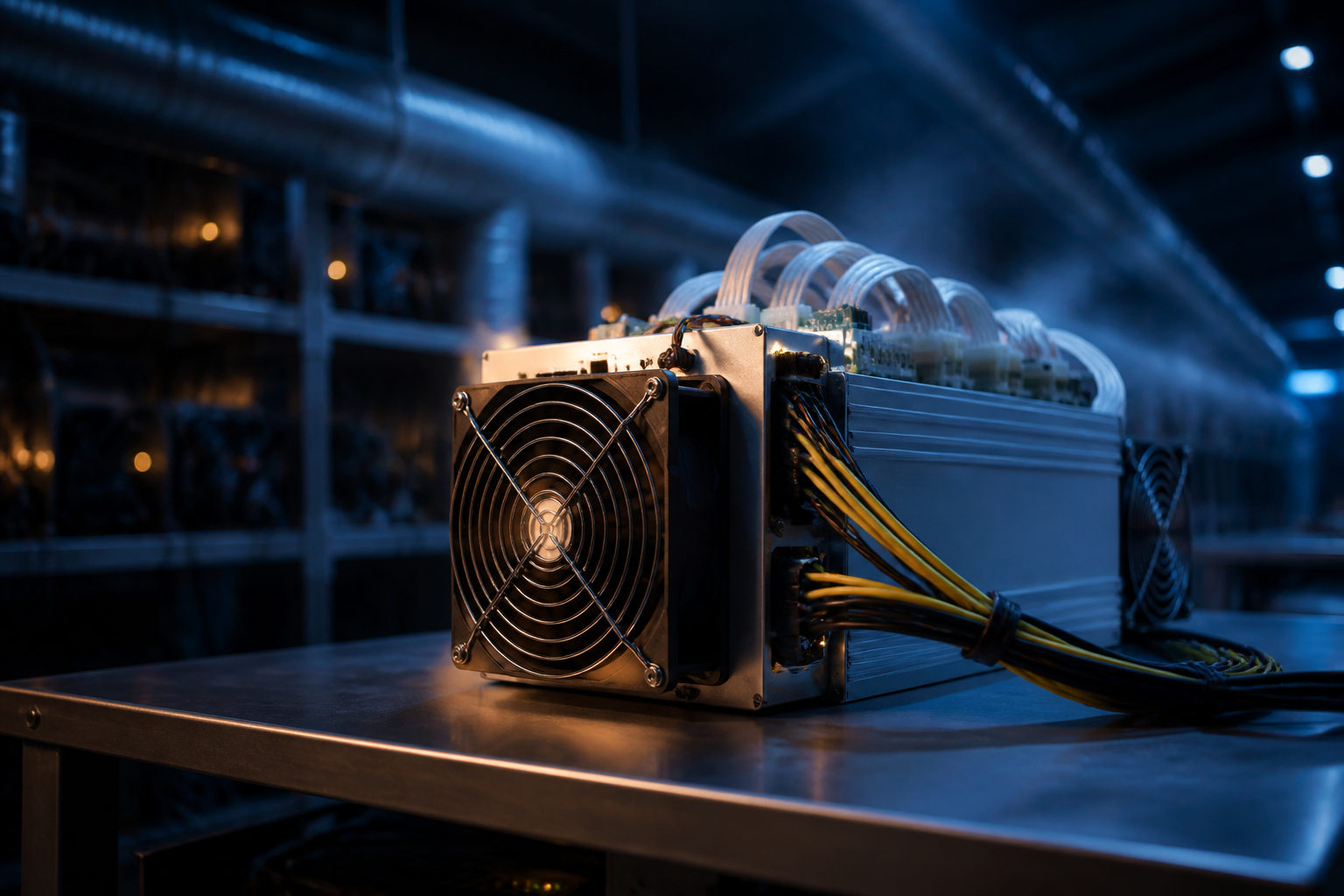
Bitcoin mining is usually not easy today. If you ask whether it is easy to mine bitcoins, the short answer is no for most people: the basic idea is simple, but real participation means dealing with hardware, global competition, power costs, cooling, and constant upkeep.
Think of mining as a race to keep the ledger
A simple way to understand Bitcoin mining is to picture a public bookkeeping race. People send transactions across the network, and someone has to collect them, verify them, and package them into a new block. Miners compete to find a valid result under Bitcoin's rules, and the winner gets the chance to add that block to the blockchain and receive the block reward plus transaction fees.
The task sounds small when described that way, yet the hard part is competition. Bitcoin produces a block about every 10 minutes, but miners around the world are trying to win the same round. Running software is one thing. Running it in a way that can compete with specialized machines day after day is something else.
This is why mining is better understood as an infrastructure activity than a casual app-based task. It depends on equipment, power delivery, heat control, network stability, and regular troubleshooting. Many beginners assume that downloading mining software means they are close to mining bitcoin successfully. In practice, installation is the easy part.
Why mining looked easier in the past
Bitcoin began in January 2009, and the early environment was very different. Fewer participants meant less competition. As more miners joined, the network adjusted mining difficulty so the average block interval stayed near 10 minutes. That built-in adjustment is a big reason mining became harder over time for any single participant.
So when people ask whether it is easy to mine bitcoins now, the useful answer is to focus on the type of market they are entering. This is a mature, competitive field. General-purpose consumer hardware once had some room to participate, but modern Bitcoin mining is commonly associated with dedicated mining machines built for this exact workload. A home computer may still help you learn the software flow, though it is usually not a practical tool for real competition.
| Factor | Earlier perception | Current reality |
|---|---|---|
| Entry barrier | Understand the rules and try | Need equipment, power, and operating discipline |
| Competition | Fewer participants | Heavy global competition |
| Hardware | General hardware once had room | Dedicated miners are far more common |
| Chance of solo success | More accessible for individuals | Much harder for a single miner |
| Main concern | How to start | How to stay efficient and stable |
Bitcoin's supply design adds another layer. The maximum supply is capped at 21 million coins, and the block subsidy is cut in half about every 4 years, or every 210,000 blocks. That schedule pushes miners to care deeply about efficiency, because rewards do not stay the same while competition keeps moving.
How people still participate in mining
Some readers are really asking a more practical question: even if mining is hard, can an ordinary person still take part? The answer is yes, but the path matters. Solo mining, pool mining, hosting, and cloud contracts are very different experiences, and they should not be treated as if they carry the same level of control or risk.
| Method | How it works | Main advantage | Main difficulty |
|---|---|---|---|
| Solo mining | You run your own machine and compete directly on the network | High control and direct participation | Low chance of finding blocks alone |
| Mining pool | You combine computing power with other miners and share results by pool rules | More regular payout patterns | You must understand fees and payout models |
| Hosted mining | Your machine runs at a third-party facility | Less burden at home | Dependence on the operator and their terms |
| Cloud mining | You buy a contract tied to third-party mining power | Little direct hardware work | Transparency can be weak and costs can be hard to judge |
For beginners, the biggest mistake is often confusing convenience with simplicity. A service may remove noise, heat, and setup from your living space, but that does not remove the need to understand what you are paying for. You still need to know where the computing power comes from, how fees are deducted, what happens during downtime, and who controls withdrawals or machine replacement.
If your goal is to learn, basic mining knowledge comes first. You should understand what a block is, why miners use specialized hardware, how pool payouts work, and where a wallet address fits into the process. Without that foundation, it is hard to tell whether a service is genuinely saving you time or simply hiding complexity behind marketing language.
The hard part is ongoing operation, not the first click
Buying a miner does not finish the job. It starts a chain of operational tasks. Mining equipment runs continuously, produces heat, draws meaningful power, and needs reliable internet access. If cooling is weak, performance can suffer. If the unit is placed in the wrong environment, noise and heat can quickly become a problem. If connectivity drops, the machine may stop contributing work even though it appears to be on.
Power cost is another central issue. Since this article does not include live market data, it avoids profit figures, but one point is clear without numbers: Bitcoin mining is highly sensitive to cost structure. Hardware quality, electricity pricing, cooling demands, repairs, and downtime all shape the result. Someone who focuses only on the machine's headline performance can miss the operating reality that comes after purchase.
Administration also matters more than many newcomers expect. You need to monitor machine status, check payout records, keep wallet details accurate, and spot unusual disconnections. Mining works best when treated as a system that needs attention rather than a gadget that can be forgotten after setup.
| Common assumption | What usually happens |
|---|---|
| Install software and mining will run smoothly | Software is only the entry point; hardware and operation decide most outcomes |
| A home PC should be enough | Consumer machines are usually not suited for sustained mining competition |
| Buying a miner means income starts automatically | Electricity, cooling, faults, and payout rules still need active management |
| High advertised hashrate tells the full story | Efficiency, reliability, support, and downtime handling matter too |
What to check before you try
If you are still asking whether it is easy to mine bitcoins, a better next step is to frame the question differently. Are you trying to understand how Bitcoin secures its ledger, or are you considering mining as an ongoing operational project? Those are separate goals, and they call for different decisions.
If learning is the main purpose, start with core concepts: hash functions, difficulty adjustment, the block reward schedule, mining pools, and wallet basics. You do not need to rush into buying hardware. If you want hands-on participation, review your conditions first. Can you handle noise, heat, machine monitoring, and a reliable power setup? If not, the first problem may appear long before you think about results.
It also helps to compare services in a structured way. Pool rules, hosting responsibilities, downtime treatment, withdrawal procedures, and maintenance terms should all be visible before money changes hands. Any option that only sells the idea of being easy or automatic, while leaving responsibility lines vague, deserves extra caution.
FAQ
Can one person still mine bitcoin alone?
Yes, solo mining is still possible in a technical sense. The challenge is that one person is competing against a very large network, so many individuals join pools to smooth out results instead of waiting for a rare solo block.
Can I mine Bitcoin with my regular computer?
You can use a regular computer to understand software setup and the general process. As a serious mining tool, it is usually a poor fit because it lacks the efficiency and durability expected in modern Bitcoin mining.
Does joining a mining pool make mining easy?
It makes payouts more regular in many cases, but it does not remove the industry's main hurdles. You still need to understand fee structures, pool payout methods, machine uptime, and how your earnings are credited.
Is cloud mining a good choice for beginners?
It can look attractive because it removes hardware handling from the user side. The tradeoff is lower visibility into the actual operation, which makes it harder for beginners to judge cost, control, and service quality.
Why does Bitcoin halving matter for mining difficulty?
Halving reduces the block subsidy on a fixed schedule, with past halvings in 2012, 2016, 2020, and 2024. That does not directly describe your odds in one moment, but it does make miners more sensitive to efficiency and operating costs over time.
If you want a practical first move, build a comparison table before spending anything. List the method, equipment needs, power setup, noise impact, maintenance burden, payout rules, and withdrawal process. That exercise will tell you more about whether mining fits your situation than any promise that it is easy.
Disclaimer: This article is for informational and educational purposes only and is not investment, financial, or legal advice. Crypto assets are highly volatile and you could lose your entire investment. Do your own research and decide carefully.