
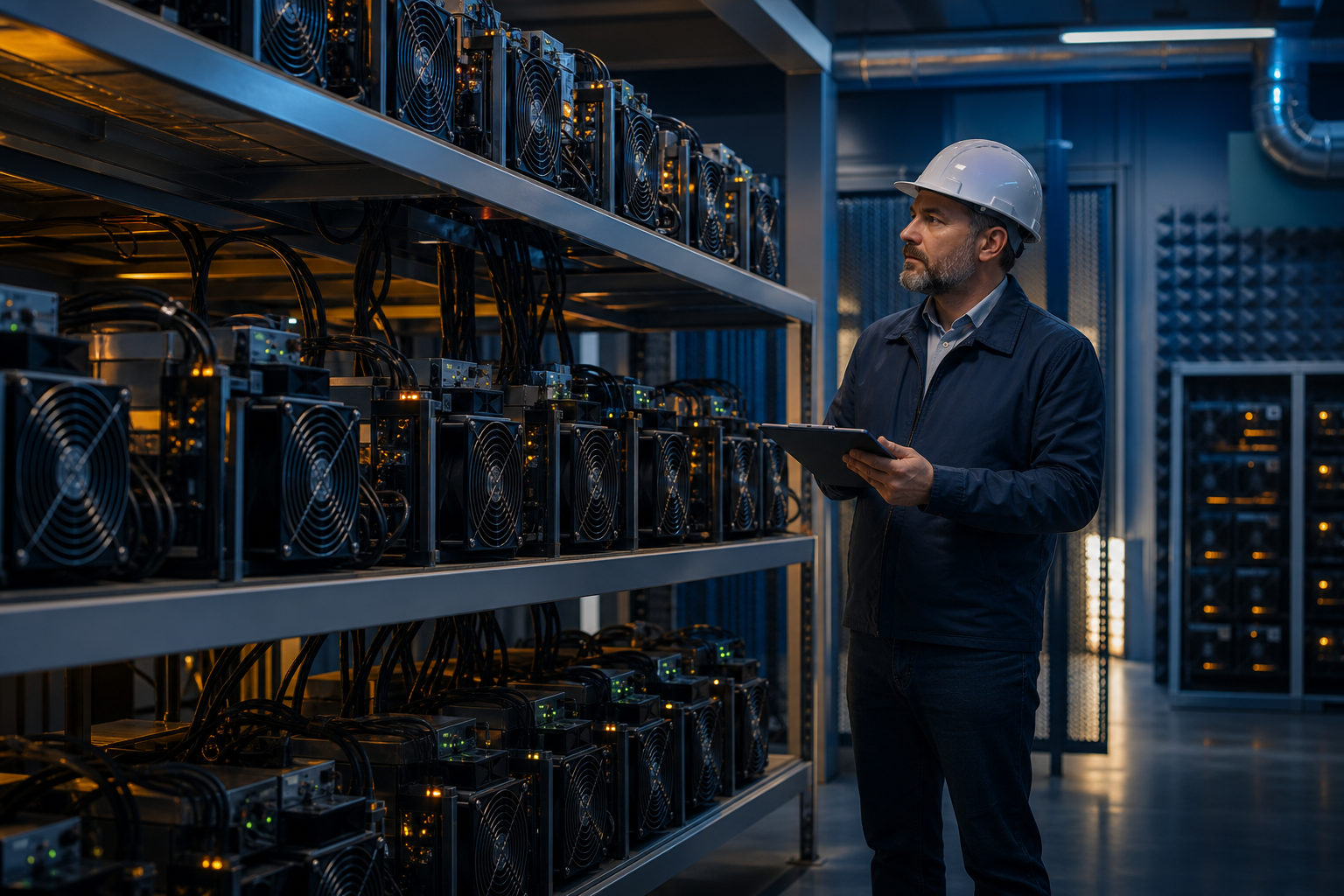
Is it illegal to mine bitcoin? There is no single global answer. Bitcoin mining is a computing activity tied to block production and network security, but whether it is legal depends on local rules on electricity use, business operations, noise, safety, and taxes.
What bitcoin mining actually is
A simple way to think about mining is to picture a public ledger that anyone can inspect. Miners are competing for the right to add the next page. They do that by running specialized machines that follow Bitcoin's rules and search for a valid block that the network will accept.
This is not the same as a company issuing coins from a private database. Bitcoin started with the genesis block in January 2009, and its design lets anyone verify whether a block is valid. The network produces a new block about every 10 minutes, so mining is better understood as a race to perform verifiable work than as a button that prints money.
That distinction matters for the legal question. In many places, the act of performing computation is not the issue by itself. The legal analysis often turns on where the machines are located, how power is being used, whether the activity has become a business, and whether the operator is meeting local compliance duties.
Why the answer depends on where and how you mine
People often ask the question as if bitcoin mining were automatically legal or automatically banned everywhere. In practice, the answer is more specific: is this activity legal in your jurisdiction, in this building, under this power arrangement, and at this scale?
The first check is electricity use. Mining machines are designed to run continuously, and that can create a very different power profile from ordinary home devices. If local rules or utility contracts separate residential, commercial, and industrial use, running mining equipment on a residential setup may raise contract or regulatory issues even if the law does not mention Bitcoin by name.
The second check is property use and operational compliance. A person testing one machine at home is in a different position from someone leasing warehouse space, operating a dedicated room, or hosting machines for others. Once the activity grows, questions around fire safety, ventilation, heat management, noise, zoning, and business registration can become more important than the technical side of mining itself.
The third check is financial and tax treatment. Buying machines, paying power bills, receiving mined bitcoin, and later selling or moving it may create reporting or recordkeeping duties. Bitcoin does not verify your real-world identity at the protocol level, but local authorities can still regulate the business conduct around it.
Rules also vary widely by jurisdiction. Some places may allow mining under ordinary business and energy rules. Others may take a restrictive view because of power strain, consumer protection concerns, or broader crypto policy. That is why copying a miner's setup from another country can be a bad idea.
What most beginners underestimate
Newcomers often imagine mining as a software task. Today, the harder part is usually physical and operational. Competition is intense, mining is highly specialized, and the real-world frictions show up fast: hardware selection, heat, noise, continuous power draw, maintenance, and downtime.
Bitcoin mining generally relies on purpose-built machines rather than ordinary laptops or office desktops. Specialized hardware can run hot, produce sustained fan noise, and require a stable network connection. A poor environment with dust, weak airflow, or unreliable wiring can shorten equipment life or create repeated interruptions.
Power setup is another point people misread. The issue is not only the electricity bill. Outlets, circuit capacity, breakers, room ventilation, and overall load tolerance all matter. In rented apartments or shared buildings, the first problem may not be the law at all. It may be a landlord, a building manager, or neighbors objecting to noise and heat.
Mining pools are also misunderstood. A pool combines the computing power of many miners and then distributes rewards according to its rules. That can smooth the experience compared with solo mining, but it does not remove your operational risks. Your machine can still fail, your power arrangement can still be noncompliant, and your location can still be unsuitable.
There is also a cost reality that people prefer to skip. Bitcoin has a fixed maximum supply of 21 million coins. The block subsidy falls over time through halving events that occur every 210,000 blocks, roughly every 4 years, with halving years including 2012, 2016, 2020, and 2024. Those protocol rules are public and clear. They do not guarantee that a given miner's setup makes sense in the real world.
What to check before you start
If you are seriously considering mining, do the compliance review before you shop for equipment. Many problems start with the building and the power contract, not with the mining software.
- Local law and policy: Check whether your country, state, or city has rules that directly address crypto mining, high-load computing equipment, data centers, or energy use.
- Utility terms: Review your electricity agreement. A setup permitted for household use may not fit a continuous mining operation.
- Property rules: Confirm what your lease, landlord, homeowners association, or building manager allows. Noise, heat, and equipment density can matter.
- Fire and safety standards: Continuous hardware operation creates heat. Ventilation and electrical safety are basic requirements, not optional extras.
- Business status: If you host equipment for others, charge fees, or run multiple machines as a service, your activity may be treated as a business rather than a hobby.
- Records and taxes: Keep records of equipment purchases, power costs, wallet receipts, and any later disposal of mined bitcoin. Clean records matter.
- Equipment source: Machines and power components from unclear sources can create both legal and safety problems.
Some people assume that staying small keeps them safe. That is not always true. A small setup can still breach utility terms, building rules, or safety requirements. Low visibility is not the same as compliance.
Other ways to get exposure without running miners
For many readers, the real question is not legal theory but whether there is a lower-friction way to take part in Bitcoin. Running mining hardware is only one path, and it is not the simplest one.
Some people choose to hold bitcoin rather than mine it. That shifts the focus toward custody, exchange access, wallet security, and transaction management instead of noise, heat, and electrical planning. Others look at mining-related services, but once you move into hosting, managed operations, or fee-based arrangements, the compliance burden can rise quickly.
Be careful with cloud mining or managed mining offers. Real bitcoin mining cannot bypass equipment, maintenance, power, and competition. If a service presents mining as effortless or hides the contract structure, fee deductions, or machine ownership details, that is a sign to slow down and read more before committing money.
It also helps to keep the unit economics in perspective without chasing promises. Bitcoin's smallest unit is 1 satoshi, equal to one hundred millionth of 1 BTC. The protocol is transparent. Your personal outcome is not. That outcome depends on costs, machine uptime, operating conditions, and the legal environment around your setup.
FAQ
Can I mine bitcoin at home legally?
Possibly, but legality depends on local law and on your housing and power arrangement. A home setup can still create issues if it violates utility terms, lease rules, noise limits, or safety standards.
Does joining a mining pool make bitcoin mining legal?
No. A pool changes how mining rewards are shared, but it does not solve legal or compliance issues tied to your machines, electricity use, property rules, or tax obligations.
Can a normal PC mine bitcoin?
In principle, any computing device can attempt the work. In practice, bitcoin mining is highly specialized now, and ordinary consumer computers are generally not suited for sustained participation.
Is cloud mining the same as mining bitcoin myself?
Not necessarily. It depends on the contract and on how transparent the provider is about machines, fees, and payout rules. If those details are vague, treat the offer with caution.
What should I review before starting?
Start with local law, your utility agreement, and your property rules. After that, check fire safety, ventilation, recordkeeping, and whether your activity could be treated as a business.
If you plan to evaluate mining seriously, make a checklist before buying anything: local rules, power terms, property limits, ventilation, noise, equipment source, and tax records. That review is often more important than the choice of machine.
Disclaimer: This article is for informational and educational purposes only and is not investment, financial, or legal advice. Crypto assets are highly volatile and you could lose your entire investment. Do your own research and decide carefully.