
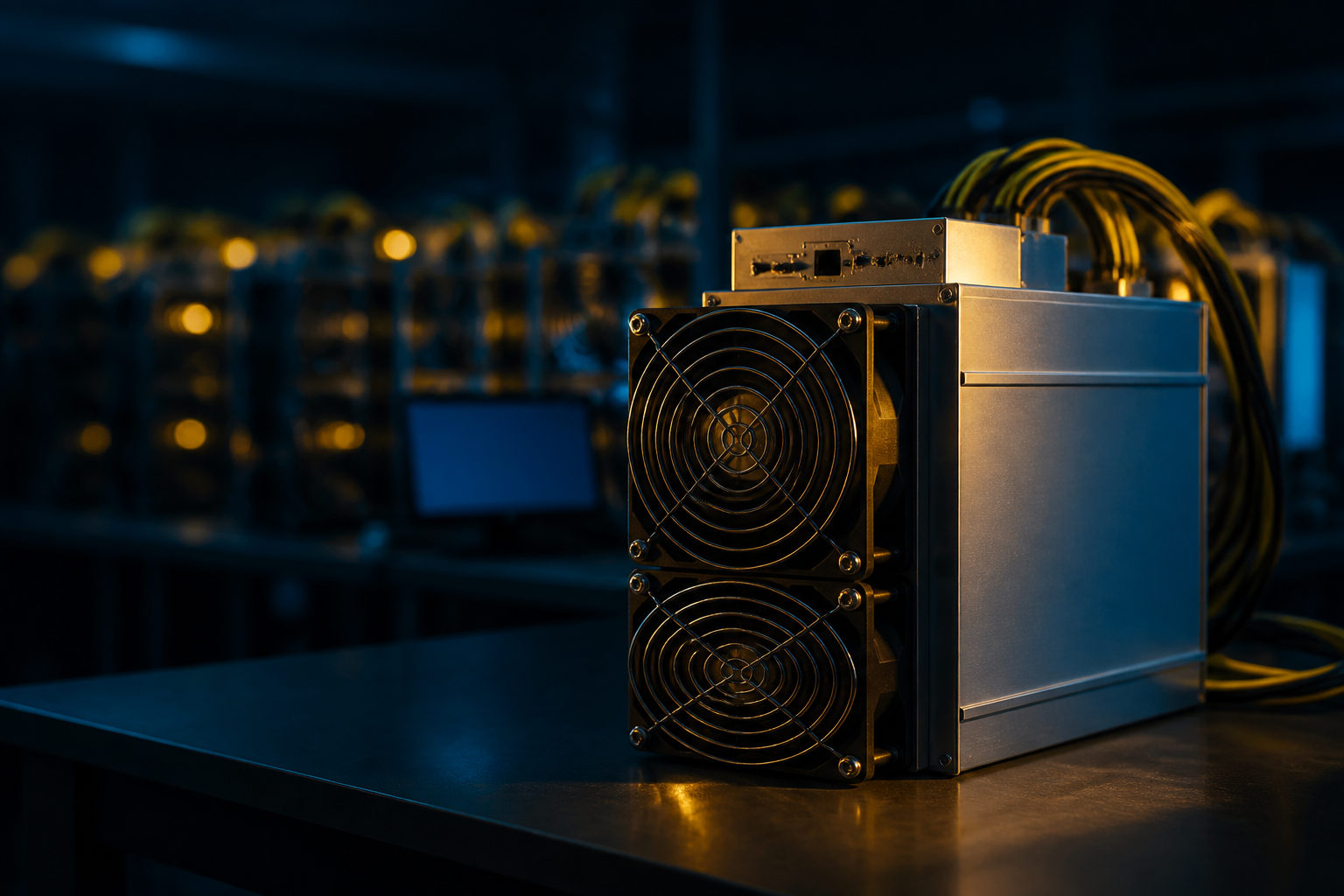
Is it possible to mine bitcoin? Yes, but for most people today, bitcoin mining means joining a pool with specialized hardware, not running a regular home computer on its own.
Bitcoin mining is a race to write the next page of the ledger
A simple way to picture mining is to imagine a public ledger that never stops receiving new transactions. Someone has to verify those transactions, group them into a block, and win the right to add that block to the chain. Mining is the competitive process used to decide who gets that turn.
Miners compete with computing power. Their machines keep trying valid hashes until one miner, or one mining pool, finds a result that satisfies the network rules. When that happens, the block is broadcast, other nodes verify it, and the block can be added. Bitcoin targets about 10 minutes per block, so this contest keeps repeating all day, every day.
The reward schedule is fixed in the protocol. The block subsidy is cut in half every 210,000 blocks, roughly every 4 years. Those halvings took place on 2012-11-28, 2016-07-09, 2020-05-11, and 2024-04-19. After the 2024 halving, the current block reward is 3.125 BTC. With about 144 blocks per day across the network, daily new issuance is about 450 BTC in total.
That last point matters because new miners often read the network-wide number the wrong way. The roughly 450 BTC created each day belongs to the entire network’s output, not to any one person or company. Your own result depends on what share of the total computing power you control, plus pool rules if you mine through a pool.
Bitcoin also has a hard cap of 21,000,000 BTC, with issuance expected to continue until around 2140. Mining was designed as a scarce, competitive process from the start, not as a fixed daily paycheck for anyone who switches on a machine.
So is it possible to mine bitcoin as an individual?
Possible, yes. Easy, no. In theory, any compatible machine can participate in mining. In practice, Bitcoin mining has become a specialized business where performance, electricity, cooling, uptime, and machine management all matter at the same time.
Years ago, hobbyists could experiment with ordinary computers. Today, serious Bitcoin mining is done with ASIC hardware built for this one task. A normal desktop or laptop may run mining software, but that does not mean it has meaningful odds of finding a block. The network is simply too competitive for general-purpose hardware to be an effective choice.
Solo mining is the clearest example of the gap between theory and reality. If you mine alone, you keep the full block reward when you find a block, but your chances may be tiny if your hash rate is a very small fraction of the network. That can mean long stretches with no result at all. A mining pool changes the payout pattern by combining many miners’ hash power and splitting rewards according to pool rules.
Home setups also face practical issues that beginners often miss. ASICs generate heat, noise, and continuous power draw. You need stable electricity, proper ventilation, a place where the noise is acceptable, and enough operational discipline to deal with downtime, hardware faults, and configuration errors. Mining looks simple in a short video; keeping machines running well is the harder part.
| Option | How you get paid | Who it fits | Main drawback |
|---|---|---|---|
| Solo mining | You receive the full block reward and fees if you find a block | Operators with strong hardware, infrastructure, and patience | Payout timing is highly uncertain |
| Pool mining | You share rewards based on pool rules and your contribution | Most individual participants | You must understand fees, payout methods, and pool risk |
| Cloud-style contracts | You buy a contract or a slice of hash power | People who do not want to run hardware | Terms can be hard to verify and quality varies widely |
What participation looks like in the real world
For most newcomers, pool mining is the realistic starting point. A pool does not create extra bitcoin, and it does not remove risk. What it does is smooth out results. Instead of waiting an unpredictable amount of time for a solo block, you receive smaller distributions based on the pool’s accounting method and your contributed hash rate.
You will also need a Bitcoin wallet to receive payouts. That means choosing where your mined BTC will be sent, learning the difference between a wallet address and an exchange account, and making sure backups are handled correctly. Bitcoin is divisible down to 1 satoshi, and 1 satoshi equals 0.00000001 BTC, so pool payouts can be much smaller than 1 BTC while still being valid on the network.
Hardware choice is only one layer. You also need to think about electricity pricing, machine uptime, internet stability, monitoring tools, and whether you can diagnose problems when a unit goes offline or overheats. If you cannot explain your own setup from power source to payout address, you are not ready to judge whether mining makes sense for you.
| Preparation area | What to check | Common mistake |
|---|---|---|
| Hardware | Whether you have Bitcoin-specific ASIC equipment and stable performance | Assuming a high-end PC is enough |
| Electricity | Power price, circuit capacity, and reliability | Counting the machine cost but ignoring ongoing power cost |
| Cooling and noise | Ventilation, heat management, and acceptable placement | Underestimating day-to-day operating conditions |
| Pool choice | Payout model, fees, transparency, and operating history | Choosing based on marketing alone |
| Wallet setup | Control of keys and backup quality | Confusing a wallet with an exchange balance |
FAQ
Can a regular person still mine bitcoin today?
Yes, a regular person can still participate. The harder question is whether that participation is competitive enough to justify the hardware, electricity, and operational work involved.
Can I mine bitcoin on a home computer?
You can run software for learning purposes, but that is different from mining effectively. Modern Bitcoin mining is dominated by ASIC machines, so ordinary computers are usually not practical for real participation.
Does joining a mining pool guarantee steady profit?
No. A pool can smooth payouts, but it cannot remove power costs, equipment wear, downtime, or changes in mining conditions. It changes how rewards are shared, not the economic reality behind them.
How do miners actually receive bitcoin?
Most miners point their pool account or machine settings to a Bitcoin wallet address. Payouts are then sent according to the pool’s rules, often in amounts far smaller than 1 BTC.
Will bitcoin mining continue for a long time?
Yes. Bitcoin has a hard cap of 21,000,000 BTC, with issuance expected to continue until around 2140. The next halving is expected around 2028, and the block subsidy will keep stepping down over time.
Before you try, answer these cost questions first
If you are thinking about mining, start with a checklist instead of a revenue guess: Can your power setup handle continuous load, can your space handle heat and noise, and do you understand the pool and wallet path well enough to operate it safely? If any one of those answers is still vague, it is smarter to learn the workflow on a small scale before treating Bitcoin mining as a serious plan.
Disclaimer: This article is for informational and educational purposes only and is not investment, financial, or legal advice. Crypto assets are highly volatile and you could lose your entire investment. Do your own research and decide carefully.