
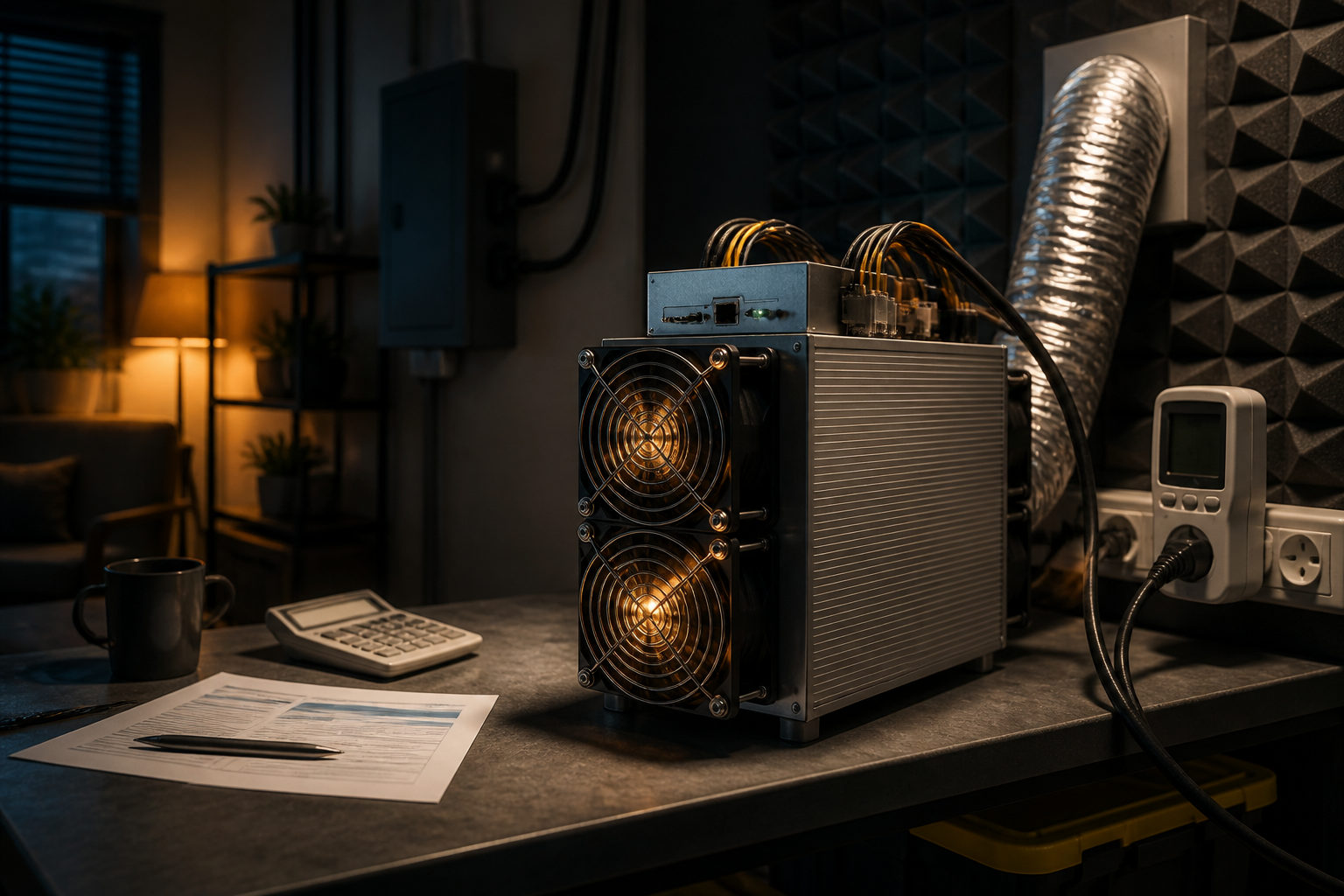
Bitcoin mining at home in 2026 may be profitable for a small number of people, but for most households the answer depends less on hope and more on power cost, machine efficiency, heat, noise, and daily upkeep.
A simple way to think about mining is a nonstop bookkeeping race. Miners keep trying to produce a valid result, and the winner gets to add the next block to the ledger and earn the block reward plus transaction fees. That means home mining is not a fixed paycheck for leaving a machine switched on. It is competition against a global field of specialized hardware.
What home bitcoin mining actually means
Bitcoin launched from its genesis block in January 2009, and its supply cap is 21 million coins. The network uses proof of work to secure the chain. Mining machines perform hashing work, and the network produces a block about every 10 minutes. As soon as one block is found, the next round begins.
This is where many beginners get the wrong idea. Home mining is not the same as running a normal PC in the background and collecting steady output. You are joining a probability-based contest. Better hardware, lower energy use, cleaner cooling, and more stable uptime all matter. A single machine mining alone can see very uneven results, which is why many participants join a mining pool. A pool can smooth payout timing, but it does not fix a weak cost structure.
The real factors behind profitability at home
Electricity is the first filter
If someone asks whether it is profitable to mine bitcoin at home in 2026, the first serious question is not about coin output. It is about electricity. A mining machine runs for long stretches and keeps drawing power the whole time. If your household power rate is high, that single factor can wipe out the entire margin.
There are household issues as well. Older wiring, weak outlets, poor airflow, and trips from electrical protection can all reduce uptime. A machine that is often offline is not just annoying. Downtime is part of the cost.
Hardware efficiency matters more than the sticker price
Many buyers focus on the purchase price because it is easy to compare. In practice, efficiency is the bigger issue. An older machine may still function, yet use far more power for the same level of work. In home mining, that can mean you are entering the race with a built-in disadvantage.
Used hardware needs extra caution. You are not only buying a machine; you are buying whatever usable life it has left. Fans, power supplies, control boards, and cooling systems wear down. A cheap unit can turn into a stream of repairs, unstable performance, and lost time. What looked affordable at first may become expensive after weeks of troubleshooting.
Heat and noise can end the plan before profits do
This is one of the most overlooked parts of home mining. Mining machines create sustained heat and loud noise. In a house with spare space and good ventilation, that may be manageable. In an apartment, small room, or shared home, it can become the main reason the setup fails.
Noise affects sleep, work, and everyone nearby. Heat affects performance and hardware life. If hot air has nowhere to go, the machine may throttle, report errors, or shut down. A setup that can boot is not the same as a setup that can run reliably every day.
Maintenance is part of the job
Some people picture home mining as buying a machine once and letting it work by itself. Real life is less passive. You may need to monitor hash rate, check for disconnects, clear dust, watch fan behavior, confirm network stability, and handle the occasional restart or fault.
If you are comfortable with basic hardware handling and troubleshooting, you can reduce some friction. If you are not, home mining can become frustrating very quickly. That does not mean skilled users are guaranteed a better outcome. It only means they are less likely to be surprised by normal operating issues.
Why the idea sounds better than the reality for many people
One common mistake is to look only at the block reward and ignore the level of competition. Bitcoin undergoes a halving about every 4 years, or every 210,000 blocks, with known halving years including 2012, 2016, 2020, and 2024. Halving changes the issuance schedule, but it does not automatically make home miners more competitive. The network is still a global contest.
Another mistake is treating pool mining as proof of profitability. A mining pool can make payouts less lumpy than solo mining, which helps with cash flow expectations. Still, if your machine is inefficient, your power cost is high, or your setup suffers regular downtime, a smoother payout pattern will not turn a bad setup into a good one.
There is also confusion between mining bitcoin and buying bitcoin. The two choices expose you to different risks. Buying bitcoin is mainly a question of asset price exposure. Mining adds hardware wear, room conditions, maintenance work, uptime risk, and utility costs. You are not only deciding whether you like bitcoin as an asset. You are deciding whether you want to operate a specialized machine at home for long periods.
A practical checklist before you even consider a home setup
- Check your power situation first. Look at household electrical capacity, outlet safety, airflow, and whether long-run power use is realistic in your space.
- Compare efficiency, not just price. A lower upfront cost can hide weaker power performance, more faults, and harder repairs.
- Plan for heat and noise. Decide where the machine would go, where hot air would exit, and whether the sound level is acceptable.
- Be honest about maintenance time. If you do not want to inspect, clean, monitor, and troubleshoot, home mining may not fit your routine.
- Choose the participation model carefully. Solo mining has extreme variance. Most home users who still want exposure study pool rules, payout methods, and fees before they start.
That is why the better question is often not whether home mining can make money. It is whether your living situation can support a loud, hot, power-hungry machine in a stable way. If the environment is wrong, the financial side usually looks worse once real operation begins.
Who is usually a poor fit for mining bitcoin at home
- People with no electricity advantage. High household power costs leave little room for error.
- People in noise-sensitive housing. Thin walls, shared space, and poor ventilation work against a home setup.
- People who want pure passivity. Home mining often needs attention, even when the setup is small.
- People drawn only by cheap secondhand gear. Low purchase prices can hide lower efficiency and higher failure risk.
- People who dislike hardware work. Even a modest setup can require regular checks and minor fixes.
On the other hand, some users do have conditions that make the idea more workable. They may have suitable power access, space that can handle heat and sound, and the willingness to maintain equipment. Even then, the right conclusion is not automatic. It simply means the assessment can start from a stronger base.
FAQ
Can I mine bitcoin at home with a regular computer?
In theory, any device that performs the required computation can try. In practice, a regular home computer is not competitive with specialized bitcoin mining hardware, so it is not a realistic main setup for most people.
Is solo mining better than joining a pool?
Solo mining has very uneven results because the wait for a successful block can be long. A pool usually makes payouts more regular, but you still carry the same hardware, electricity, and maintenance costs.
What should I check before buying a miner for home use in 2026?
Start with power cost, electrical safety, cooling, and noise tolerance. After that, compare machine efficiency, reliability, and how easy it is to service if something goes wrong.
Is mining bitcoin at home better than just buying bitcoin?
They are different decisions. Buying bitcoin is mainly about market exposure, while home mining is closer to operating equipment with ongoing overhead and operational risk.
Where can I check the live bitcoin price before deciding?
You can compare the live market view on major exchange pages and widely used crypto market data sites. It helps to check more than one source, but price alone should not drive the decision without looking at power cost and hardware efficiency.
If you want to evaluate home bitcoin mining seriously in 2026, do not start by ordering a machine. Start with a written list of your power conditions, ventilation, heat tolerance, noise limits, and the time you can devote to maintenance; if one of those basics fails, the setup is usually weak before the first day of mining even begins.
Disclaimer: This article is for informational and educational purposes only and is not investment, financial, or legal advice. Crypto assets are highly volatile and you could lose your entire investment. Do your own research and decide carefully.