
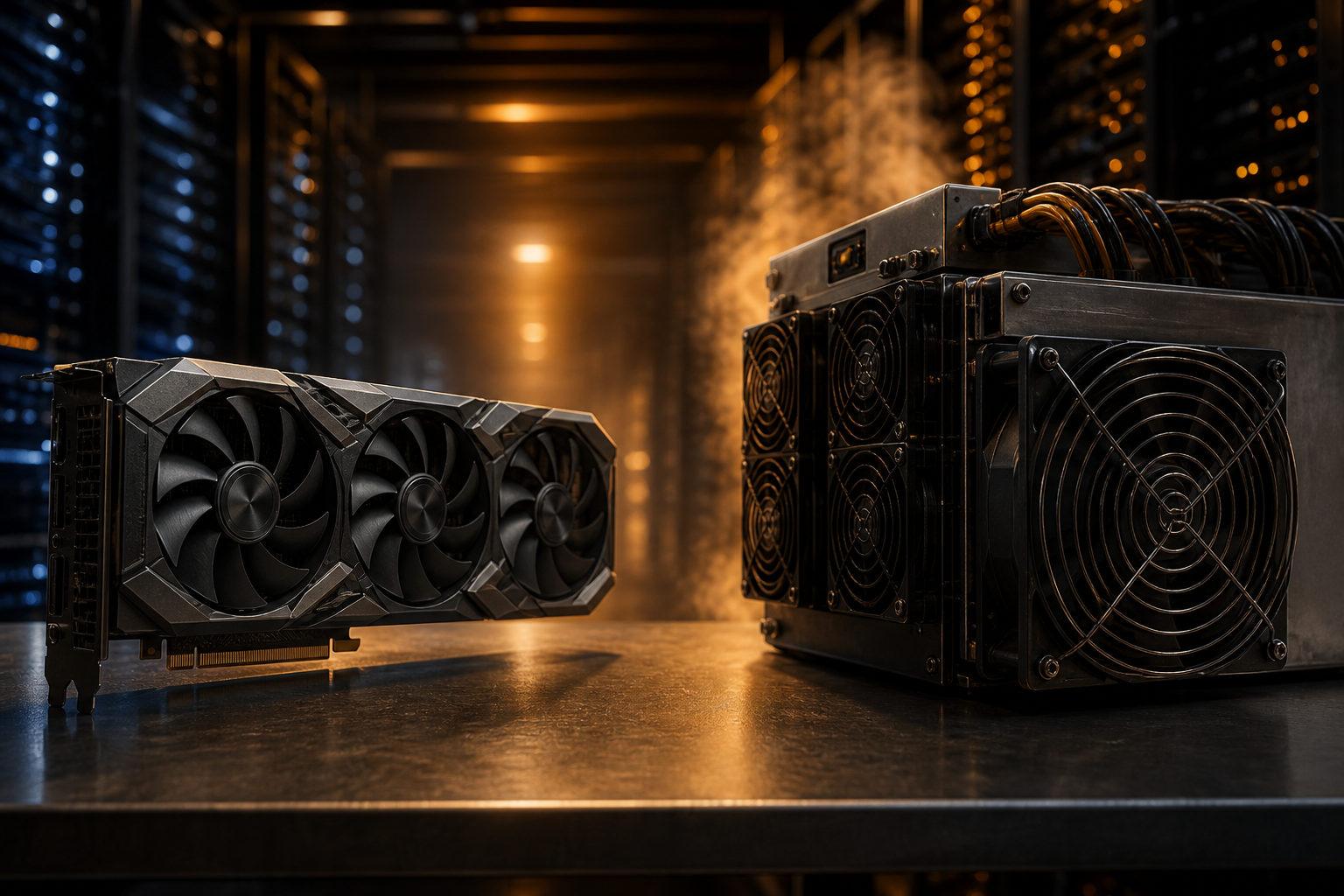
For most people, mining Bitcoin with a GPU in 2026 is unlikely to make economic sense. A GPU can still help you understand how mining works, but Bitcoin mining itself is no longer a contest between consumer graphics cards. It is a competition dominated by purpose-built ASIC machines.
A simple way to picture Bitcoin is to imagine a nonstop bookkeeping race. Miners compete to add the next page to a public ledger, and the network produces a new block about every 10 minutes. As more specialized hardware joins that race, a standard GPU has a harder time turning raw participation into a workable business.
Why GPU mining and Bitcoin mining are no longer the same thing
Bitcoin uses proof of work. Miners repeatedly perform computations, trying different outputs until one of them meets the network's rules. In broad terms, more effective computing per unit of power gives a miner a better chance to contribute to the next block.
Years ago, people often associated crypto mining with CPUs, then GPUs, then more specialized systems. For Bitcoin, that progression matters because the hardware race did not stop at graphics cards. ASIC miners were designed specifically for Bitcoin's mining process, which means they are built for the exact job a GPU tries to do in a more general way.
That distinction changes the real question. Asking whether a GPU can mine Bitcoin is different from asking whether it is sensible to do so in a competitive market. A gaming PC may be able to run mining software, connect to a pool, and submit work. That does not mean it can compete well enough against ASIC-based operations that are planned around power efficiency, cooling, uptime, and long-term cost control.
This is where many beginners get stuck. They see that mining software installs correctly, the hardware works, and the machine starts hashing. From there, it is easy to assume the setup is commercially viable. In Bitcoin mining, those are separate questions.
What decides profitability in 2026
If someone asks whether it is profitable to mine Bitcoin with a GPU in 2026, the honest answer depends on a cost-and-competition framework, not on a single performance claim. Revenue is influenced by your share of effective hash power, the way a mining pool distributes rewards, block rewards, transaction fees, and the plain fact that mining is competitive. Costs come from electricity, cooling, hardware wear, maintenance time, downtime, and the risk of configuration mistakes.
Electricity is only part of the picture. A GPU running under sustained load also creates heat, noise, and wear on fans and other components. In a home setting, that can become a practical issue fast. What looks manageable on a product page can feel very different after long periods of continuous use.
Hardware depreciation matters too. Even if a card still functions, long-term stress changes its value and your margin for error. If a setup needs repeated tuning, reboots, thermal adjustments, or replacement parts, the real cost of mining rises beyond the power bill.
Bitcoin's issuance schedule also shapes the economics. The network launched with the genesis block in January 2009, and Bitcoin has a hard cap of 21 million coins. New issuance falls over time because the block subsidy halves about every 4 years, or every 210,000 blocks, with halving years including 2012, 2016, 2020, and 2024. That structure tends to make efficiency and operating discipline more important over time, not less.
What many people actually mean when they ask this question
A lot of readers who search for this topic are really asking one of two different questions. The first is whether a GPU can directly mine BTC on the Bitcoin network. The second is whether a GPU can be used to mine some other asset and then convert the proceeds into Bitcoin. Those paths may both end with BTC in your wallet, but they are not the same activity.
Direct Bitcoin mining means competing in Bitcoin's own proof-of-work system. On that front, GPUs are generally outmatched by ASIC equipment. Indirectly earning Bitcoin through other mineable assets is a different strategy. It adds more moving parts: asset selection, liquidity, storage, exchange execution, security, and local tax treatment. A setup that sounds easier at first can become more complex once those extra layers are included.
That is why it helps to separate goals before buying anything:
- Learning goal: You want to understand wallets, pools, proof of work, and block production.
- Experiment goal: You want to test hardware behavior, system stability, and power conditions on a small scale.
- Profit goal: You need a strict economic test, with full costs included and no assumptions based on wishful thinking.
- Bitcoin accumulation goal: You should be clear on whether you mean direct BTC mining or earning something else and swapping into BTC later.
Mixing those goals often leads to bad decisions. A setup can be educational without being profitable. It can also be technically functional while still making no sense as a long-term operation.
The bookkeeping race analogy: where GPU users lose ground
Think again about the bookkeeping race. Every participant is trying to win the right to write the next page in a shared record. If one group arrives with machines built only for that race, while another shows up with flexible hardware designed for many tasks, the specialized group usually has the edge.
That edge is not only about speed. It is also about how much energy is spent to produce useful work, how reliably the machines can run, and how easy it is to manage them at scale. A GPU is versatile. That versatility is valuable in many computing tasks. Bitcoin mining, though, rewards specialization.
For a home miner, the gap shows up in ordinary day-to-day ways. Cooling becomes harder than expected. Noise becomes annoying. System tuning takes longer. Small interruptions reduce uptime. Wallet and software security need attention. None of those factors is dramatic on its own, but together they push a marginal setup further away from profitability.
How to evaluate a GPU mining idea without fooling yourself
If you are seriously considering GPU-based mining in 2026, start with a reality check instead of a hardware purchase. Ask what success would actually mean for you. If the answer is education, a small experiment may be reasonable. If the answer is dependable profit from direct Bitcoin mining, the bar is much higher.
Next, review your environment. Can your space handle continuous heat and noise? Is your power setup suitable for extended load? Are you prepared for component wear, cleaning, troubleshooting, and periods when the system is not operating as planned?
Then review the security side. Mining touches wallet software, operating system permissions, remote management tools, and downloads that can expose you to malware or theft if handled carelessly. A weak security setup can turn a modest mining idea into an asset-protection problem.
Finally, avoid treating online claims as proof. A screenshot of a running miner does not tell you the full cost structure behind it. A person saying a setup works does not tell you whether it works well enough after electricity, maintenance, downtime, and depreciation are counted.
FAQ
Can a GPU still mine Bitcoin directly in 2026?
At a technical level, a GPU can still be part of the process of running mining software and connecting to mining infrastructure. In practical terms, direct Bitcoin mining with a GPU is usually at a major disadvantage because ASIC miners are built specifically for that job.
Does joining a mining pool make GPU Bitcoin mining profitable?
A mining pool can smooth out reward distribution by sharing returns across participants. What it does not do is erase the efficiency gap between GPUs and ASIC machines, so the core economic problem remains.
If I already own a powerful graphics card, is that enough reason to try?
It may be enough reason to learn, test, and understand the mechanics. It is not, by itself, evidence that direct Bitcoin mining will make financial sense, because ownership of the card does not remove power, wear, cooling, and management costs.
What if my goal is just to end up with Bitcoin?
Some people use GPUs on other networks and later convert the proceeds into BTC. That is different from mining Bitcoin directly, and it brings extra market, custody, platform, and compliance risks that should be understood before you begin.
What should I examine first before trying any mining setup?
Start with total cost, not imagined revenue. If you list power, cooling, wear, downtime, maintenance effort, and security responsibilities in one place, the decision usually becomes much clearer.
If you plan to test mining in 2026, the safest first step is not buying more GPUs. Check whether your hardware type matches the task, whether your power and cooling conditions are realistic, whether your wallet security is solid, and whether you are treating the project as a controlled experiment rather than assuming it will be profitable.
Disclaimer: This article is for informational and educational purposes only and is not investment, financial, or legal advice. Crypto assets are highly volatile and you could lose your entire investment. Do your own research and decide carefully.