
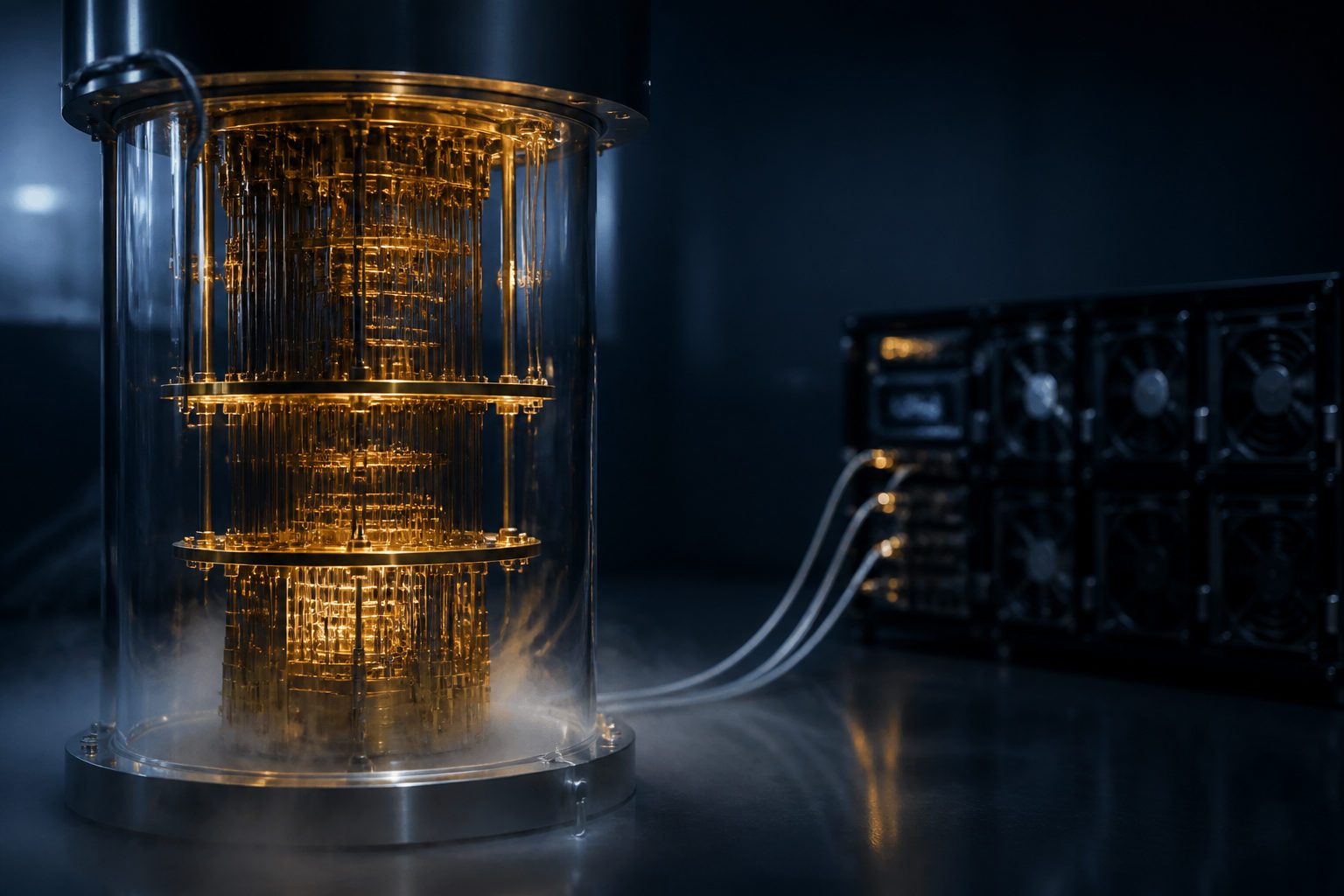
A quantum computer cannot efficiently mine bitcoins today. For Bitcoin mining, the gap between theory and real-world deployment is still wide, and the main limits are hardware scale, error correction, task fit, and cost.
Start with the right mental model: mining is a bookkeeping race
Bitcoin mining makes more sense when you picture it as a bookkeeping race. Many participants try to package transactions into a block, and the first one to find a valid result gets to present that block to the network. If the network accepts it, that round of record-keeping is complete.
The contest is not about solving one deep puzzle once. It is about running huge numbers of repeated hash attempts as efficiently as possible. Bitcoin produces a block about every 10 minutes, and the protocol adjusts mining difficulty over time so the network stays near that rhythm. That matters because any faster hardware does not get to ignore the rules of the system; it still has to compete inside a network that adapts.
This is where many headlines go wrong. People hear “quantum computer” and assume every form of computation becomes dramatically faster. Mining does not reward vague speed. It rewards sustained, reliable, large-scale performance on a very specific kind of workload.
What a quantum computer might help with, and what it does not solve
Quantum computing attracts attention because some algorithms may speed up certain classes of problems. That does not mean every task benefits in the same way. Bitcoin mining depends on hash-based competition, and the real question is whether quantum hardware can run the relevant algorithm at meaningful scale, with tolerable error rates, for long enough to beat specialized mining machines.
Even if a quantum method offers theoretical acceleration for search-like problems, mining is not just a clean lab exercise. A miner has to produce valid work continuously, deal with machine instability, handle timing and coordination, and stay competitive after network difficulty responds. A narrow speedup on paper is not enough by itself.
There is also a practical issue: Bitcoin mining has already been shaped around ASICs, which are custom-built devices optimized for the job. They are not general-purpose winners. They dominate because the work is repetitive, well-defined, and highly specialized. For a quantum computer to replace that setup, it would need more than a scientific breakthrough. It would need a full operating model.
| Question | ASIC mining today | Quantum computing angle |
|---|---|---|
| Main task | Repeated high-speed hashing | Task fit is still uncertain in practice |
| Deployment | Built around established mining hardware | Large-scale deployment is still far off |
| Reliability | Optimized for long running workloads | Error correction and noise remain hard problems |
| Network competition | Directly joins existing hash competition | Any edge still faces difficulty adjustment |
| Current status | Mainstream mining method | More of a research topic than a practical replacement |
Another common mix-up is treating mining and key breaking as the same issue. They both involve computation, but they are different problems. Mining is about winning the right to add a block. Breaking cryptographic protections is about wallet control and transaction authorization.
The first pressure point may be signatures, not mining speed
When people discuss quantum risk for Bitcoin, they often focus more on public-key cryptography than on mining. Bitcoin transactions use digital signatures to prove spending authority. If quantum systems ever become strong enough in the relevant ways, signature schemes could become the earlier pressure point.
That does not mean mining is irrelevant. It means the risk path is different. A future quantum advance could matter more for how funds are authorized than for how blocks are found. For ordinary users, this distinction is useful because it separates scary headlines into two clearer questions: can quantum hardware change mining competition, and can it pressure current signature assumptions?
Bitcoin is also an open protocol, not a frozen object. If quantum-related security pressure becomes serious, discussion would likely center on migration paths, wallet support, signature changes, and how the network reaches agreement on any upgrade. The timing and outcome would depend on broad adoption across developers, node operators, miners, wallets, and users.
Can ordinary people take part in “quantum mining”?
Under current conditions, there is no realistic path for most people to do that. Bitcoin mining today is built around ASIC hardware, mining pools, electricity access, and operational management. Quantum computers are not consumer devices that you can simply connect to a pool and put to work.
Even if access to quantum compute services expands, that still would not mean they are suitable for Bitcoin mining. The workload has to map well to the hardware. Errors have to be controlled. Results have to arrive consistently enough to matter in live competition. The total operating cost has to make sense. Without those conditions, “access” does not turn into “useful miner.”
| Participation path | Real-world feasibility | Main obstacle |
|---|---|---|
| Buy your own quantum machine to mine | Very low | Access, maintenance, and cost barriers |
| Rent quantum compute for mining | Limited | Task mismatch and uncertain stability |
| Keep using ASIC-based mining | High | Normal mining competition and operations |
| Track post-quantum security changes | High | Need to understand wallet and signature updates |
If the real question is whether someone should prepare for a near-term shift into quantum mining, the careful answer is no. Right now it makes more sense to watch this as a technology and security topic than as an immediate mining strategy.
Speed alone is the wrong metric; effective speed is what matters
Questions about “how fast” often miss the most important point. In mining, useful speed is not just how fast one step runs in isolation. It is whether a system can produce competitive work over time, with acceptable reliability, manageable downtime, and a cost structure that does not collapse the whole model.
That is why ASICs still matter so much. Their strength comes from specialization. A quantum computer would need to show an advantage across the full chain: workable algorithms, stable execution, scaling, integration into mining operations, and enough staying power to remain useful after the network adjusts around new competition.
So when you ask how fast a quantum computer can mine bitcoins, the better follow-up questions are: which part gets faster, how often does that speed hold, what is the error burden, and does the advantage survive once it is placed inside a live Bitcoin network. Without those answers, “fast” is too vague to be meaningful.
FAQ
Could a quantum computer one day wipe out current Bitcoin miners?
There is no clear basis for that today. Mining is not just a benchmark contest; it depends on stability, scaling, and the ability to operate under real network conditions.
Even a stronger machine would still compete inside a system that adjusts difficulty, so hardware gains do not translate into a simple fixed mining edge.
Is the bigger quantum risk about mining or wallet security?
The more immediate discussion usually centers on digital signatures and public-key cryptography. That is because wallet control depends on authorization methods, not only on raw computing power.
Mining remains part of the conversation, but it is not the only or even the first issue people mean when they talk about quantum risk.
Should Bitcoin holders do anything right now because of quantum computing?
For most users, there is no reason to take drastic action today based on this topic alone. A better approach is to follow major wallet providers and the broader Bitcoin community for any concrete move toward new signature standards.
If migration ever becomes necessary, the important developments will likely show up through wallet support and protocol discussions rather than through surprise overnight change.
If quantum mining becomes possible, could individuals still participate?
That would depend on access. If the hardware remains concentrated in a small number of high-barrier environments, ordinary users may not get equal participation conditions.
In practice, learning how mining pools, specialized hardware, and protocol changes fit together is more useful than imagining direct hands-on control of a quantum machine.
What signs should I watch if I want to follow this seriously?
Watch two tracks. One is whether quantum hardware reaches stable, error-corrected, scalable operation. The other is whether Bitcoin development starts moving toward concrete signature migration paths and wallet support.
If a story only promises extreme speed but says little about deployment constraints or network mechanics, it is probably far from real mining use.
To make this topic actionable, separate it into two questions: whether quantum computing can change mining efficiency in practice, and how Bitcoin may adapt if signature security ever needs an upgrade.
Disclaimer: This article is for informational and educational purposes only and is not investment, financial, or legal advice. Crypto assets are highly volatile and you could lose your entire investment. Do your own research and decide carefully.