
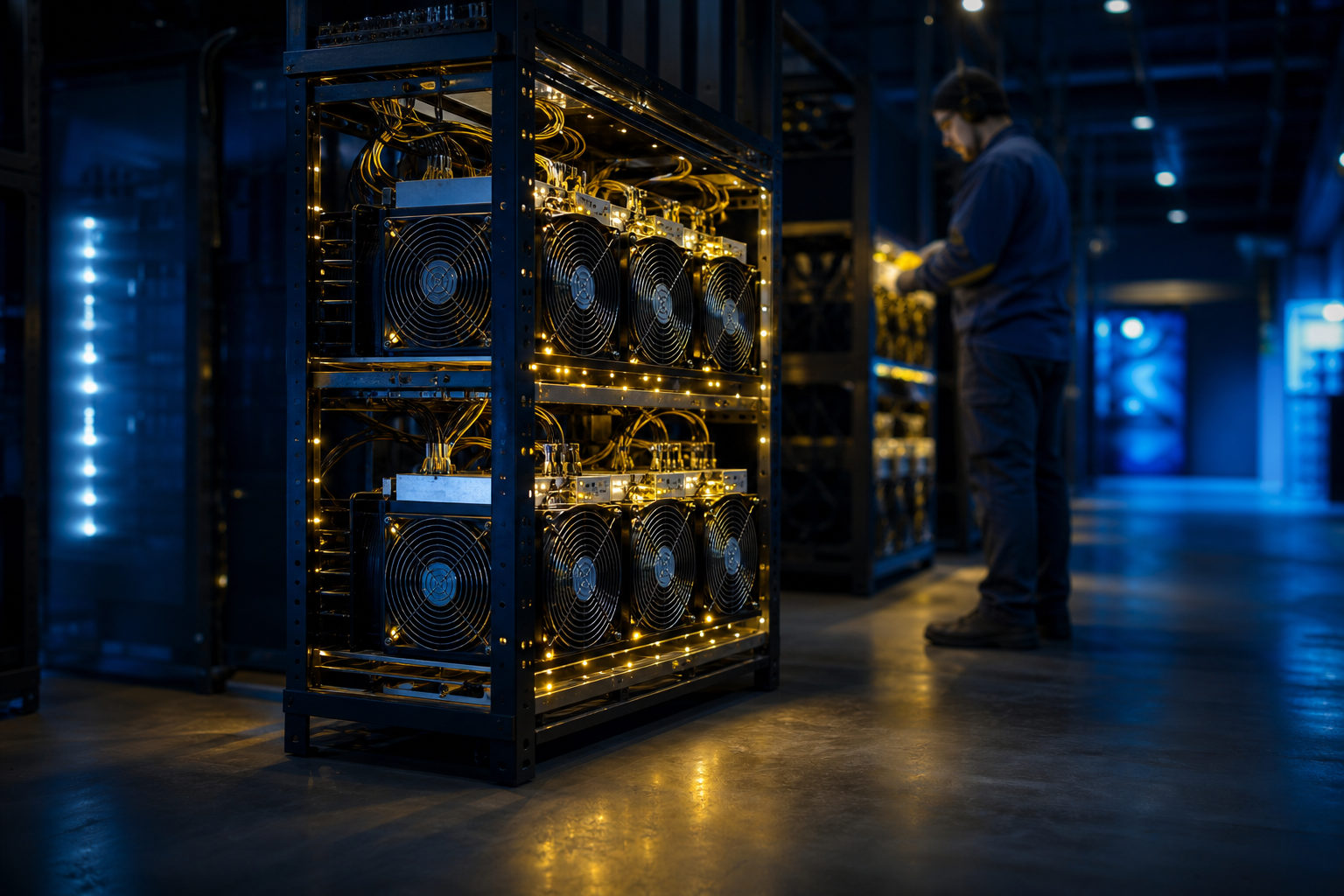
How many bitcoins MARA mines has no fixed answer on its own. For a public mining company, bitcoin output depends on hash rate, machine uptime, network difficulty, and how well operations stay online, not on a simple production target.
Think of mining as a nonstop bookkeeping contest
Bitcoin mining is often described as “creating” coins, but that framing hides the real process. The network needs participants to package transactions into blocks and compete to add the next valid block to the chain. A better mental model is a public bookkeeping contest: miners keep trying calculations, and the winner of each round gets the chance to append a block and receive the block reward plus transaction fees.
That is why a question like “how many bitcoins does MARA mine” cannot be answered with one timeless number. MARA is not running a factory that outputs the same amount every day. It is competing against the rest of the network, and its share changes when other miners add machines, old hardware is retired, facilities go offline, or maintenance interrupts operations.
What actually determines MARA’s bitcoin output
If you only look at a headline figure for coins mined, you miss the operating story behind it. A mining company’s output is shaped by several moving parts, and each one can change the result even if the business still looks “large” from the outside.
| Factor | What it affects | Why it changes |
|---|---|---|
| Hash rate | The company’s share of computing power in the network race | New machines come online, older units are replaced, deployment can be delayed |
| Uptime | How much of the installed fleet is actually mining | Power issues, repairs, cooling limits, and site work can reduce live output |
| Network difficulty | How hard it is to win blocks across the network | Difficulty adjusts as the wider miner base expands or contracts |
| Pool arrangement | How rewards are tracked and distributed | Different pool methods can change the timing and smoothness of payouts |
| Halving cycle | The amount of newly issued bitcoin per block | Block rewards fall on a scheduled cycle |
| Power and operations | Whether machines can stay productive over time | Electricity terms, maintenance quality, and thermal management all matter |
For MARA, the core issue is not whether it owns a lot of miners on paper. The real question is how much effective hash rate is active and stable during a given period. A large fleet that is waiting on deployment, repair, or power access does not produce the same result as a fully operating fleet.
The halving is another piece people often treat too casually. Bitcoin has a hard cap of 21 million coins. The first block, the genesis block, appeared in January 2009. New blocks arrive about every 10 minutes, and the block reward is cut in half roughly every 210,000 blocks, or about every four years. Past halving years were 2012, 2016, 2020, and 2024. After a halving, miners need better efficiency or stronger execution to keep output from slipping.
Why people keep asking how many bitcoins MARA mines
This question usually carries more than one intention. Some readers want a quick operating gauge. Others are trying to judge whether the company turns capital spending into real on-chain production. Some are looking for a way to understand how sensitive the business is to changes in bitcoin’s economics.
A mining company is different from a passive bitcoin holder. A holder mainly faces price swings. A miner also has to manage hardware purchases, site buildout, power arrangements, cooling, repair cycles, staffing, and downtime risk. When investors track MARA’s mined bitcoin, they are often trying to judge whether the company can convert heavy infrastructure into steady output.
There is a common mistake here. People sometimes treat “coins mined” as if it were the same thing as profit. It is not that simple. A miner may hold some of the bitcoin it produces, or sell part of it to pay for electricity, hosting, payroll, repairs, and expansion. Two companies can mine similar amounts and still have very different cash pressure.
| Lens | What a single output number misses | Better way to read it |
|---|---|---|
| Monthly or quarterly production | Short periods can be distorted by outages or timing | Read output together with the reporting window |
| Fleet growth | Purchased machines may not be active yet | Check whether deployment is complete |
| Holding versus selling | Mined bitcoin does not show how much was sold for costs | Pair operating data with treasury behavior |
| Network conditions | External competition can look like poor execution | Compare company results with wider mining conditions |
Can an individual participate the way MARA does?
Yes, but not under the same conditions. MARA operates at industrial scale. Most individuals do not have access to similar power terms, cooling infrastructure, deployment speed, or maintenance capacity. Before copying a mining company in spirit, it helps to separate the available participation paths.
| Path | Best suited for | Main hurdle | Practical reality |
|---|---|---|---|
| Buying your own ASIC miners | People with space, power access, and technical tolerance | Noise, heat, repairs, and setup | Owning hardware means running an ongoing operation, not a one-time purchase |
| Hosted mining | People who do not want machines at home or on-site | Counterparty trust and contract terms | You still need to understand downtime, maintenance, and settlement rules |
| Joining a pool | People who want smoother reward distribution | Understanding the pool’s payout method | A pool can reduce variance, but it does not erase operating costs |
| Buying bitcoin directly | People who only want bitcoin exposure | Execution and custody | This is market exposure, not mining participation |
If MARA’s production made you curious about mining, the first lesson is not “buy more machines.” The better lesson is cost structure. Hardware is only the visible layer. Underneath sit electricity, ventilation, networking, maintenance, machine aging, site constraints, and replacement timing. New miners often model the hardware purchase and ignore the rest, which leads to bad decisions.
Pool mining deserves a clear distinction as well. A pool helps smooth the randomness of finding blocks, especially for smaller participants. It does not pay your power bill, keep your machines cool, or stop hardware from wearing out. That difference matters because many beginners mistake lower reward variance for lower business risk.
How to check MARA’s mined bitcoin without getting misled by one figure
If you are following the company, avoid hunting only for a lifetime total or a single recent number. The useful reading method is to place production beside operating context and network conditions.
| What to check | Question to ask | Risk of reading it in isolation |
|---|---|---|
| Reporting period | Is the figure monthly, quarterly, or for a longer window? | Short-term noise can hide the broader trend |
| Deployment status | Were new machines actually energized and hashing? | Announcements can be mistaken for live production |
| Downtime events | Did weather, power, repairs, or site work interrupt output? | A drop may look worse than it really is |
| Treasury policy | Did the company hold the mined bitcoin or sell part of it? | Output alone says little about cash flexibility |
| Halving context | Was the period before or after a reward reduction? | Cross-period comparisons can become misleading |
That approach gives you a cleaner answer than chasing a stand-alone number. It turns the question from “how many bitcoins does MARA mine” into the more useful one: what operating conditions produced that result, and is it repeatable?
FAQ
Is MARA mining bitcoin for itself or on behalf of other people?
When people discuss MARA’s mining, they usually mean the company is running or arranging mining equipment to compete on the Bitcoin network and earn block-related rewards under network rules. It is not a made-to-order production service in the usual sense.
Why can the same mining company produce different amounts of bitcoin over time?
Output changes with uptime, effective hash rate, network difficulty, maintenance interruptions, and the halving schedule. Even if the company’s fleet size looks similar, live production can still move around a lot.
Does joining a mining pool make output stable?
A pool can make reward distribution less lumpy by sharing results across participants. It improves payout smoothness, but it does not remove power costs, machine failures, or the need for good operations.
Why should a regular investor care how many bitcoins MARA mines?
Because the figure can reveal whether infrastructure spending is turning into actual network production. It also helps you see how exposed the business is to uptime problems, difficulty shifts, and the halving cycle.
If you want a practical way to follow this topic, read production figures in a fixed order: first the reporting period, then active deployment, then downtime, then network conditions, and only after that the bitcoin total. That sequence is far more informative than the headline number alone.
Disclaimer: This article is for informational and educational purposes only and is not investment, financial, or legal advice. Crypto assets are highly volatile and you could lose your entire investment. Do your own research and decide carefully.