
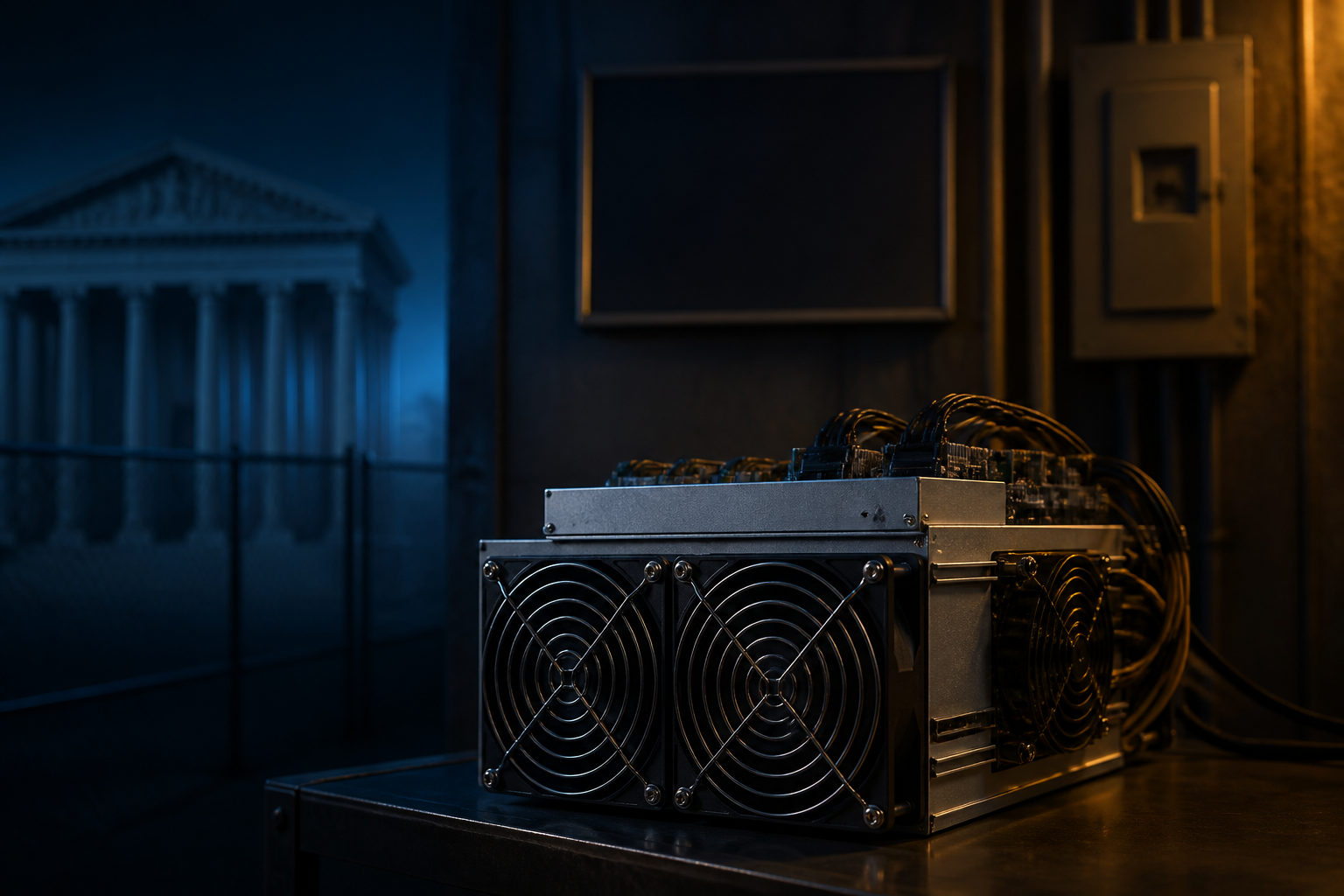
Bitcoin mining is usually legal in the US, but that does not mean you can run mining equipment anywhere you want. State rules, local zoning, power contracts, noise limits, and the type of property you use all matter.
What bitcoin mining actually is
A simple way to picture mining is a bookkeeping race. The Bitcoin network is a public ledger, and miners compete for the right to add the next block of transactions. The machine or group of machines that solves the required computation first can add that block and receive the block reward plus transaction fees inside that block.
This system follows fixed rules. Bitcoin aims for a new block about every 10 minutes. The block reward is cut in half every 210,000 blocks, which is roughly every 4 years. The latest halving took place on 2024-04-19, and the current block reward is 3.125 BTC. At that reward level, the network adds about 450 BTC per day in total, assuming about 144 blocks in a day. That figure is for the whole network, not for any individual miner or company.
Bitcoin also has a hard supply cap of 21,000,000 BTC, expected to be fully issued around 2140. The genesis block was mined on 2009-01-03. Before that, Satoshi Nakamoto released the white paper, Bitcoin: A Peer-to-Peer Electronic Cash System, on 2008-10-31.
So, is it illegal to mine bitcoin in the US?
In general, no. There is no blanket federal ban that makes Bitcoin mining illegal across the United States. For most people, the real issue is not whether mining exists inside the law in the abstract. The real issue is whether a specific mining setup complies with the rules that apply to a specific location and property.
That distinction matters. A person may be allowed to own mining hardware and run it as part of a lawful business or personal activity, yet still run into trouble because of zoning, electrical load restrictions, lease terms, or local nuisance rules. In practice, many mining disputes are about where and how machines are operated, not about Bitcoin itself.
State and local conditions vary. Some areas are more open to data-center-style operations. Others are more sensitive to grid strain, industrial noise, ventilation, building code compliance, or changes in property use. Even within the same state, one county or city may treat high-load computing very differently from another.
| Level | What it usually focuses on | Why it matters to miners |
|---|---|---|
| Federal | Lawful business activity, tax reporting, source of funds | Usually not the first barrier for basic mining activity |
| State | Energy policy, business rules, environmental approach | Shapes the local climate for mining operations |
| Local government | Zoning, noise, fire safety, building use, permits | Often decides whether a site can operate at all |
| Utility and contracts | Power plans, load limits, electrical upgrades, breach terms | Directly affects long-term operation |
| Property owner or HOA | Lease limits, community rules, disturbance concerns | A common sticking point for home mining |
Home mining, hosted mining, and business mining are not the same
A lot of beginners assume legality is one yes-or-no question. It is not that simple. A machine in a garage, a rack in a hosted facility, and a company-run site on dedicated power all face different compliance issues.
Home mining raises very practical questions. Can your lease or building rules restrict continuous high-load equipment? Is the wiring suitable for sustained use? Will fan noise or heat exhaust create complaints? If you are renting, the landlord may care more about electrical modifications and property wear than about Bitcoin as a topic.
A business operation shifts the focus. You may need to treat mining as an ongoing hardware and infrastructure activity rather than a side hobby. Site use, insurance, maintenance plans, accounting records, tax treatment, and control over mined coins become part of normal operations.
Hosted mining falls somewhere in between. You do not manage the facility yourself, but you still need to understand who controls the machine, who approves repairs, how downtime is handled, and how payouts are calculated.
| Approach | Main hurdle | Common blind spot |
|---|---|---|
| Home mining | Power, heat, noise, housing rules | Residential agreements may not allow sustained heavy loads |
| Self-run site | Location, permits, electrical setup, maintenance | Building and fire rules can be harder than buying machines |
| Hosted mining | Service terms, machine custody, payout terms | Downtime and repair authority are often vague |
| Company operation | Accounting, tax process, internal controls | Compliance work continues long after setup |
Knowing the rules is only half the story
Mining is a competition in computational work. That means the question is never just, “Can I switch on a machine?” It is also whether your setup can run steadily, whether your cooling plan works, whether downtime will be frequent, and whether your costs make the activity sensible.
Two misunderstandings show up again and again. First, people see that the network adds about 450 BTC per day and assume they can estimate a personal daily output from that number. They cannot. Individual results depend on machine performance, mining difficulty, the share of total network hashpower, pool terms, and interruptions. There is no fixed number that works for everyone.
Second, many newcomers look only at coin production and ignore power pricing, maintenance, replacement parts, ventilation work, and lost time during outages. A setup can be technically lawful and still be a poor decision once those realities are included.
If you only want exposure to Bitcoin, mining is not the only path. The smallest unit of bitcoin is 1 satoshi, equal to 0.00000001 BTC. That fact matters because it reminds people that learning about Bitcoin or owning some bitcoin does not require running mining hardware.
A practical checklist before you start
| Checkpoint | What to verify | Why it matters |
|---|---|---|
| Location rules | Whether your state, county, or city has special conditions for high-load computing | A site can fail before hardware is even installed |
| Property type | Whether residential, commercial, or industrial use fits your plan | Zoning conflicts can shut a project down |
| Power agreement | Whether sustained heavy usage is allowed and whether upgrades need approval | Contract breaches can lead to shutoff or eviction |
| Heat and noise | Fan sound, exhaust routing, impact on neighbors | One of the most common reasons small setups get challenged |
| Recordkeeping | Equipment purchases, operating expenses, coin receipts, later sales | You will need a clean paper trail for accounting and taxes |
| Hosting contract | Downtime rules, maintenance authority, relocation, withdrawal process | Disputes often begin when these points are unclear |
FAQ
Can I mine bitcoin at home in the US without breaking the law?
Often yes, but the answer depends on the property and the rules attached to it. A home setup may still breach a lease, violate HOA terms, or trigger complaints because of noise, heat, or electrical changes.
That is why checking the location and contract terms comes before buying hardware.
Is joining a mining pool legal in the US?
In general, yes. Joining a pool is usually a method of sharing block rewards based on contributed work, not a separate category that is broadly banned.
You still need to review the pool's payout rules, fee structure, and the tax treatment of what you receive.
Do all US states treat bitcoin mining the same way?
No. Energy policy, local politics, community tolerance, and zoning rules can produce very different outcomes from one place to another.
The useful version of the question is not “Is it legal in America?” but “Can this exact address support it lawfully and reliably?”
If mining is legal, does that mean it is worth doing?
Not automatically. Legal status answers one part of the decision, while cost, uptime, cooling, maintenance, and contract limits answer the rest.
A lawful setup can still be impractical if the operating conditions are poor.
Can I keep the bitcoin I mine instead of selling it right away?
Technically yes, as long as you can receive it into a wallet you control. The harder part is keeping solid records from the moment the coins are received.
Many problems appear later, when a person wants to move or sell coins and cannot reconstruct the original records.
If you are considering Bitcoin mining in the US, start with the site, power terms, local rules, and recordkeeping plan. Until those pieces are clear, talking about output is premature.
Disclaimer: This article is for informational and educational purposes only and is not investment, financial, or legal advice. Crypto assets are highly volatile and you could lose your entire investment. Do your own research and decide carefully.