
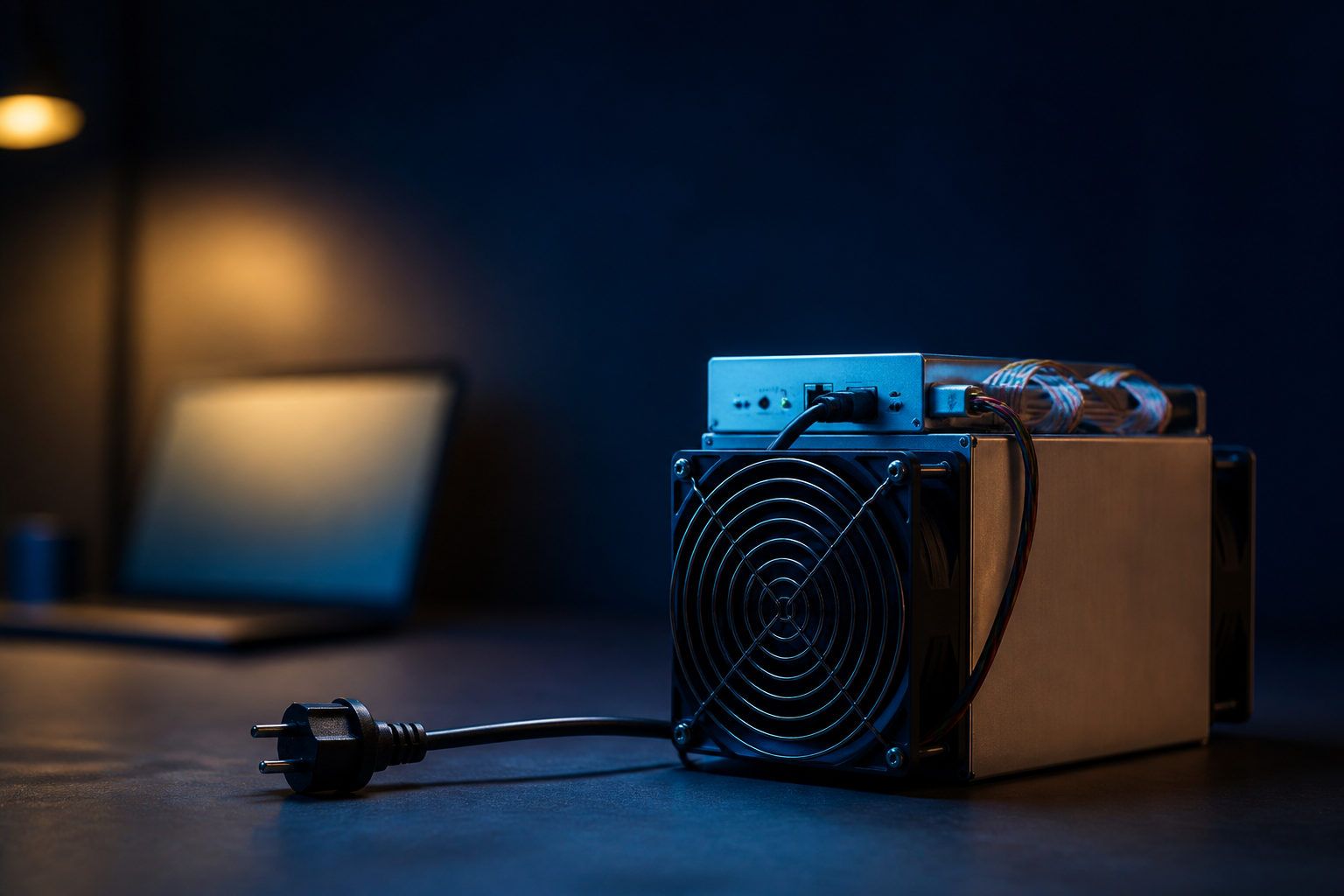
If you want to know how to farm bitcoin for free, the short answer is this: real Bitcoin mining almost never happens at zero cost. Most “free” methods are promotions, task rewards, or rented-compute offers dressed up as mining.
What Bitcoin mining actually is
A simple way to picture Bitcoin mining is to think of it as an ongoing bookkeeping race. People send transactions across the network, and miners compete to verify them, package them into a block, and produce a valid proof of work. The miner that finds a valid block first gets the right to add it to the blockchain and can receive the block reward plus transaction fees under network rules.
That process is called mining because participants spend computing power to compete for a scarce outcome. Bitcoin produces a new block about every 10 minutes, so the work is continuous. This is not a manual side task and it is not something a casual device can usually do well.
Bitcoin launched from the genesis block in January 2009, and its monetary policy is fixed in code. The supply cap is 21 million coins. The block subsidy is cut in half about every 4 years, or every 210,000 blocks, with halvings in 2012, 2016, 2020, and 2024. Those rules matter because they shape how competitive mining becomes over time.
“Free Bitcoin mining” can mean very different things
Many people use one phrase to ask several different questions. They may mean actual mining from home, joining a pool without buying much hardware, or simply getting a small amount of bitcoin without paying cash upfront. Those are not the same thing, and mixing them together leads to bad decisions.
| Method | What it really is | Close to free? | Main limitation |
|---|---|---|---|
| Running your own miner | Direct participation in Bitcoin proof-of-work | No | Needs hardware, electricity, setup, and upkeep |
| Joining a mining pool | Combining hash power with other miners | No | You still need mining equipment and ongoing costs |
| Cloud mining | Renting hash power or buying a contract | Usually no | Contract terms and payout rules may be weak or unclear |
| Signup rewards | A platform promotion | Sometimes close | Often not mining at all |
| Task or reward apps | Trading time for tiny crypto payouts | On the surface, yes | Small rewards, restrictions, and withdrawal issues |
If you care about precision, only the first three belong in the mining category. The last two are better described as marketing incentives or compensation for attention and time.
Why “free” Bitcoin mining is hard in practice
Consumer devices are not built for serious Bitcoin mining
Bitcoin uses proof of work, and the race is heavily shaped by specialized hardware. A normal laptop, desktop, or phone may be able to run software, but that does not mean it is competitive on the Bitcoin network. In practice, modern Bitcoin mining is tied to dedicated machines designed for that single job.
That is why many claims about “mining bitcoin on your phone” need a closer look. In many cases, the app is showing simulated output, internal reward points, or a separate service model. A moving counter on a screen does not prove that your device is mining blocks on the Bitcoin network.
Mining pools spread outcomes, not costs
A mining pool lets many miners combine their hash power so rewards arrive more steadily, then divides proceeds according to pool rules. This helps reduce the luck problem that comes with mining alone. It does not remove the need for hardware, power, cooling, and maintenance.
If someone presents a pool as a no-cost way to get bitcoin, stop and read the details. The pool is a distribution system layered on top of mining work; it does not replace the underlying expense of producing that work.
Cloud mining is closer to a service contract
Cloud mining sounds convenient because you do not need to buy and run a machine yourself. What you usually buy, though, is access to rented hash power or a contract whose payout formula is controlled by the provider. That creates a different risk profile from self-custody or direct mining.
The key questions are practical ones: How are fees deducted? Under what conditions can the service stop? How often are rewards settled? What are the withdrawal rules? If the sales page focuses on ease and skips those points, you should treat the offer carefully.
If your budget is near zero, what is more realistic?
For most beginners, the practical path is not to chase the phrase “free mining.” It is to separate the goal of owning a little bitcoin from the method of industrial-style mining. Once you do that, the alternatives become clearer.
| Approach | Who it suits | What you may get | What to verify first |
|---|---|---|---|
| Learning rewards or newcomer promos | Beginners exploring crypto basics | A small amount of bitcoin or equivalent rewards | Whether rewards can actually be withdrawn |
| Getting paid in bitcoin for work or services | People with useful skills | Direct bitcoin payment | How payment is received and moved to your own wallet |
| Reward or task platforms | People willing to spend time | Very small payouts | Whether the platform is clear about conditions and withdrawals |
| Buying a small amount directly | People who simply want exposure | Bitcoin itself | Platform rules, withdrawal process, and wallet control |
That last option may sound out of place in an article about getting bitcoin for free, but it matters because “free” often hides other costs. Time spent on poor-quality reward schemes, privacy exposure, confusing withdrawal rules, and the risk of ending up with non-withdrawable balances can all cost more than a small, direct acquisition route.
How to judge “free mining” offers without getting lost in hype
You do not need advanced technical knowledge to filter weak offers. A few basic checks will remove many of the worst ones.
- Ask where the reward comes from. Real bitcoin rewards should have a clear source: network mining, pool distribution, a company subsidy, or a promotion with terms you can read.
- Watch for claims that sound effortless. If the pitch is built around passive gains, auto-earn language, or a constant reward meter, but says little about conditions, caution is warranted.
- Check whether “free” turns into a deposit request later. Some offers attract users with a no-cost entry point, then gate withdrawals or higher reward tiers behind extra payments.
- Read the withdrawal rules before doing any tasks. A reward is not very meaningful if you cannot move it to a wallet you control.
- Be careful with app permissions and account access. A simple reward tool should not need broad access to your contacts, device controls, or sensitive data.
Another useful detail: the smallest unit of bitcoin is the satoshi, and 1 satoshi equals one hundred millionth of 1 BTC. That matters because some reward systems do distribute bitcoin, but the amount can be tiny. The real test is not whether a dashboard shows earnings; it is whether those earnings are genuine, withdrawable, and transferable to your own wallet.
FAQ
Can I really farm bitcoin for free with no upfront money?
If you mean actual Bitcoin mining, usually no. Hardware, electricity, and operating costs are part of the process. If a service says it is free, that often means a trial credit, a signup bonus, or a task-based reward model.
Can a phone mine real bitcoin?
A phone can run apps, but that does not make it suitable for competitive Bitcoin mining. Many phone-based “mining” tools are better understood as reward apps, simulations, or platform systems rather than direct participation in Bitcoin block production.
Is joining a mining pool a cheap shortcut for beginners?
A pool helps distribute rewards more steadily among miners who already contribute hash power. It is useful in the mining process, but it is not a free-entry button for someone with no suitable equipment.
Is cloud mining safer than running hardware myself?
It can be simpler operationally because you avoid setup and maintenance at home. Still, you take on provider risk, contract risk, and payout-rule risk, so simpler does not automatically mean safer.
If I only want a small amount of bitcoin, what should I learn first?
Learn the difference between bitcoin on-chain, balances held by a platform, and reward points inside an app. Then learn how wallet addresses, backups, and withdrawals work so you can tell whether an offer gives you real control or just a number on a screen.
Before you spend time on any “free bitcoin” offer, check three things: whether the reward is actual bitcoin, whether it can be withdrawn, and whether it can be sent to a wallet you control. If any one of those answers is vague, stop there.
Disclaimer: This article is for informational and educational purposes only and is not investment, financial, or legal advice. Crypto assets are highly volatile and you could lose your entire investment. Do your own research and decide carefully.