
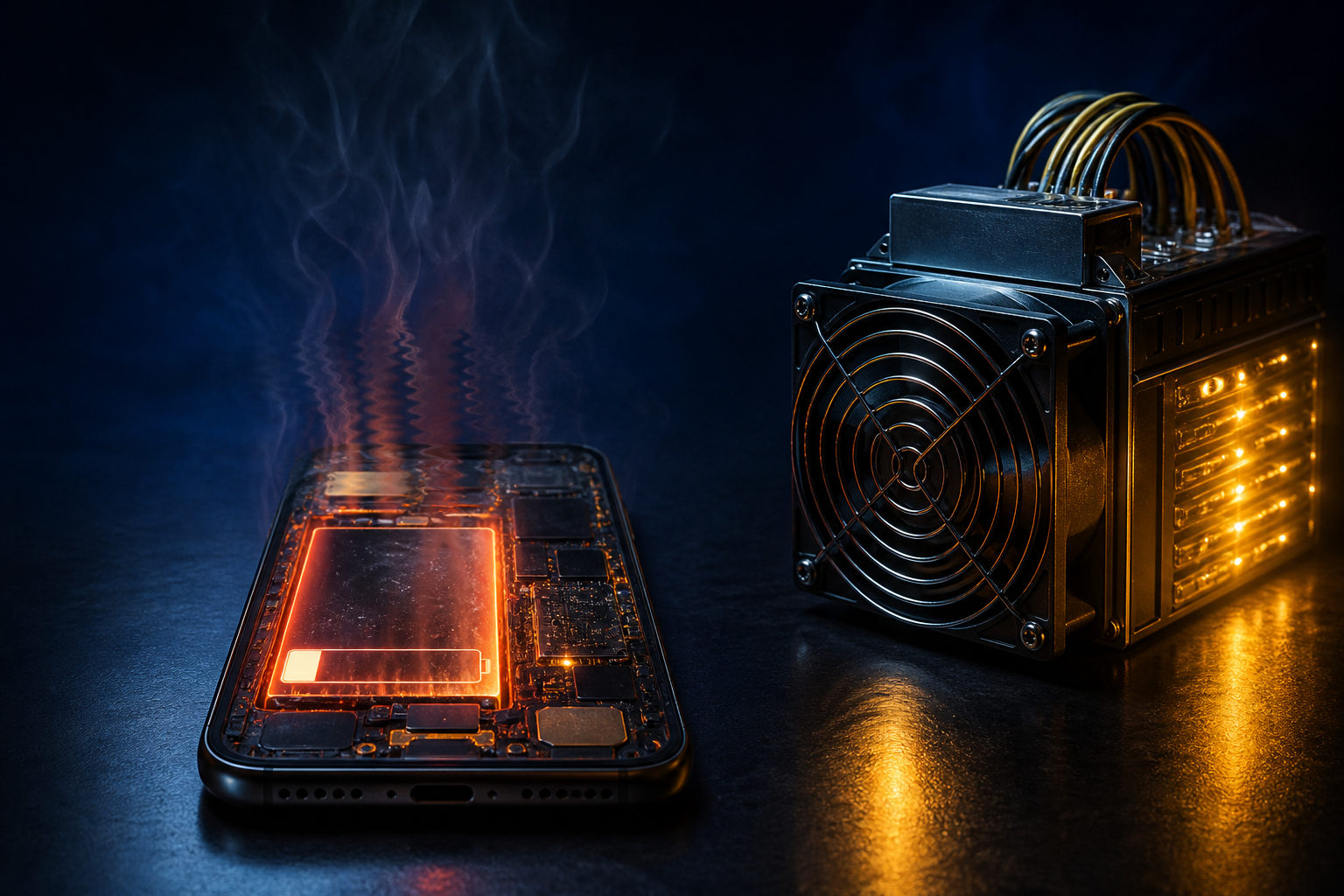
In 2026, mobile Bitcoin mining is usually not profitable. A phone may run mining-related software, but Bitcoin mining itself is a hardware competition, and phones are a weak fit for that job.
Think of mining as a nonstop bookkeeping race
A simple way to understand Bitcoin mining is to picture a race to win the right to add the next page to a public ledger. Miners compete to produce valid work under Bitcoin's rules, and the winner of a new block can receive the block reward plus transaction fees.
The problem for phones is not whether they can calculate anything at all. The real question is whether they can calculate fast enough, efficiently enough, and long enough to compete against specialized machines. In practice, Bitcoin mining rewards sustained performance, power efficiency, cooling, and uptime. Those are not the strengths of a mobile device built for messaging, browsing, payments, and apps.
That is why the answer to “is mobile bitcoin mining profitable 2026” is usually no. Even if a phone can participate at some level, that does not mean it can do so in a way that makes economic sense.
Why Bitcoin mining became a specialized activity
Bitcoin began with the genesis block in January 2009, following the 2008 white paper titled Bitcoin: A Peer-to-Peer Electronic Cash System by the pseudonymous creator Satoshi Nakamoto. The network uses proof of work, which means miners perform computations to compete for the next block. A new block is produced about every 10 minutes.
Once that process became highly competitive, efficiency started to matter more than raw access. A general-purpose device can still perform work, but it has to compete against hardware built for this exact task. Over time, mining moved toward specialized machines because they can do more useful work per unit of power and run in conditions better suited to nonstop operation.
Bitcoin's monetary design also matters here. The total supply is capped at 21 million coins, and the block subsidy is reduced through halvings that occur about every 4 years, or every 210,000 blocks. Halving years so far include 2012, 2016, 2020, and 2024. As rewards decline over time, cost control and hardware efficiency matter even more. That does not make phones stronger candidates; it makes their limits harder to ignore.
“Mobile Bitcoin mining” can mean several different things
Many people use the phrase loosely, but it often points to very different activities. If you do not separate them, it becomes easy to confuse a monitoring app with actual mining.
Using the phone itself to perform mining work
This is the literal meaning. You install software and let the phone use its processor for mining-related computation. On paper, that sounds simple. In real use, the device runs hot, drains quickly, may throttle performance to protect itself, and can become unpleasant or impractical as an everyday phone.
The hidden costs are easy to miss. Battery wear, thermal stress, reduced device lifespan, and weaker day-to-day performance are all real costs, even if they do not show up as a separate line item the first day you try it.
Using a phone to monitor or control mining equipment
Some people say they are “mining on mobile” when the phone is only a dashboard. The phone checks machine status, sends alerts, switches pool settings, or shows account data. The actual computation is happening on dedicated hardware somewhere else.
In that setup, the phone is not the source of mining power. Any profit question depends on the mining hardware, electricity costs, downtime risk, pool terms, and operational stability. The handset is just the control screen.
Cloud mining, reward apps, or point-based systems
Another category uses the language of mining for services that may involve rented hash power, app-based rewards, or task systems built around check-ins, referrals, or in-app activity. Some of these products may not correspond clearly to verifiable Bitcoin mining at all.
That is where transparency matters. A credible mining service should explain where the computing power comes from, how fees are charged, how payouts are calculated, and under what conditions users can withdraw. If a product focuses on easy passive income while avoiding operating details, caution is the right response.
What actually decides whether mobile Bitcoin mining pays off
You do not need price targets or return estimates to judge the economics. The basic structure is enough. Mobile Bitcoin mining tends to struggle because several practical limits stack on top of each other.
- Efficiency: Phones are not designed for Bitcoin proof-of-work workloads. Their performance per unit of power is usually poor compared with specialized machines.
- Heat: Sustained heavy workloads create heat, and heat leads to throttling, weaker performance, and more stress on the device.
- Battery wear: Long periods of charging and high load can age a battery faster and make the phone less reliable for normal use.
- Device depreciation: A phone is a daily-use product. Turning it into a constant-work machine adds wear and shortens its useful life.
- System limits: Mobile operating systems restrict background activity, power use, and resource access. That makes stable nonstop operation difficult.
- Security risk: Untrusted mining apps may request broad permissions or expose users to malware, data theft, or account risk.
Seen this way, the issue is not simply whether you can start. The issue is whether continuing makes sense once all costs, restrictions, and trade-offs are included. For most people, it does not.
If profit is the goal, phones are usually the wrong tool
A lot of interest in mobile mining comes from a reasonable idea: people want a low-barrier way to take part in Bitcoin. The mistake is assuming that mining is the best entry point, or that a phone is a practical substitute for purpose-built hardware.
Phones are useful in the Bitcoin ecosystem in other ways. They are good for learning how wallets work, receiving and sending test transactions, checking confirmations, reviewing fee settings, and practicing backup habits. They are also useful for security tasks such as protecting wallet access and keeping recovery information organized. Those are productive uses of a mobile device in Bitcoin.
If you want to understand mining more deeply, focus on the mechanics instead of the marketing. Learn why miners matter, how blocks are produced, why mining pools exist, how transaction fees fit into miner revenue, and why halvings change the economics over time. Once you understand that structure, many “mine Bitcoin from your phone” claims become easier to evaluate.
It also helps to separate different forms of participation. Buying Bitcoin, holding Bitcoin, using a wallet, running a node, remotely managing mining machines, and buying cloud hash power are all different activities. They may sound related, but their risks and cost structures are not the same.
FAQ
Can a phone still mine Bitcoin directly in 2026?
At a technical level, a phone can run some computation. In practical terms, direct mobile mining is not well suited to Bitcoin's competitive environment, and long sessions can create heat, battery wear, and poor overall efficiency.
Is mobile mining the same as cloud mining?
No. Direct mobile mining uses the phone itself for computation. Cloud mining usually means paying for access to someone else's mining capacity, while the phone acts only as a way to log in and manage the account.
Can a simple app on my phone generate Bitcoin income?
That depends on what the app is actually doing. Some apps are task platforms or promotional systems rather than real Bitcoin mining, so users should check how the service works, what fees apply, and what withdrawal rules exist.
What happens if my phone gets hot and I keep mining?
The device may reduce performance to protect itself, which weakens results even more. Beyond that, repeated heat stress can age the battery faster and make the phone less dependable for normal daily use.
Where should I check the live Bitcoin price?
You can use major market data platforms or established trading services to view live prices. When checking the market, look beyond one headline number and pay attention to volatility, liquidity, and trading costs.
A practical way to judge the idea before you try it
If you are still asking whether mobile Bitcoin mining is profitable in 2026, start with three checks. Can your phone handle sustained heavy use without becoming unstable? Are you comfortable with battery wear and device depreciation? Does the app or service explain its source of computing power, fees, and withdrawal rules clearly?
If any of those answers are unclear, it should not be treated as a dependable profit plan. For most users, a phone makes more sense as a tool for learning Bitcoin, managing a wallet, following the market, and handling security basics than as a serious Bitcoin mining machine.
Disclaimer: This article is for informational and educational purposes only and is not investment, financial, or legal advice. Crypto assets are highly volatile and you could lose your entire investment. Do your own research and decide carefully.