
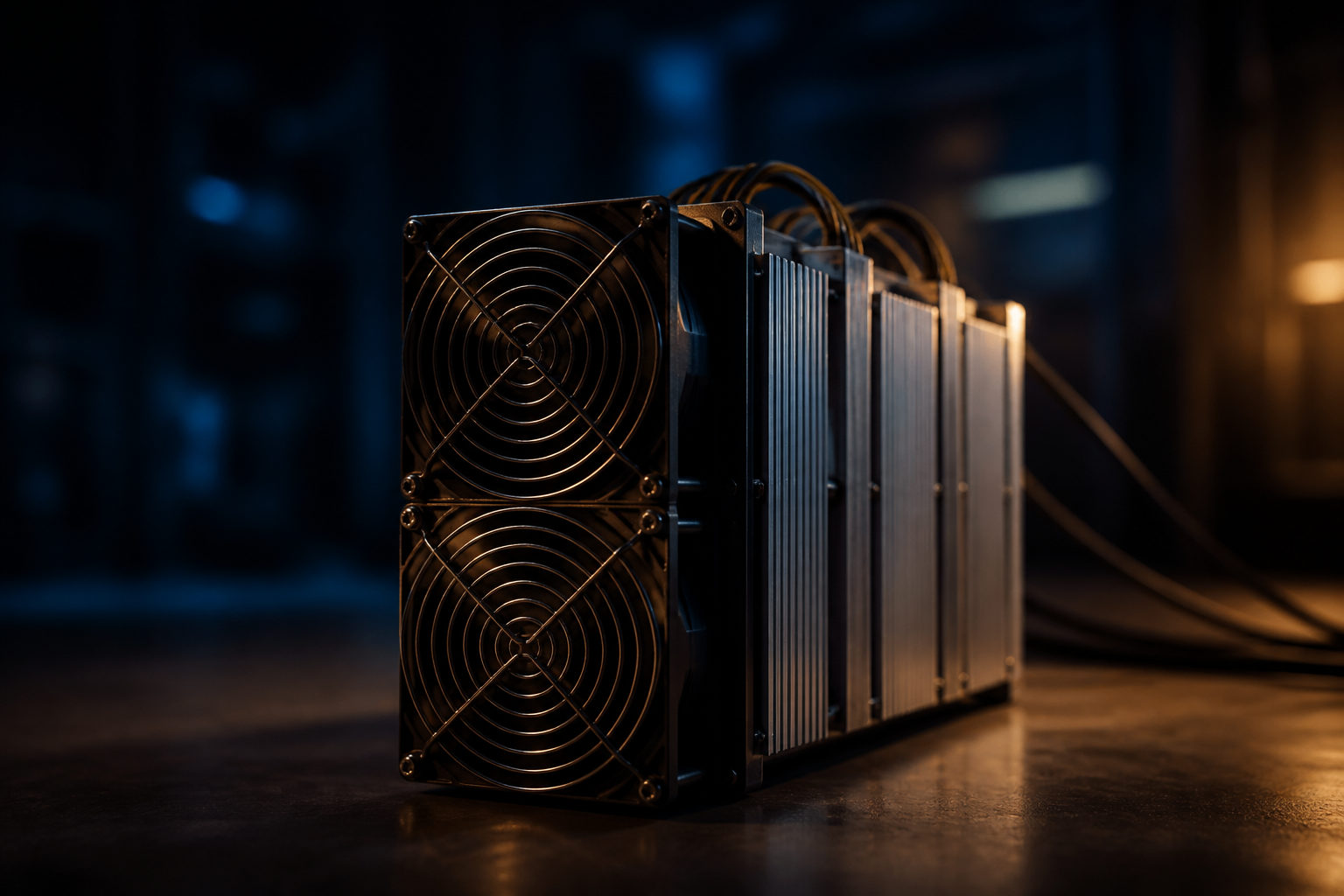
Bitcoin mining is a running contest to record the next block: machines keep hashing, and the first valid result can win the right to add a block to the Bitcoin network and collect the block reward.
What bitcoin mining is actually doing
The word “mining” makes it sound like coins are buried somewhere and pulled out one by one. That image is useful for beginners, but it misses the real process. Miners are not extracting bitcoin from a hidden pool. They are using computing hardware to perform repeated hash calculations in a race for block production.
A simple way to picture it is a bookkeeping competition. People send transactions across the network, and those transactions need to be grouped, checked, and placed into blocks. Miners assemble candidate blocks and keep trying different values until one machine finds a result that satisfies the current difficulty target. If the rest of the network validates that block, it becomes part of the blockchain.
Bitcoin aims for a new block about every 10 minutes. To keep that pace from drifting too far, the network adjusts mining difficulty as total hash power changes. When more machines compete, the race gets harder. When hash power falls, difficulty can adjust downward. For anyone asking about para minar bitcoins, this is the first reality check: success depends on your share of the global competition, not just on whether you can turn on a device.
Miner revenue has two main parts: the block subsidy and transaction fees. After the 2024-04-19 halving, the current block reward is 3.125 BTC. With about 144 blocks per day, the network issues about 450 BTC daily in total. That figure describes the whole network, not what a single miner, home setup, or mining company produces.
Why miners are paid at all
Bitcoin needs a reason for independent operators to spend money on hardware, electricity, cooling, and maintenance. The reward system provides that reason. Miners compete to secure the chain and confirm transactions, and the protocol issues new bitcoin according to fixed rules.
The supply schedule is one of the best-known parts of Bitcoin. Total issuance is capped at 21,000,000 BTC, with the final coins expected to be issued around 2140. The block subsidy is cut in half every 210,000 blocks, or roughly every four years. The halving dates so far are 2012-11-28, 2016-07-09, 2020-05-11, and 2024-04-19, with the next one expected around 2028.
This matters because mining economics change over time even if your machine does not. A setup that made sense in one cycle may look very different in the next. The reward side shrinks on schedule, while competition, fee conditions, and operating costs move on their own.
Mining also adds security. Rewriting old blocks would require enormous computing effort and energy, and an attacker would need to keep up with the chain as new blocks continue to arrive. A broad, competitive mining base makes low-cost interference much harder.
| Term | Meaning | Why it matters for mining |
|---|---|---|
| Block | A batch of confirmed transactions | Miners compete for the right to add the next one |
| Hashing | Repeated calculations to find a valid result | It decides who produces a valid block first |
| Block reward | New bitcoin issued by the protocol | It is 3.125 BTC after the 2024 halving |
| Transaction fees | Fees attached to user transactions | They add to miner income alongside the subsidy |
| Difficulty adjustment | A mechanism that keeps blocks near a 10-minute target | Higher network competition reduces the odds for solo miners |
How people participate in bitcoin mining today
If you read older stories about mining, you may get the impression that a normal computer is enough. That was once closer to reality. Today, Bitcoin mining is dominated by specialized hardware and organized operations. For most people looking up para minar bitcoins, the practical options are very different from the early years.
Solo mining
Solo mining means you run your own hardware and compete on your own. If your machine finds a block, you do not split the block subsidy with a pool. The downside is variance. Results can be extremely uneven, and for small operators the wait for a successful block can be very long.
Pool mining
A mining pool combines the hash power of many participants. When the pool finds blocks, rewards are distributed according to the pool’s rules. This does not increase the total bitcoin issued by the network, but it smooths the payout pattern for individual miners. That is why pool mining is the common route for smaller participants today.
Hosted mining
Some users buy machines and place them in a facility run by a third party. Hosting can solve problems that make home mining difficult, such as noise, cooling, power delivery, and routine maintenance. It also adds dependence on the operator’s uptime, transparency, contract terms, and response to outages.
| Method | Who it suits | Main advantage | Main tradeoff |
|---|---|---|---|
| Solo mining | Operators with strong technical conditions and patience | No pool split if a block is found | Very uneven results and high competition pressure |
| Pool mining | Most individual participants | Smoother payouts over time | Pool fees and dependence on pool rules |
| Hosted mining | People who cannot run hardware at home | Less burden from noise, cooling, and maintenance | Reliance on a hosting provider |
What to check before you try to mine bitcoin
The biggest mistake beginners make is treating mining as a hardware purchase and nothing more. In practice, it is an operating system made of several moving parts: machine efficiency, electricity cost, cooling, noise control, network stability, downtime management, and payout rules.
On hardware, the key point is specialization. Modern Bitcoin mining is built around ASIC miners, which are designed for this specific job. A home PC, gaming rig, or office laptop may run software, but that does not mean it has meaningful competitive value on the Bitcoin network.
Power cost is usually the first hard limit. Mining machines are meant to run continuously, so electricity is not a side expense. Heat comes next. A machine that runs too hot can lose stability, throttle, or stop. Noise is another issue people often ignore at first and then regret later, especially in home environments.
Internet quality matters as well. Mining does not always need huge bandwidth, but it does need steady connectivity. Frequent disconnects, unstable latency, or repeated reconnections can reduce effective work submitted to the pool. A machine that appears active on your side may still be performing poorly from the pool’s point of view.
| Factor | Why it matters | Common beginner mistake |
|---|---|---|
| ASIC hardware | It determines whether you have basic competitive capability | Assuming a powerful PC can fill the same role |
| Electricity | It shapes long-run operating viability | Looking only at purchase cost |
| Cooling and noise | They affect uptime and whether the setup is practical at home | Underestimating heat and sound output |
| Pool rules | They affect fees and payout structure | Joining without reading how rewards are calculated |
| Maintenance | Downtime and faults need attention | Thinking the machine can be left alone indefinitely |
Is bitcoin mining still realistic for an individual?
That depends on your goal. If you want a hands-on way to understand proof of work, block production, pool mechanics, and wallet flows, a small-scale learning exercise can be useful. If you are thinking about running a serious long-term operation, the standard is much higher.
Bitcoin mining has become highly professional. An individual still can participate, but the edge rarely comes from simply owning a machine. It comes from having the right electricity conditions, a workable environment for heat and noise, dependable maintenance habits, and a clear view of downtime risk. Many people do not lack instructions. They lack an honest cost framework.
There is also a separate point that clears up a lot of confusion: you do not need to mine bitcoin in order to own bitcoin. The smallest unit is 1 satoshi, equal to 0.00000001 BTC. That means buying and learning are separate decisions. Once you split those two ideas apart, the question “para minar bitcoins” becomes easier to evaluate in practical terms.
FAQ
Can I mine bitcoin with a regular home computer?
In a technical sense, you can run mining-related software on many computers. In a practical sense, regular consumer hardware has little chance of being competitive on the Bitcoin network today. Current mining is centered on ASIC machines.
Does joining a mining pool make mining safe or guaranteed?
No. A pool mainly changes how payouts are distributed over time, turning rare large wins into smaller and more regular allocations. It does not remove the impact of electricity cost, machine failure, difficulty changes, or pool policy.
Did mining stop making sense after the latest halving?
Mining did not stop, but the conditions changed. Since 2024-04-19, the block reward has been 3.125 BTC, so operators have had to weigh machine efficiency, fees, and ongoing costs more carefully. A single rule change never tells the full story by itself.
Is cloud mining a good shortcut for beginners?
It can look simple because you do not need to install hardware yourself. The harder part is verification. If you cannot inspect the machines, confirm how downtime is handled, or understand the contract in detail, your risk may be harder to judge than with equipment you control directly.
What should I do first if I only want to learn how mining works?
Start by deciding whether your goal is education or long-term operation. If learning is the priority, study blocks, pools, wallets, reward distribution, and equipment requirements before spending money on hardware. That order usually leads to better decisions.
If you are seriously evaluating para minar bitcoins, make a checklist before you buy anything: hardware type, electricity setup, cooling space, pool terms, and how you will deal with outages. Any weak point on that list tends to show up later as operating stress, not as a minor inconvenience.
Disclaimer: This article is for informational and educational purposes only and is not investment, financial, or legal advice. Crypto assets are highly volatile and you could lose your entire investment. Do your own research and decide carefully.