
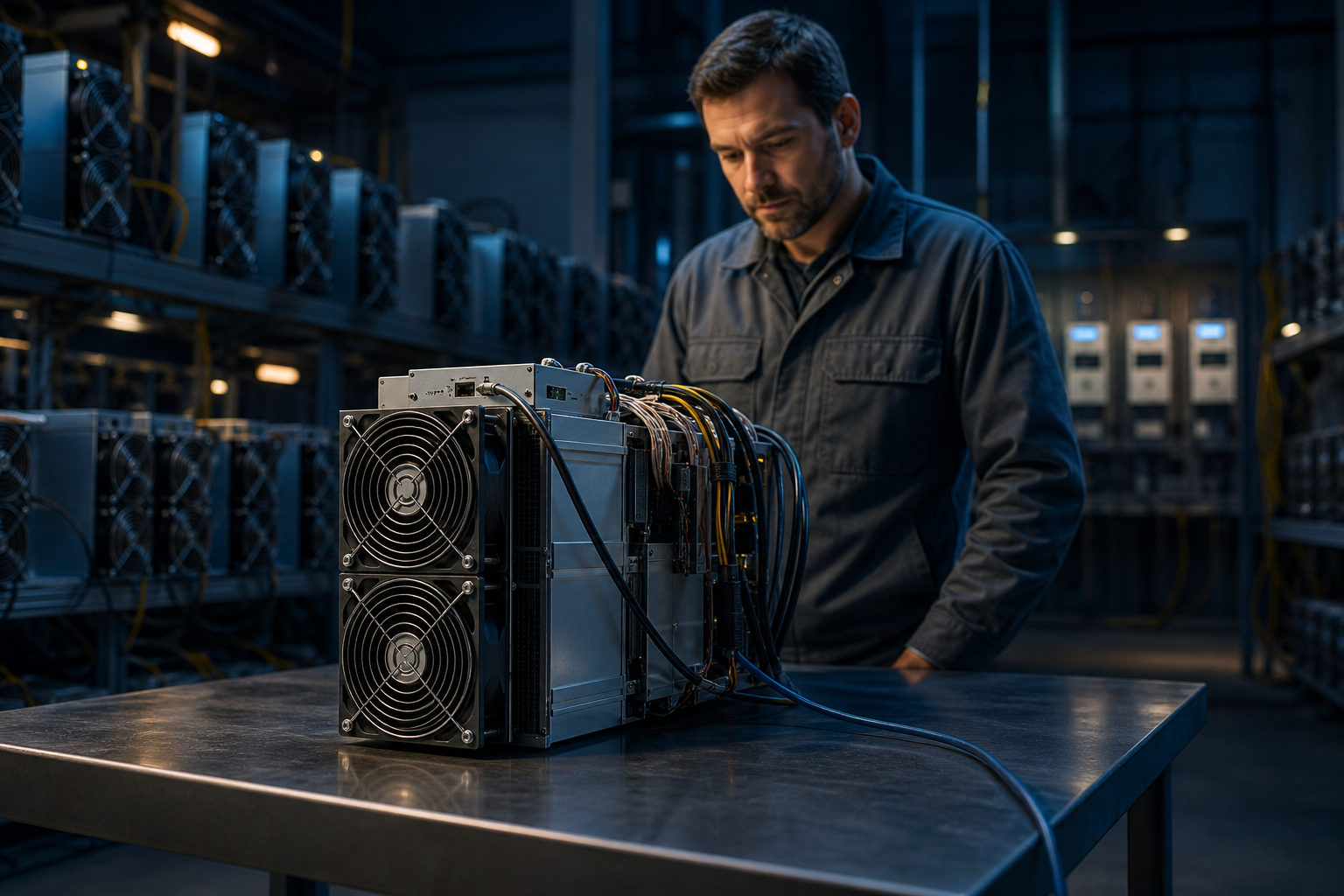
To become a bitcoin miner, you need more than a machine. You are joining a nonstop competition to add the next block, so hardware, electricity, cooling, and daily operation matter as much as interest in Bitcoin itself.
What a bitcoin miner actually does
A simple way to picture mining is to think of Bitcoin as a public ledger that anyone can inspect. New transactions keep arriving, but the network still needs a rule-based way to decide which set of transactions goes into the next block. That is where miners come in.
Miners use specialized machines to perform hashing work again and again until one result meets the network requirement. The miner that finds a valid result first gets the chance to produce the next block. Bitcoin creates a new block about every 10 minutes, so mining is an ongoing process rather than a task you do once in a while.
What you need before you start
Mining is no longer a casual home-computer activity
Many beginners first imagine that becoming a bitcoin miner means downloading software and letting a regular computer run. That view is outdated. In practice, Bitcoin mining is dominated by specialized mining hardware, not ordinary laptops or desktop machines.
The reason is simple: competition is intense, and efficiency decides who stays online and who gives up. If your hardware is far behind, the gap is not small. It changes the whole experience.
You need the right setup around the machine
The machine is only one part of the job. A workable setup also needs stable power, a reliable internet connection, enough cooling, and a place where heat and noise will not become a daily problem. For many people, the location question becomes the real bottleneck.
This is why some first-time miners change their mind after looking at the practical side. A device that runs for long periods will affect the room, the electricity bill, and the amount of attention you need to give it.
Ongoing operation is part of the role
Buying hardware does not make you a functioning miner by itself. Machines can go offline, fans can fail, temperatures can climb, and network settings can break. You need to be comfortable checking a control panel, restarting devices, reading basic status information, and handling maintenance.
That does not mean you need advanced engineering skills. It does mean you should expect mining to behave more like operating equipment than holding an asset in a wallet.
Ways to participate in Bitcoin mining
For most people, there are three broad paths: solo mining, pool mining, and hosting. Each route gives you a different mix of control, complexity, and responsibility.
Solo mining
Solo mining means your machine connects in a way that leaves the result entirely on your side. You keep full control over the setup, but you also take on the full uncertainty. For beginners, this is often the hardest path to justify.
Pool mining
Pool mining is the more common starting point. Instead of working alone, you connect your hash power to a shared system that groups many miners together and distributes results by its own rules. If you are asking "how do I become a bitcoin miner," learning how pools work is usually more useful than thinking about a solo setup first.
Hosted mining
Some people own the machines but place them in a separate facility. This can reduce noise and cooling issues at home, but it adds a new layer of dependence on the hosting provider. You need to pay close attention to machine access, downtime terms, and service conditions.
A practical path for beginners
- Learn the basics first: blocks, hashing, mining difficulty, and the role of pools.
- Check your location for power stability, internet quality, airflow, and tolerance for noise.
- Choose hardware and a power setup that you can realistically maintain.
- Prepare a Bitcoin wallet for receiving mining-related payouts.
- Create a pool account if you plan to join one, then configure the machine correctly.
- Monitor the system after launch, watching for disconnects, heat issues, and error messages.
- Review your ongoing costs and workload before expanding further.
Those steps sound straightforward on paper. The difficulty sits in the day-to-day details, where small mistakes can lead to lost uptime or a frustrating setup.
The cost reality most beginners underestimate
People often focus on the machine and ignore the structure around it. Bitcoin mining usually brings several ongoing demands at once: equipment purchase, electricity use, cooling, maintenance, internet reliability, and the strain that long running hours put on hardware over time.
Electricity deserves special attention because mining hardware is built to run continuously. If power is expensive or unstable, that alone can change whether your plan makes sense. Even without quoting any return figures, it is clear why many people step back after looking at power, heat, and noise together.
You should also understand the halving cycle. Bitcoin has a supply cap of 21 million coins, and the block subsidy halves about every 4 years, or every 210,000 blocks. Halvings happened in 2012, 2016, 2020, and 2024. That does not tell you what your outcome will be, but it does show that mining conditions change over time.
FAQ
What should I do first if I want to start mining Bitcoin?
Start with the rules, not the shopping list. Learn what miners do, how pools work, and whether your power and cooling situation can support a machine for long periods.
Can I become a bitcoin miner with a regular computer?
In most cases, no. Bitcoin mining is built around specialized hardware now, so a standard computer is usually not competitive or practical for sustained operation.
Is joining a mining pool the easiest option?
It is often the most accessible route, but not effortless. You still need to configure the machine, manage wallet details, track uptime, and fix issues when the system goes offline.
Do I need a wallet before I start mining?
Usually yes. A wallet gives you a place to receive payouts or other mining-related distributions, and you should understand backup and security before using one.
Does becoming a bitcoin miner mean passive income once the machine is on?
Not really. Mining equipment needs supervision, and the setup around it matters a lot. If the network drops, cooling fails, or the machine has errors, the fact that it is powered on will not help much.
If you want to move from curiosity to action, make a checklist for location, power, cooling, wallet setup, and pool selection before buying hardware. That order will save you more trouble than rushing to get a machine first.
Disclaimer: This article is for informational and educational purposes only and is not investment, financial, or legal advice. Crypto assets are highly volatile and you could lose your entire investment. Do your own research and decide carefully.