
How to mine 1 bitcoin starts with a reality check: you do not dig up coins one by one. You join Bitcoin’s block-validation race, and any path to accumulating 1 BTC depends on hardware, electricity, operating conditions, and a lot of uncertainty.
What Bitcoin mining actually means
A simple way to picture Bitcoin mining is to think of a nonstop bookkeeping contest. Transactions wait to be confirmed, miners group them into blocks, and machines perform repeated hash calculations to find a valid result under the network’s rules.
When a miner finds that result first, the block can be added to the chain and the miner becomes eligible for the block reward under the protocol. Bitcoin produces a new block about every 10 minutes, and the network adjusts mining difficulty so block production stays near that rhythm even as total competition changes.
That is why the question of how to mine 1 bitcoin often gets framed the wrong way. There is no personal progress meter that fills up until the network hands over a coin; in practice, you either mine blocks on your own or collect smaller shares through a mining pool until those amounts add up over time.
Main ways people take part
Solo mining
Solo mining means you run your own equipment and compete directly against the rest of the network. If you find a block, the reward is yours under the rules of the system, but your chances as an individual operator are usually small compared with larger industrial players.
This makes solo mining highly uneven. Long stretches with no block at all are normal, so the path to 1 BTC can be unpredictable even if your setup runs well.
Pool mining
Pool mining is the route most individuals look at first. A pool combines the computing power of many miners, joins the same block race as a group, and then distributes rewards based on each participant’s contribution.
This does not remove the hard economics of Bitcoin mining. It mainly changes the payout pattern from rare, lumpy wins to smaller and steadier shares, which is easier for many people to manage and understand.
Cloud mining
Cloud mining services advertise a lower barrier by offering rented hash power instead of physical machines at home or in a hosted facility. The sales pitch can sound convenient, but the risks are hard for ordinary users to verify because contract terms, fees, machine ownership, and service quality vary widely.
If you are researching how to mine 1 bitcoin, this is one of the easiest places to make a bad decision. Any offer that makes mining sound effortless while saying little about costs or operational limits deserves extra caution.
What you need before you start
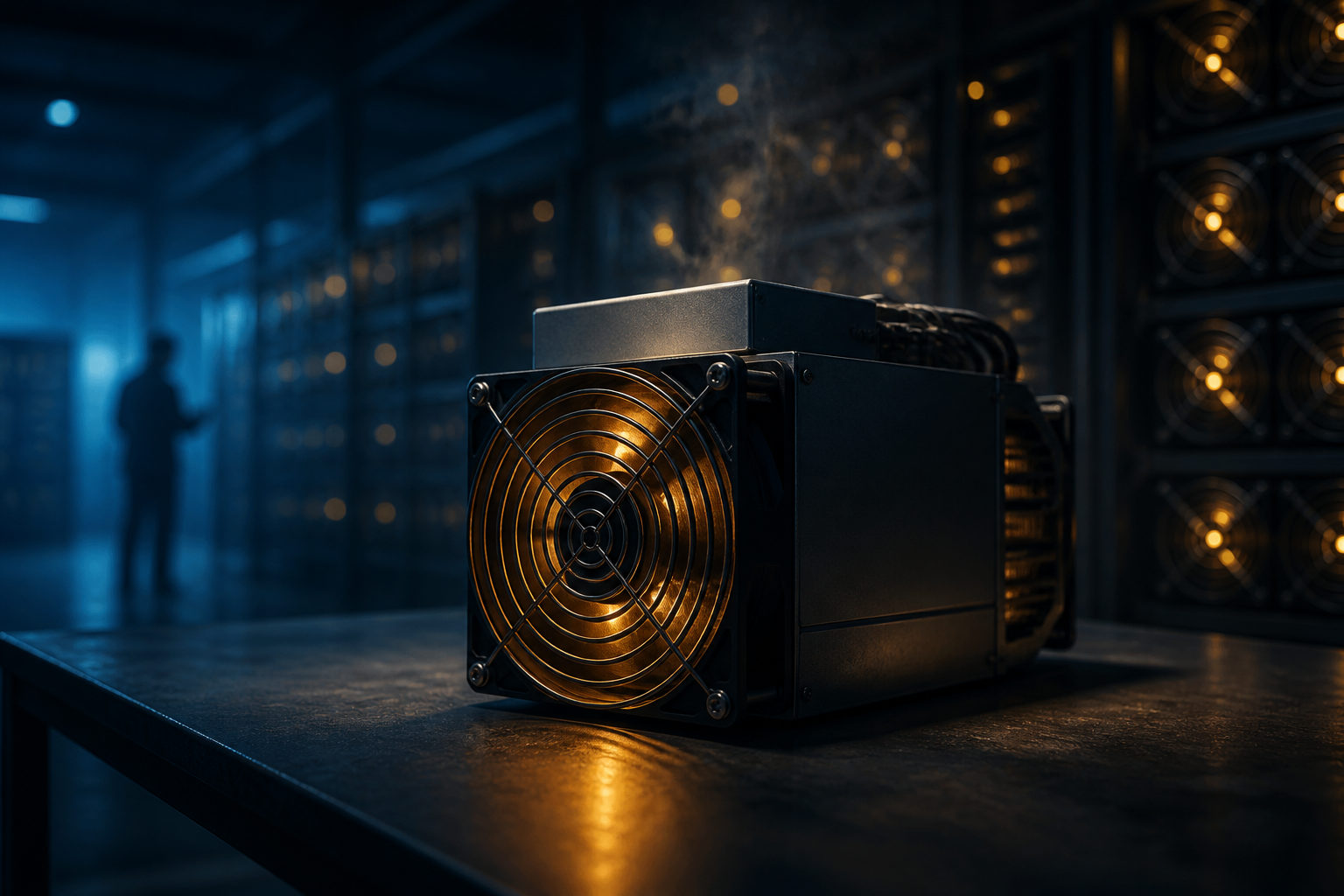
The first requirement is specialized hardware. In current Bitcoin mining, dedicated ASIC machines are the standard. A regular home computer or phone may be able to run software, but that is very different from being competitive on the Bitcoin network.
The second requirement is stable power and heat management. Mining machines run continuously, draw significant electricity, and generate noise and heat. A setup that looks simple on paper can become hard to live with if your space, wiring, airflow, or local rules are not a good fit.
You also need the software side in order. That usually includes machine configuration, pool settings if you join one, a Bitcoin wallet address for payouts, and routine monitoring to catch downtime or errors. The process is learnable, but it is not something to set once and ignore forever.
Security matters as much as hardware. Wallet keys, exchange or pool credentials, and admin access for your mining equipment should all be protected carefully. Some newcomers focus only on machine specs and forget that account security can become the first point of failure.
Why mining 1 bitcoin is harder than it sounds
One reason is supply design. Bitcoin has a maximum supply of 21 million coins, the genesis block appeared in January 2009, and the issuance schedule is built into the protocol. The block subsidy halves about every 4 years, or every 210,000 blocks, with halving years including 2012, 2016, 2020, and 2024.
Another reason is competition. You are not just turning on a machine in an empty field; you are competing with operators that may have better power arrangements, better cooling, stronger maintenance routines, and more experience managing uptime.
A third reason is that people often ask the timing question too early. Instead of asking how long it takes to mine 1 bitcoin, it is more useful to ask whether your setup can stay online, whether your operating costs are manageable, and whether you understand how pool payouts or solo variance work. Those answers shape the outcome far more than a simple timeline.
Costs people tend to underestimate
- Electricity: often the biggest ongoing factor for home or small-scale miners.
- Hardware wear: mining machines age, fail, and lose resale appeal over time.
- Heat and noise: both can make a location impractical even if the machine works well.
- Maintenance time: restarts, network issues, misconfiguration, and downtime need attention.
- Cash flow pressure: upfront spending and later mining payouts may not line up well.
If you are still exploring the topic, it may be smarter to learn the workflow before buying equipment. Setting up a wallet, reviewing how pool dashboards work, and understanding basic machine management can save you from expensive mistakes.
FAQ
Can one person still mine bitcoin today?
Yes, an individual can still participate in Bitcoin mining. The better question is whether your power costs, space, and maintenance capacity make it sensible for you.
Can I mine Bitcoin with a normal computer?
In theory, general-purpose devices can perform the underlying calculations. In practice, standard computers are usually far too inefficient to compete with ASIC miners on the Bitcoin network.
Is it very hard to mine 1 bitcoin alone?
Yes, for most people it is difficult. The challenge is not just setup; it is the mix of competition, running costs, hardware limits, and the uncertainty of finding blocks or collecting enough pooled rewards over time.
Does joining a mining pool make 1 BTC easier to reach?
A pool can make payouts steadier and easier to track. It does not change the basic fact that Bitcoin mining remains competitive and cost-sensitive.
Where should I check the live Bitcoin price?
If price matters to your mining plan, check the live Bitcoin quote on major market data platforms or large trading services. Look at update timing, market depth, and fee details instead of relying on a single displayed number.
Before you spend money, verify three things: you have suitable power access, you have a place that can handle constant heat and noise, and you can secure your wallet and mining accounts properly. That order matters more than chasing the idea of mining 1 bitcoin as fast as possible.
Disclaimer: This article is for informational and educational purposes only and is not investment, financial, or legal advice. Crypto assets are highly volatile and you could lose your entire investment. Do your own research and decide carefully.