
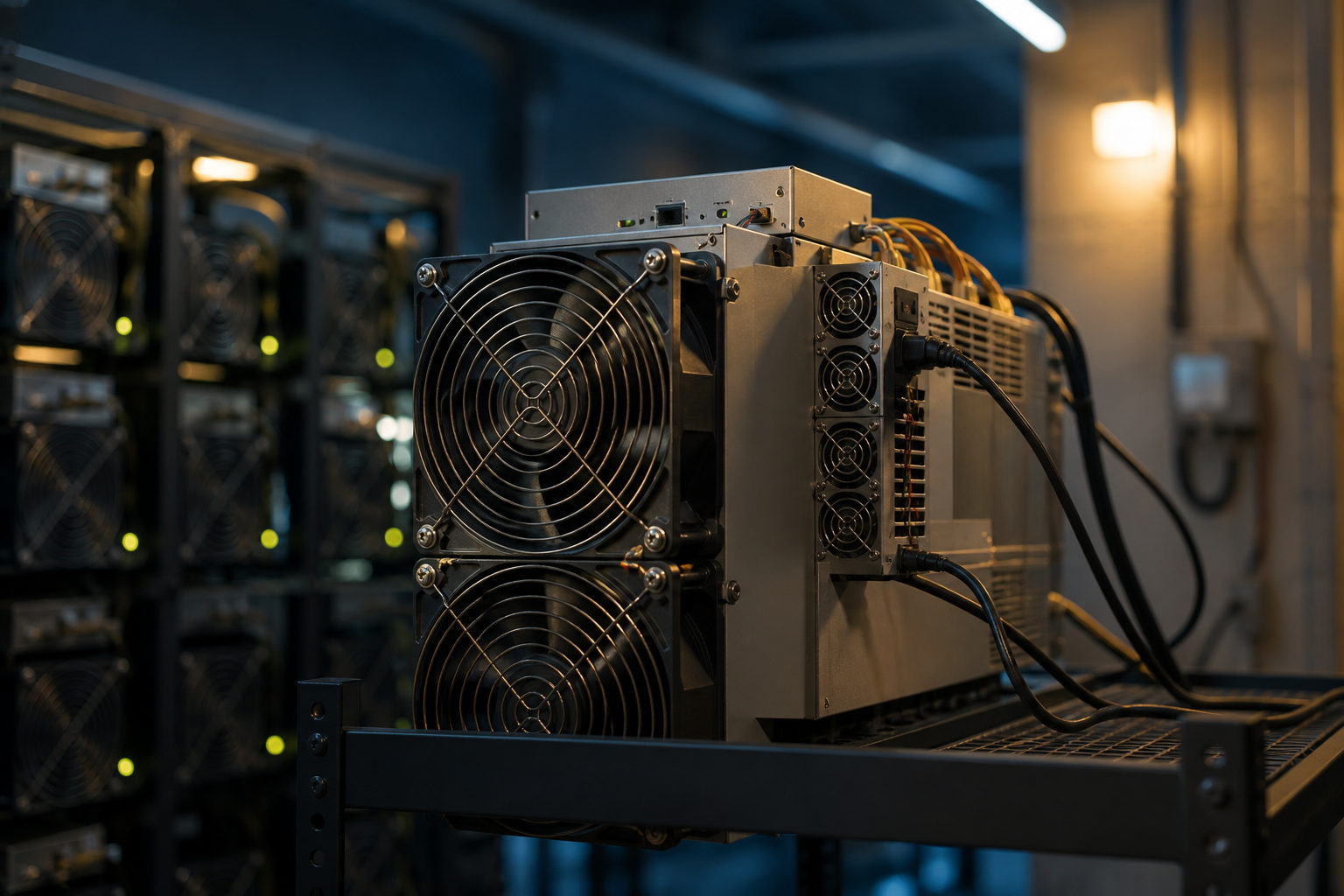
How to mine Bitcoin Cash comes down to this: run compatible mining hardware, connect it to the network directly or through a pool, and compete for the right to add blocks in exchange for block rewards and transaction fees.
What Bitcoin Cash mining actually does
A simple way to picture Bitcoin Cash is as a public ledger that keeps updating. Transactions wait to be confirmed, and miners gather a batch of them into a candidate block. From there, machines perform repeated calculations to find a valid result that the network will accept.
This process uses proof of work. Mining hardware keeps hashing until one participant finds a block header that meets the current difficulty requirement. Once that block is broadcast and validated by other nodes, it becomes part of the chain and the successful miner earns the reward tied to that block.
For a beginner, the useful mental model is a nonstop bookkeeping contest. Your outcome depends on hardware efficiency, electricity costs, uptime, network quality, and the payout rules of the pool you choose.
Main ways to participate
Most people who mine Bitcoin Cash today do it with dedicated ASIC hardware. A regular desktop or gaming PC can still perform calculations, but in real competition it usually cannot match specialized machines built for this task.
There are several ways to join:
- Buy and run your own hardware: You handle the machine, power, cooling, network access, and monitoring yourself. This gives you full control, but it also means more noise, more maintenance, and more operational responsibility.
- Buy hardware and join a mining pool: This is the most common path for individual miners. Pools combine the hash power of many participants, which makes block discovery more consistent and turns highly uneven rewards into smaller, more regular payouts.
- Use a hosting arrangement: Your hardware runs in a facility managed by someone else. That can reduce the burden of onsite maintenance, though you now depend on the operator for uptime, reporting, and payout handling.
If your goal is education, learning how a pool dashboard works will already teach you a lot. If your goal is actual mining, cost planning should come before hardware shopping.
What you need before you start
Compatible mining hardware
Bitcoin Cash uses the same proof-of-work algorithm as Bitcoin, so hardware compatibility is the first check. Spec sheets often highlight hashrate and power draw, but those numbers do not tell the whole story. Long-run stability, replacement parts, repair options, and failure behavior matter just as much once the machine is operating day and night.
A Bitcoin Cash wallet address
You need a wallet address to receive payouts. Some users prefer a custodial setup for convenience, while others choose self-custody so they control the keys. Either way, the payout address has to be entered correctly. A bad address means your mining can continue while the proceeds go somewhere you did not intend.
Reliable network access
Mining hardware has to stay in contact with a pool server or a node. Poor routing, unstable internet service, or frequent disconnects can reduce accepted shares and make your reported hashrate less useful in practice. New miners often focus on the machine and ignore the connection path behind it.
Power and cooling
Mining equipment runs under sustained heavy load. That puts pressure on power delivery, ventilation, dust control, and heat removal. Home setups can look fine during a short test, then run into thermal throttling or noise problems once the machine stays active for long periods.
Pool account and machine settings
When joining a pool, you usually create worker credentials, enter server details, set your payout address, and monitor accepted shares in the dashboard. One common mistake is reading every number as if it meant the same thing. Instant hashrate, average hashrate, and theoretical output describe different parts of performance.
How to choose a mining pool
Many new users compare pools by fee alone, but that is too narrow. The payment method, reporting clarity, server stability, and withdrawal conditions can matter as much as the headline percentage.
| Area to review | What to check | Why it matters |
|---|---|---|
| Payout model | Whether rewards are based on submitted shares or tied more closely to actual block discovery | This affects income variability and payout timing |
| Fee structure | Pool fees and any extra deductions | These change what reaches your wallet |
| Minimum payout rules | What threshold triggers a transfer | This shapes how often funds arrive |
| Server quality | Stability and region options | Latency and disconnects can reduce valid work |
| Dashboard transparency | Whether you can clearly track shares, hashrate, and payments | This helps with troubleshooting and verification |
Pool terminology can be dense. Before pointing your machine at a new service, make sure you understand whether a rule affects rewards, connectivity, or account control. That saves a lot of confusion later.
The cost side is where many beginners get surprised
Mining Bitcoin Cash is an operating business at the machine level, even if you only run one unit. Buying hardware is only the first layer. Electricity, cooling, maintenance, replacement components, downtime, and the time needed to manage the setup all influence whether it remains practical.
Profit conditions also change. Network competition can shift, machine performance can degrade, and hardware can fail at inconvenient times. A used machine may look attractive because the upfront cost is lower, yet worn fans, stressed power supplies, or aging boards can turn a cheap purchase into a stop-and-start headache.
There is also a gap between a machine being powered on and a machine contributing efficiently. Rejected shares, unstable temperature, bad pool settings, and internet interruptions can all reduce real output. Skilled operators watch the full chain of conditions, not just whether fans are spinning.
Solo mining or pool mining
Solo mining means you face the full variance of block discovery on your own. Until your machine finds a block, there may be no payout at all. If a block is found, the reward goes to you. That structure can make sense only for miners with enough hash power and enough patience to handle long dry periods.
Pool mining smooths the experience. You contribute work in the form of valid shares, and the pool distributes earnings according to its method. For most individuals, this is easier to manage because payouts are more regular and hardware performance is easier to interpret through the pool dashboard.
The choice depends on your tolerance for variance, your maintenance ability, and how comfortable you are relying on a third party for payout accounting.
Security should be part of setup, not an afterthought
Your pool account, miner interface, and wallet address form the core of your operating setup. Weak passwords, exposed remote management panels, or a copied address with one mistake can all lead to direct losses.
If you use a self-custody wallet, keep seed phrases and private key control separate from machine administration. Someone who helps you manage hardware does not need authority over withdrawals. If a pool offers extra account protection, turning it on can reduce the chance of a payout address being changed by someone else.
When you set a payout address for the first time or replace an old one, test carefully before treating the configuration as final. A small verification step can prevent a much larger problem.
FAQ
Can I mine Bitcoin Cash with a regular computer?
In theory, a regular computer can take part in the hashing process. In practice, it usually cannot compete well against ASIC hardware, so it is better for learning than for a long-term mining plan.
Do I have to join a pool to mine Bitcoin Cash?
No. You can mine solo if you want. For most individuals, a pool is more practical because it reduces payout variance and makes income arrive on a steadier schedule.
How do I know whether my miner is working properly?
Do not judge by fan noise or power lights alone. Check the dashboard for online status, accepted shares, rejected shares, and connection stability, since those indicators show whether the machine is contributing valid work.
What is the difference between a wallet and a pool account?
A wallet receives and stores your Bitcoin Cash. A pool account tracks your worker activity and calculates what you should be paid based on the pool's rules.
Is home mining realistic?
It can be, but only if you can deal with heat, noise, power quality, and internet reliability. Many home setups fail on the environment side rather than on the software side.
If you plan to try it, start by choosing the wallet you will use for payouts, then review hardware compatibility and pool terms, and only after that decide whether to buy equipment or use hosting. That order helps filter out weak options before they become expensive mistakes.
Disclaimer: This article is for informational and educational purposes only and is not investment, financial, or legal advice. Crypto assets are highly volatile and you could lose your entire investment. Do your own research and decide carefully.