
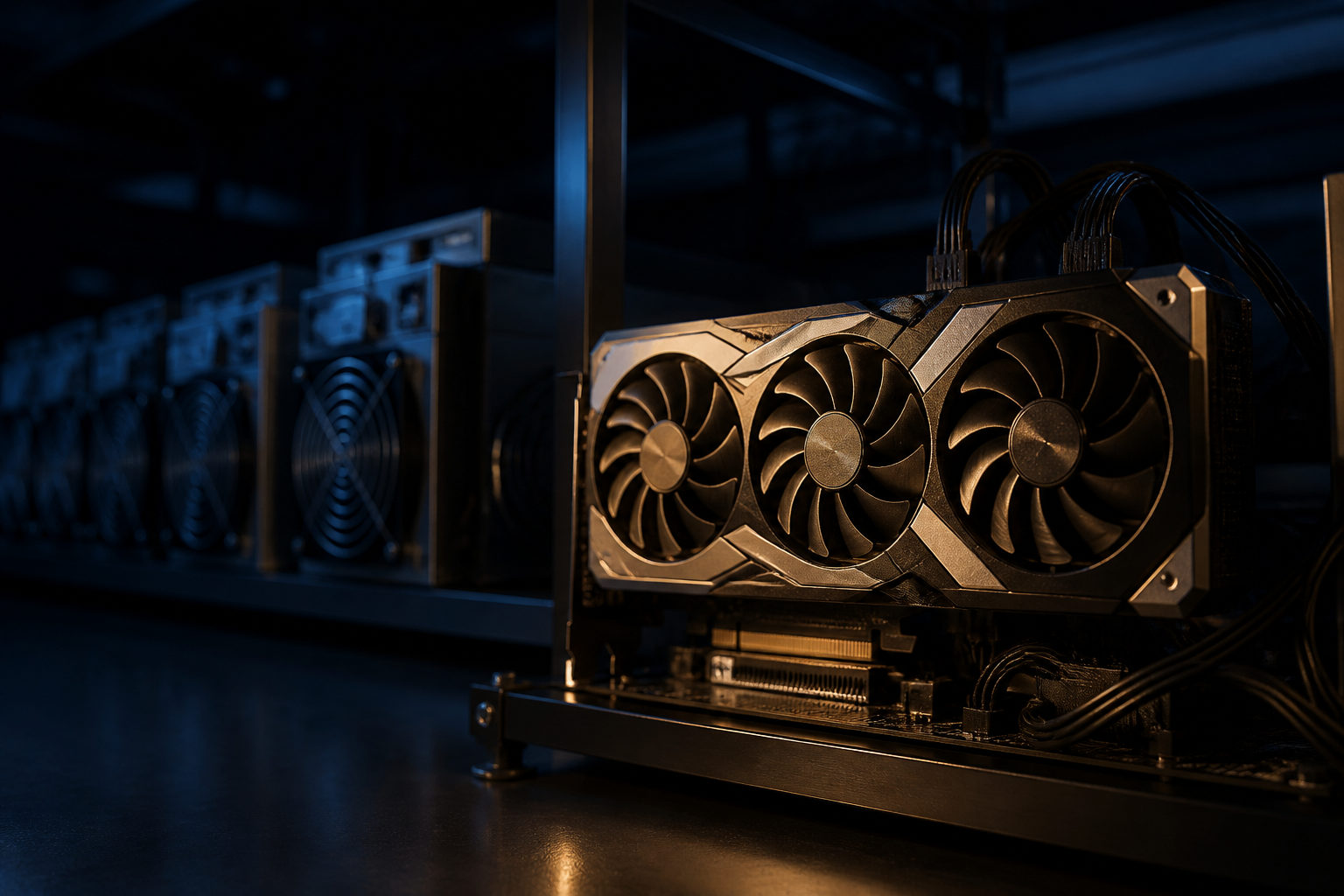
If you want to mine Bitcoin with a GPU, the short answer is this: a graphics card can run mining software, but using it to compete on the Bitcoin network is usually impractical today. For most people, it makes more sense as a learning exercise than as a serious mining setup.
What Bitcoin mining is actually competing for
A simple way to picture Bitcoin mining is to think of it as a nonstop race for the right to write the next page of a shared ledger. Transactions wait in a pool, miners package them into a candidate block, and then machines keep guessing until one produces a result that fits the network’s rules. The miner that finds that valid result first gets to add the new block and claim the block reward plus transaction fees.
This is not a contest of opinion or manual review. It is a contest of computation under a fixed rule set. Bitcoin produces a new block about every 10 minutes, and the difficulty adjusts so that the network keeps that pace even as total computing power changes. Once you understand that, the role of hardware becomes obvious: the more efficiently a device performs this specific task, the better its chance in the race.
Bitcoin’s first block appeared in January 2009, and its creator used the name Satoshi Nakamoto. Mining has two jobs at once. It confirms transactions, and it distributes newly issued bitcoin according to the protocol.
Why GPUs used to matter more than they do now
In earlier stages of mining, general-purpose hardware had a better shot. Over time, competition intensified, and the hardware path moved from CPUs to GPUs and then to ASICs, which are application-specific integrated circuits built for one narrow job. That shift happened because specialized hardware gained a major edge in efficiency for Bitcoin’s proof-of-work process.
GPUs are good at parallel workloads. That makes them useful in graphics, machine learning, and some types of crypto mining. Bitcoin mining, though, became a specialized field. A GPU can still perform hashing, but the real question behind “how to mine bitcoin with a gpu” is whether that effort can compete against dedicated Bitcoin miners already designed around the same task.
| Hardware | Main strength | Real-world position in Bitcoin mining |
|---|---|---|
| CPU | General-purpose computing | Effectively noncompetitive |
| GPU | Strong parallel processing | Can run mining software, but struggles to compete directly |
| ASIC miner | Built for a specific mining algorithm | Standard choice for Bitcoin mining |
That is why the topic needs a reality check. The issue is not whether a GPU can be turned on for mining. The issue is whether doing so still makes sense on the Bitcoin network as it exists now.
If you still want to try, here is what the process looks like
The workflow itself is not hard to describe. You need a computer with a dedicated graphics card, working drivers, mining software, and a wallet to receive payouts. After that, you choose between solo mining and joining a mining pool.
Solo mining means you work alone and only get rewarded if your machine finds a valid block before everyone else. Pool mining combines the work of many participants and shares results according to pool rules, which can make outcomes less erratic for smaller participants. That said, a pool does not erase the hardware gap between a GPU and an ASIC miner.
| Step | What you do | What people often miss |
|---|---|---|
| Check hardware | Confirm the GPU, cooling, power supply, and system stability | Heat and noise grow fast under sustained load |
| Install tools | Set up drivers, mining software, and a wallet | Untrusted downloads can carry malware |
| Pick a mode | Choose solo mining or a pool | Solo mining with small hardware is highly uneven |
| Configure settings | Enter wallet details, device settings, and pool information | Bad settings can produce invalid work |
| Monitor operation | Watch temperatures, uptime, and connection status | A running program does not always mean useful output |
Beginners often mistake visible activity for effective participation. A dashboard may show the GPU working, fans spinning, and shares being submitted, yet that does not automatically mean the setup is competitive in Bitcoin mining. The gap between “it runs” and “it makes practical sense” is the key point here.
What makes GPU Bitcoin mining difficult in practice
The biggest obstacle is not installation. It is economics and infrastructure. Mining is continuous work, so electricity, cooling, hardware wear, and environmental noise all matter. In a home setting, those factors become noticeable very quickly, even before you think about whether the machine has any realistic edge.
There is also the question of opportunity cost. A GPU dedicated to mining is a GPU not being used for gaming, design work, or other workloads. If you need a stronger power supply or extra cooling just to keep the system stable, your setup gets more demanding before it gets more useful.
Security belongs on the same checklist. Mining software can attract fake installers and malware. Wallet software introduces another layer of risk. If someone wants to experiment, the safer approach is to separate the test environment from daily computing, protect wallet credentials carefully, and verify every download source before installation.
| Issue | Why it matters | Effect on a home GPU setup |
|---|---|---|
| Electricity use | Mining runs for long periods | Ongoing operating cost |
| Cooling demand | Sustained load raises temperatures | Can reduce stability and comfort |
| Hardware wear | Components age under heavy use | Maintenance risk grows over time |
| Noise | Fans work harder at high load | Can be disruptive in living spaces |
| Security | Mining tools and wallets are frequent targets | Poor setup can expose funds or devices |
More realistic ways to approach Bitcoin mining today
For a newcomer, a GPU can still have value if the goal is education. It can help you understand wallets, pools, proof of work, device monitoring, and the basic flow of mining software. Used that way, the GPU is a teaching tool.
If the goal is serious Bitcoin mining, the discussion usually shifts toward ASIC hardware and the supporting conditions around it: power availability, cooling design, maintenance, placement, and operating noise. Bitcoin mining is no longer something most people can treat as a casual background task on a spare computer.
Some people look at hosted mining or cloud-style contracts instead. Those models require extra caution. You need clear answers about who owns the hardware, how downtime is handled, how payouts are calculated, and what restrictions apply to withdrawals. If those points are vague, the risk rises fast.
| Approach | Best fit | Main limitation |
|---|---|---|
| GPU experiment | People learning the process | Weak competitive position on Bitcoin itself |
| ASIC mining | People studying serious mining operations | Higher hardware and operating demands |
| Mining pool participation | People who want less uneven results | Still limited by the underlying device |
| Hosted or cloud-style mining | People avoiding hardware management | Transparency and contract risk |
FAQ
Can a home GPU still mine Bitcoin directly?
It can run the relevant software and take part at a technical level. The problem is that direct competition on the Bitcoin network is dominated by specialized hardware, so a home GPU rarely has a practical edge.
Does joining a mining pool make GPU Bitcoin mining viable?
A pool can smooth out how results are distributed, especially for smaller participants. It does not change the fact that the underlying hardware is still much less efficient than dedicated Bitcoin miners.
Should I learn mining with software first or study the basics first?
Start with the basics. If you understand proof of work, wallets, and pool roles before installing anything, the software setup will make more sense and you will spot bad assumptions much earlier.
Is solo mining worth trying with one GPU?
It can be useful as a demonstration of how mining works. As a practical route for competing on the Bitcoin network, one GPU is usually too limited to make solo mining a sensible plan.
If I do not plan to buy an ASIC, is there any point in testing with a GPU?
Yes, if your goal is to learn the workflow rather than build a serious operation. A short test can teach you how wallets, software settings, cooling, and monitoring fit together before you commit to anything larger.
So if your question is whether you can mine Bitcoin with a GPU, the honest answer is yes in a technical sense, but usually no in a practical one. Before you install anything, check power, cooling, software sources, wallet separation, and system security first.
Disclaimer: This article is for informational and educational purposes only and is not investment, financial, or legal advice. Crypto assets are highly volatile and you could lose your entire investment. Do your own research and decide carefully.