
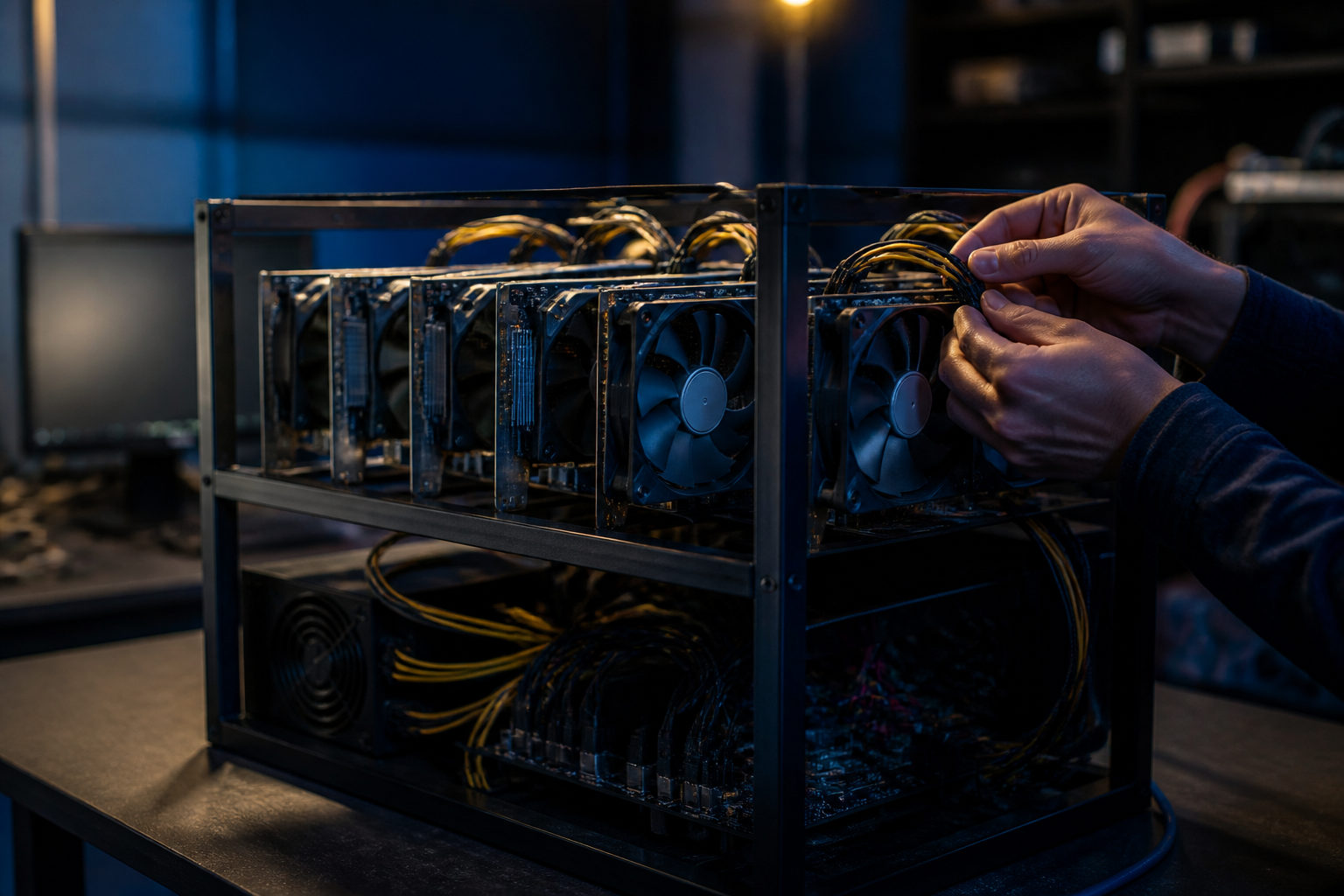
How to make a bitcoin miner starts with a hard truth: you can assemble a setup that participates in Bitcoin mining, but building a competitive miner from ordinary computer parts is not realistic.
Think of a miner as a tool for a bookkeeping race
The Bitcoin network keeps packaging transactions into blocks. Miners compete to process block data over and over until one machine finds a result that meets the network's requirement. The winner gets to publish the next block and claim the related block reward plus transaction fees under the network rules.
This helps to picture mining as a giant bookkeeping race where everyone runs at the same time. Bitcoin produces a block about every 10 minutes, and mining difficulty adjusts with network participation, so a machine does not need only raw computing power. It also needs stable power, steady internet access, and cooling that can handle continuous operation.
When people search for how to make a bitcoin miner, they often mean one of two very different things. One is building a machine or setup that can join the mining process at all. The other is creating a true Bitcoin miner from the chip level up. The first goal is possible for a hobbyist project. The second belongs to specialized engineering and manufacturing.
There are three very different DIY paths
| Path | Can it join Bitcoin mining? | Main difficulty | Best fit |
|---|---|---|---|
| Run mining software on a standard computer | In theory, yes | Very weak efficiency compared with dedicated hardware | People learning the process |
| Build your own environment around existing ASIC hardware | Yes, if you already have a miner or hash boards | Power delivery, cooling, noise, network setup, firmware | Hands-on users who want to deploy gear |
| Design and manufacture an ASIC miner | In theory, yes | Chip design, validation, production, supply chain | Professional teams |
This distinction matters because a Bitcoin miner is not just a powerful PC. Modern Bitcoin mining depends on ASICs, which are application-specific integrated circuits built for a single mining algorithm. You can make your own frame, cable layout, airflow plan, and monitoring system. That still does not replace the specialized silicon that performs the actual hashing work.
So in practice, most readers should interpret DIY as building a mining environment, deploying an existing miner, or modifying the surrounding setup. It usually does not mean inventing a commercially competitive miner from scratch.
What a homemade mining setup actually needs
If your goal is a working Bitcoin mining setup, break it into separate parts. The mining unit handles hashing. The power system keeps the machine fed. Cooling removes heat before it turns into throttling or shutdowns. The network connection lets the miner communicate with a pool. A management interface lets you configure pool details, watch status, and troubleshoot faults.
| Component | Purpose | Common issue in DIY builds |
|---|---|---|
| ASIC miner or hash board | Performs Bitcoin mining calculations | Compatibility, firmware support, hardware source |
| Power supply | Provides continuous electrical power | Connector fit, safety margin, wiring safety |
| Cooling and airflow | Keeps temperature under control | Heat buildup, dust, fan behavior, noise |
| Network connection | Links the miner to a pool | Dropouts, router setup, local network management |
| Control and monitoring | Used for setup, reboots, alerts, and checks | Default passwords, exposed admin access |
A lot of home projects fail after the first successful boot. That is because mining hardware is closer to an always-on appliance than a normal desktop computer. If power fluctuates, temperatures rise, or the network drops, the miner may disconnect, report errors, restart unexpectedly, or run below normal performance.
Noise is another factor many first-time builders miss. Mining hardware often relies on high-speed fans to move hot air out of the machine. Even if your room has enough power and internet access, the sound level and heat output can make a home setup difficult to live with.
A practical build sequence for beginners
Before buying parts, decide what success looks like. Are you trying to understand how Bitcoin mining works, or do you want a machine that stays online for long periods? Those are different projects. A learning build can tolerate inefficiency. A deployment build has to survive day after day without constant manual fixes.
| Step | What to do | What to check |
|---|---|---|
| Define the goal | Choose between learning and long-term operation | Whether you can handle heat, noise, and maintenance |
| Pick a hardware route | Decide on existing ASIC gear or an experimental setup | Whether you have suitable mining hardware |
| Prepare power and internet | Check circuits, outlets, router access, and placement | Whether the device can stay powered and connected |
| Configure pool details | Enter pool server information and worker name | Whether the pool dashboard detects the miner |
| Watch temperature and logs | Review fans, heat, error messages, and uptime | Whether the machine runs without repeated faults |
Another point often missed: solo mining and pool mining are not the same thing. Most individuals join a mining pool, where many miners combine hash power and receive distributions according to the pool's rules. That means your real task after assembly is usually pool setup and stable operation, not competing alone against the entire network.
If you want the project to feel more custom, there are still useful areas to work on. You can improve rack layout, airflow direction, cable management, remote monitoring, or restart automation. Those are meaningful upgrades for usability and maintenance. They do not turn a standard consumer PC into a serious Bitcoin miner.
The biggest mistake: treating DIY as a cheap shortcut
Many newcomers assume that if they know how to build a computer, they can enter Bitcoin mining on the cheap. The hard part sits elsewhere: getting the right hashing hardware, supporting it with safe power and cooling, and managing failures when they happen. A miner that constantly overheats or disconnects is not a working setup in any useful sense.
| Common mistake | Why it causes trouble | Better approach |
|---|---|---|
| Using a normal PC as a Bitcoin miner | Bitcoin mining has long shifted toward specialized chips | Use a PC to learn the workflow, not as production hardware |
| Buying parts before checking the room | Power, cooling, and placement limits may block the project | Inspect the environment first |
| Stopping at the first successful boot | Long-term stability is the real test | Track logs, uptime, temperatures, and disconnects |
| Ignoring security settings | Weak credentials and open admin pages create risk | Change defaults and restrict management access |
If you want to learn how to make a bitcoin miner in a useful way, the best sequence is simple. First, understand the mining process. Next, understand why ASIC hardware dominates Bitcoin mining. Only after that should you spend time on frames, fans, scripts, and monitoring tools.
FAQ
Can I mine Bitcoin with a computer I built myself?
You can use a self-built computer to understand the workflow and test software, but that does not make it competitive for Bitcoin mining. Dedicated ASIC hardware is the standard for serious participation.
What is the most important part of a homemade Bitcoin miner?
The key part is the specialized hashing hardware that performs the Bitcoin algorithm efficiently. Without that layer, the rest of the build is only support infrastructure.
Do I need to watch the miner all day after connecting to a pool?
No, but you do need regular checks. Typical items include online status, temperature behavior, fan operation, and repeated errors in the system logs.
Is a home Bitcoin miner practical?
It depends on your power setup, cooling options, noise tolerance, and available space. A short learning project is easier to manage than a machine intended for continuous operation.
Does designing my own chip count as truly making a Bitcoin miner?
Yes, in the strict sense. It also moves the project into semiconductor design and manufacturing, which is far beyond a normal DIY build.
Before you buy anything, write down your goal, your room limits, and the kind of maintenance you are willing to handle. If you start with a stable basic setup instead of chasing a fully homemade miner, your project is far more likely to work.
Disclaimer: This article is for informational and educational purposes only and is not investment, financial, or legal advice. Crypto assets are highly volatile and you could lose your entire investment. Do your own research and decide carefully.