
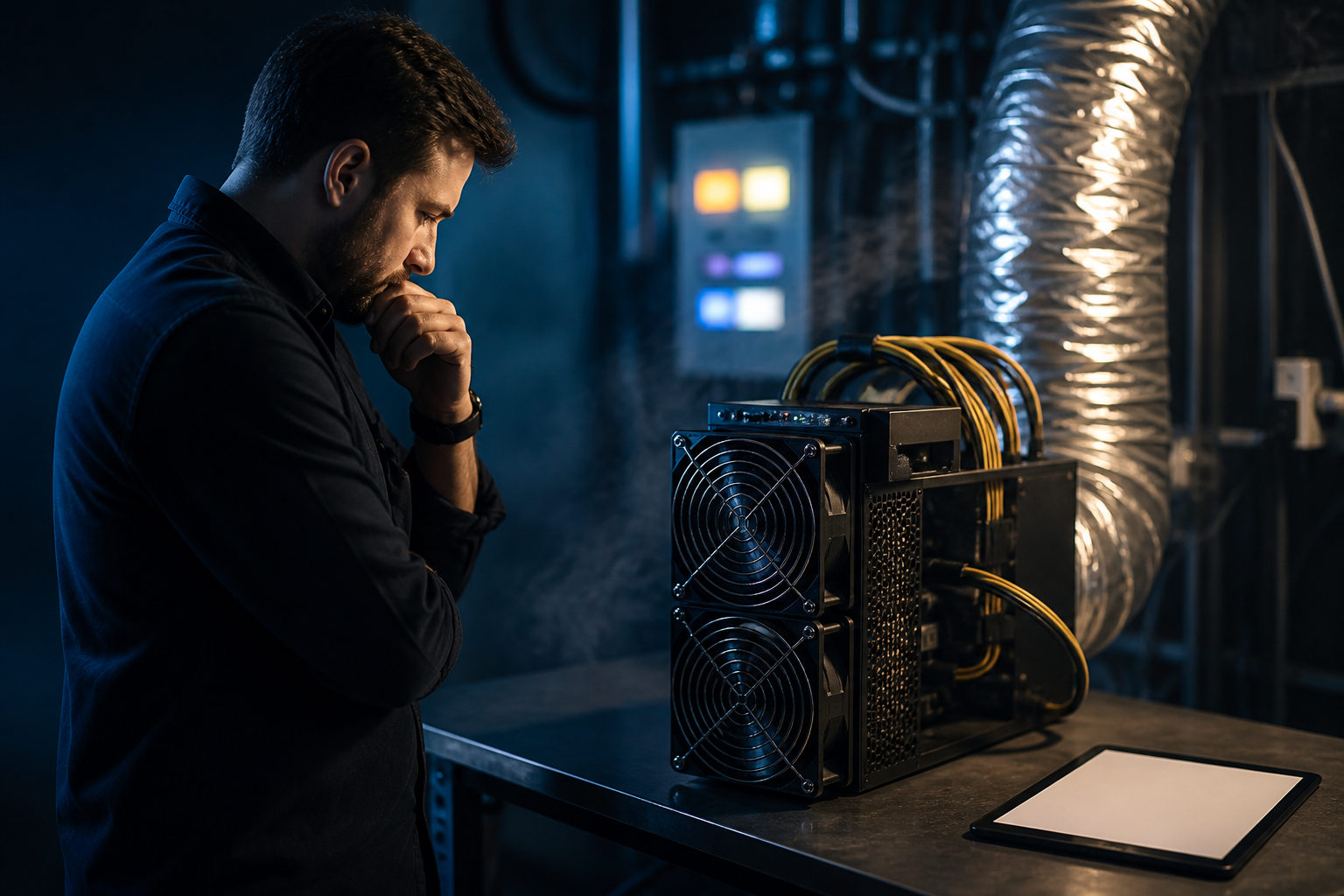
Should I be mining bitcoins? For most people, the honest answer is: only if your power, hardware, space, cooling, upkeep, and cash-flow tolerance all line up. Mining is less about enthusiasm and more about whether your setup can handle a demanding operating job.
Start with the real question: are your conditions a fit?
Bitcoin mining is easy to misunderstand because the headline sounds simple: buy a machine, turn it on, collect BTC. In practice, mining converts electricity, hardware life, and operating discipline into a chance to earn part of the network's fixed issuance. If one part breaks down, the whole plan can disappoint.
The network rules that matter here are stable. Bitcoin targets a new block about every 10 minutes. The block subsidy is cut in half every 210,000 blocks, roughly every four years. Halvings took place on 2012-11-28, 2016-07-09, 2020-05-11, and 2024-04-19. After the 2024 halving, the current block reward is 3.125 BTC, and the next halving is expected around 2028. The network adds about 450 BTC per day at this stage, but that is a network-wide total, not a promise to any individual miner.
| Decision area | Good sign | Warning sign |
|---|---|---|
| Power | You have stable electricity and know how ongoing power costs affect the plan | You cannot clearly estimate or manage continuous power use |
| Space | You have a place that can handle heat, airflow, and constant machine noise | Your home setup is likely to struggle with noise or ventilation |
| Hardware knowledge | You know Bitcoin mining usually requires ASIC hardware | You expect a normal PC to be a realistic long-term option |
| Maintenance | You can deal with dust, disconnects, heat issues, and downtime | You want a zero-maintenance setup |
| Cash flow | You can tolerate uncertain payback and price swings | You need quick and predictable recovery of costs |
What actually drives the decision
Many people focus on price first. That matters, but it is only one layer. Before any mining setup reacts to market moves, it has to survive power bills, heat output, fan noise, hardware aging, and periods when the machine is not running as expected.
Electricity comes first because mining only works while the machine stays on. If power is unstable, expensive, or difficult to plan, your estimates become weak from the start. Two people can have the same view on Bitcoin and still reach opposite decisions because one has workable power conditions and the other does not.
Hardware comes next. In current Bitcoin mining, the standard tool is the ASIC miner, not a gaming PC and not a laptop. Specialized hardware can be effective for one task, but that focus comes with tradeoffs: limited alternate use, sensitivity to newer and more efficient models, and resale value that depends on market conditions.
Then there is the operating environment. Mining machines produce serious heat and noticeable noise over long periods. That is why home mining often fails at the practical level even when the owner is comfortable with Bitcoin itself. If your space cannot manage airflow and heat removal, the problem is not abstract; it shows up in performance, stability, and daily livability.
| Factor | Why it matters | Common mistake |
|---|---|---|
| Electricity cost | It shapes your ongoing operating burden | Looking only at machine purchase cost |
| Cooling | It affects stability and hardware life | Assuming a basic fan setup is enough |
| Noise | It affects your home and nearby people | Underestimating constant machine sound |
| Hardware aging | It affects how flexible your exit can be | Treating miners like durable all-purpose equipment |
| Downtime | It reduces your chance to earn during operation | Assuming the machine will run at full pace all the time |
Mining Bitcoin versus buying BTC directly
When someone asks whether they should mine bitcoins, they are often choosing between two paths: buy exposure to BTC directly, or buy equipment and operate for BTC over time. Both connect you to Bitcoin, but they do not expose you to the same risks.
Direct ownership puts the main pressure on price volatility, custody, and timing. Mining adds a second stack of risk on top of that: machine failure, efficiency loss relative to newer hardware, site limitations, power dependence, and operational mistakes. You are no longer dealing only with an asset. You are running a system.
| Path | Main cost | Main risk | Best fit |
|---|---|---|---|
| Buy BTC directly | Capital to buy and cost of secure custody | Price swings and custody errors | People who want Bitcoin exposure without operating equipment |
| Run your own miners | Machines, power, space, and maintenance | Price swings plus operating and hardware risk | People with workable infrastructure and hands-on capacity |
| Hosted mining | Machines and hosting fees | Dependence on the host's execution and transparency | People without a suitable site who can still do careful due diligence |
That difference matters because some people do not really want a mining business, even a very small one. They want Bitcoin exposure. If that is your actual goal, direct ownership may match it more cleanly.
Questions to answer before you decide
First, can you accept uncertain output? Bitcoin has a hard cap of 21,000,000 BTC, with issuance expected to continue until about 2140, but a fixed issuance schedule does not produce a fixed personal result. The network may target a block about every 10 minutes, yet the share any one miner earns depends on hardware efficiency, how they participate, competition, and uptime. No honest framework can give you a universal daily output number for an individual miner.
Second, are you willing to spend time on upkeep? Mining is not a buy-and-forget activity. Network interruptions, dust buildup, temperature control, power issues, and machine errors all matter. You may not need to work on it every day, but you do need to be ready for periods when attention is required.
Third, what is your exit plan? If the noise becomes too much, the site no longer works, or you simply decide the effort is not worth it, you need to know what happens next. Can the equipment be resold? Is moving it practical? Are you comfortable owning hardware whose value may change for reasons outside your control?
Fourth, are you comparing today's mining with stories from an earlier era? On 2010-05-22, Laszlo Hanyecz used 10,000 BTC to buy two pizzas, a famous early real-world Bitcoin purchase. That story shows how early the network once was; it does not mean today's mining still offers easy participation under light conditions. Modern Bitcoin mining is a contest of hardware efficiency, power quality, and operational discipline.
There is also a basic unit detail worth knowing when reading mining tools or pool dashboards: 1 satoshi is 0.00000001 BTC. That does not tell you whether mining is right for you, but it helps you read payout information without confusion.
FAQ
Can an individual still mine Bitcoin today?
Yes, an individual can still participate. The harder question is whether that participation makes sense under your power, hardware, and space constraints, because those limits often matter more than interest in Bitcoin itself.
Can I mine Bitcoin at home?
Sometimes, but home setups often run into noise, heat, and airflow problems long before they reach a stable routine. If your living space cannot absorb those side effects, the plan may fail for practical reasons rather than financial ones.
Is mining better than just buying BTC?
Not by default. Buying BTC is mainly an asset and custody decision, while mining also asks you to manage equipment, power, and downtime. Which one fits better depends on the kind of risk you are prepared to carry.
Why can't anyone tell me exactly how much Bitcoin I will mine per day?
Because a miner's result is not fixed. Network issuance is fixed at the protocol level, but personal output changes with machine efficiency, participation method, competition, and uptime; the network-wide figure of about 450 BTC per day cannot be used as a personal estimate.
Do I need a specialized miner for Bitcoin?
For realistic Bitcoin mining today, specialized ASIC hardware is the standard route. Treating a normal computer as a serious long-term setup usually leads to a bad decision from the start.
If you are undecided, the best next step is not to rush into an order. Write down your power situation, space limits, noise tolerance, cooling plan, maintenance time, and exit options; if one of those already looks unacceptable, that answer is more useful than any generic pitch about mining.
Disclaimer: This article is for informational and educational purposes only and is not investment, financial, or legal advice. Crypto assets are highly volatile and you could lose your entire investment. Do your own research and decide carefully.