
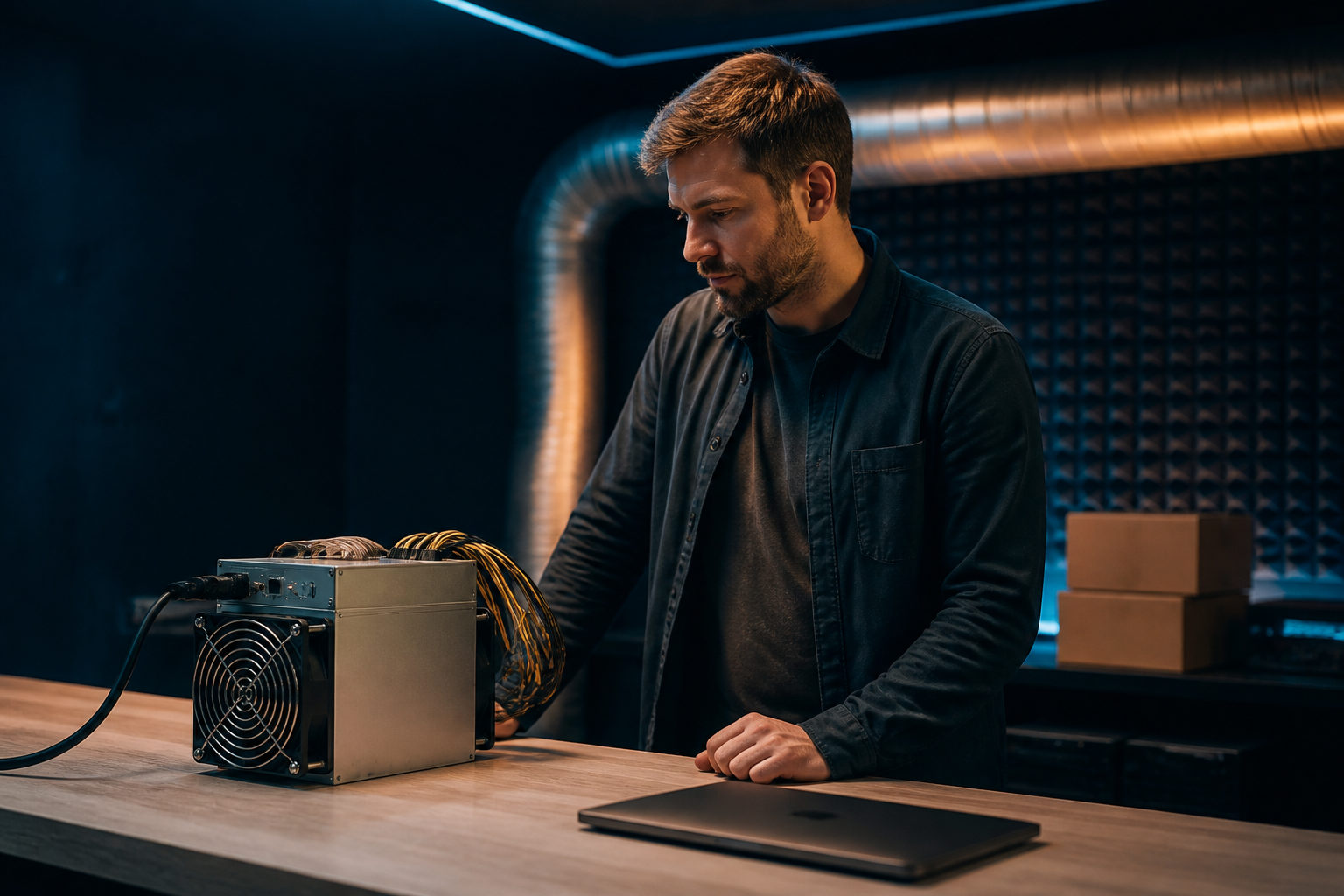
Should I mine for bitcoins? There is no universal yes or no. The useful answer comes from checking your power costs, hardware setup, operating discipline, and tolerance for an uncertain payoff.
Start with the right question
Many people approach bitcoin mining as if it were a simple way to collect BTC with a machine. In practice, mining is closer to running a small industrial process. You are managing hardware, heat, network uptime, pool settings, and ongoing expenses, then hoping the output justifies the effort.
Bitcoin is designed to produce a block about every 10 minutes, and the current block subsidy is 3.125 BTC. That reward does not go to every miner directly; it goes to the miner or pool that finds the block, then gets distributed under the pool's payout method. On a network-wide basis, daily new issuance is about 450 BTC, but that figure applies to the entire network, not to any individual miner.
The subsidy also changes on a schedule. Every 210,000 blocks, roughly every 4 years, the reward is cut in half. The halving dates already passed were 2012-11-28, 2016-07-09, 2020-05-11, and 2024-04-19, with the next one expected around 2028. If you are thinking beyond a short experiment, that built-in reduction matters from day one.
| Situation | Mining may be worth evaluating | Reason for caution |
|---|---|---|
| Power access | Stable electricity, clear billing rules, long-term availability | Uncertain rates, residential limits, unreliable supply |
| Site conditions | Good ventilation, room for heat exhaust, manageable noise | Shared living space, neighbor issues, poor airflow |
| Capital | You can absorb hardware depreciation | You need quick payback or borrowed funds |
| Operations | You can monitor uptime and fix problems | You want a hands-off setup |
| Exit plan | You know when to stop, sell, or relocate equipment | You are only thinking about starting |
The variables that decide the outcome
Power cost sets the floor
For most individuals, electricity is the first hard filter. Mining income moves with network competition and the market value of BTC, while the power bill tends to arrive on a far more rigid schedule. If the electricity side does not work, the rest of the model usually breaks quickly.
This is also where many first-time miners underestimate total cost. The machine itself is only part of the equation. Cooling, fans, power distribution, downtime after outages, and the practical limits of the site all affect the real operating bill.
Hardware is a wasting asset
Mining machines do not age like ordinary consumer devices. Their resale value depends on efficiency relative to newer models, overall market demand, and the condition of the unit after sustained high-load use. A machine that looks acceptable on paper can lose attractiveness fast if a better generation arrives or if the unit has been run under poor thermal conditions.
That is why payback estimates should be treated as moving targets, not promises. The number changes with difficulty, pool rules, machine health, uptime, and your ability to sell the equipment later without a steep discount.
Noise and heat are not side issues
A common mistake is to test whether a miner can be turned on, then assume the site is suitable. Long-term operation is a different standard. Mining hardware can generate substantial heat and noticeable noise, and those two factors often become the real barrier in homes, small offices, or mixed-use spaces.
Dust, cable load, failed fans, and unstable internet connections sound like minor details until they begin to cut into uptime. A setup that is annoying to maintain usually performs worse than its spreadsheet version.
The network adjusts whether you are ready or not
Bitcoin has a hard cap of 21,000,000 BTC, with issuance expected to continue until about 2140. The genesis block was mined on 2009-01-03, following the white paper published by Satoshi Nakamoto on 2008-10-31. For mining decisions, the historical dates matter because they show that issuance is governed by rules rather than operator preference.
Difficulty adjustments and the halving cycle mean your expected output per unit of hashpower is not fixed. You cannot control how much new competition enters the network, how the pool environment changes, or how your machine compares with newer hardware over time.
Cash flow stress often appears before a final profit answer
Some miners focus only on whether the operation might be profitable in theory. A better question is whether the operation can stay manageable while conditions are unfavorable. Electricity, hosting, repairs, and replacement parts can pressure you long before you feel comfortable with the result.
If weak performance over a stretch would force you to shut down at the wrong time, that matters more than an optimistic estimate built on uninterrupted operation.
A practical checklist before you decide
If you want a sober decision process, use a checklist instead of a headline claim. Mining is easier to judge when the operating pieces are laid out side by side.
| Check item | What to verify | If ignored |
|---|---|---|
| Electricity terms | Rate structure, load limits, permission for continuous high usage | Unexpected bills or forced shutdowns |
| Site readiness | Airflow, heat exhaust, noise control, dust management, safety | Thermal throttling, higher failure risk, complaints |
| Internet reliability | Connection stability, recovery after outages, remote access | Lost uptime and weaker results |
| Mining pool terms | Payout method, fees, minimum payout, account security | Mismatch between expected and actual distributions |
| Wallet setup | Address management, backups, separation of access | Operational errors and avoidable confusion |
| Exit conditions | When to stop, when to sell, whether relocation or hosting is possible | Delayed decisions and larger losses |
You also need to decide whether you are considering solo mining or pool mining. For an individual with limited hashpower, solo mining carries very high variance. A pool can smooth the income pattern, but it adds pool-specific rules, account management obligations, and counterparty exposure.
Another useful comparison is mining versus simply buying BTC. If your goal is only to gain bitcoin exposure, mining adds hardware depreciation, operating complexity, and power risk on top of price volatility. Buying spot leaves you exposed mainly to the asset price itself. These are different risk profiles, so one should not be treated as an automatic substitute for the other.
Common errors that distort the decision
The first mistake is treating the network-wide figure of about 450 BTC per day as a personal benchmark. It only describes aggregate new issuance. Your own share depends on hashpower, uptime, pool method, and machine performance.
The second is reading the halving as a simple positive signal for miners. After the 2024-04-19 halving, the block subsidy became 3.125 BTC. Lower new supply may matter for the asset, but for miners it also means fewer newly issued coins are being distributed per block.
The third is underestimating downtime. Projections often assume constant operation, but overheating, fan failures, unstable networking, or local power interruptions can quickly separate expected output from real output.
The fourth is skipping a small-scale trial. Even if you plan a larger setup, a limited test can expose noise issues, site problems, internet weaknesses, and payout misunderstandings before they become expensive.
| Common belief | More accurate view |
|---|---|
| Buying a miner means steady BTC production | The machine is only a tool; results depend on cost control and uptime |
| Halving makes mining automatically better | A lower subsidy can tighten miner economics at the same time |
| If the machine powers on, the site is fine | Long-run suitability depends on heat, noise, wiring, and maintenance |
| Someone else's payback period will apply to me | Your power terms, site limits, and operating quality may be very different |
FAQ
Can a regular person still mine bitcoin today?
Yes, participation is still possible, but suitability is the real question. You need to judge power access, site conditions, and your ability to handle operating problems before looking at potential output.
What should I calculate first before mining bitcoin?
Start with recurring costs, especially electricity and site-related expenses. Those tend to be the least flexible part of the setup and can put you under pressure fast if results disappoint.
Is joining a mining pool the better option for beginners?
For people with limited hashpower, a pool is often the more practical route because income is less erratic. You still need to understand payout rules, fees, and account protection before relying on it.
Does the 2024 halving change the case for mining?
It changes the math that miners have to work with. Since 2024-04-19, the block subsidy has been 3.125 BTC, so any mining plan should be judged under that reward level rather than older assumptions.
If I only want bitcoin exposure, do I need to mine at all?
Not necessarily. Mining and buying BTC can lead to the same asset, but they expose you to different risks. Mining adds operational demands that do not exist when you simply buy and hold.
The most useful next step is not to rush into hardware shopping. Build your own decision sheet first: power terms, heat handling, noise tolerance, internet stability, pool rules, wallet process, and clear stop conditions. If several of those items are still vague, waiting is a disciplined choice, not a missed opportunity.
Disclaimer: This article is for informational and educational purposes only and is not investment, financial, or legal advice. Crypto assets are highly volatile and you could lose your entire investment. Do your own research and decide carefully.