
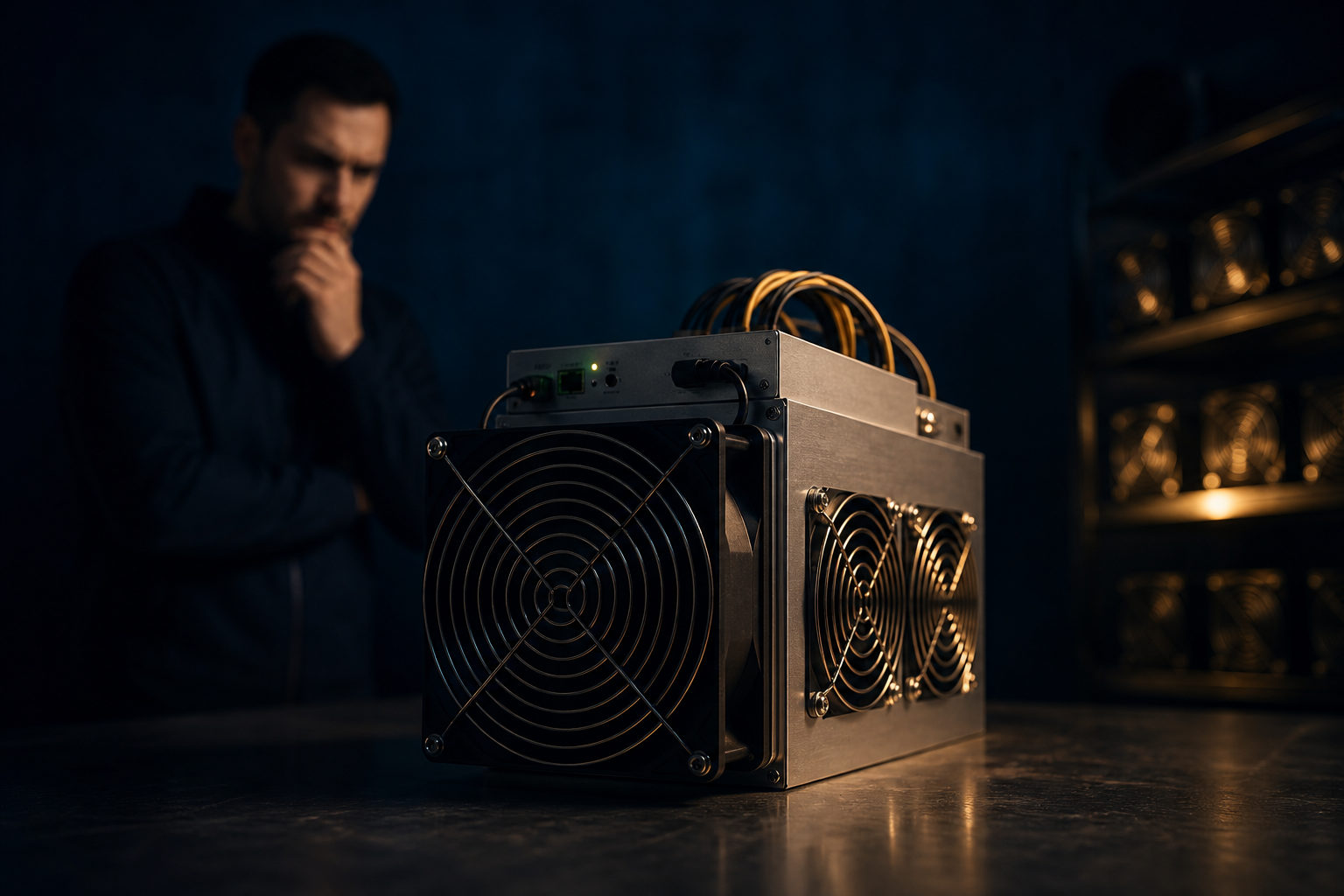
In 2026, solo Bitcoin mining is usually not profitable for most individuals. The main reason is simple: mining is a competitive race to add blocks, and a small operator may wait a very long time to find one, while power, hardware, and maintenance costs keep running every day.
Think of solo mining as a bookkeeping race
A useful way to understand Bitcoin mining is to picture a nonstop bookkeeping contest. The network needs new blocks added to the chain, and miners compete to produce the valid result that lets a block be accepted. The miner that finds that result gets the block reward and transaction fees for that block.
Solo mining means you enter that contest on your own. You do not share rewards with a pool, but you also do not share the variance. That sounds attractive at first because a successful block brings the full payout to one operator. The catch is that success depends on how much of the network's total hash power you control, and most individuals control only a tiny fraction.
Bitcoin produces a block about every 10 minutes on average, but that timing applies to the network as a whole, not to a single machine. A home miner can run for a long stretch without finding a block at all. That gap between expectation and reality is where many people get the economics wrong.
Why profitability is so hard for solo miners
The question is not whether solo mining can ever produce revenue. It can. The real question is whether the odds, costs, and operating conditions make sense for one person in 2026. For most setups, the answer is no.
Start with probability. If your share of total hash power is very small, your chance of finding a block is also very small. Over a long enough period, probability may even out in theory, but individuals do not operate in theory. They operate with monthly bills, equipment aging, and a limited tolerance for uncertainty. If your mining income arrives in rare bursts, but your costs arrive every day, the business can break down long before probability works in your favor.
Then there is the cost stack. People often focus on buying a machine and ignore everything else that follows. Mining also involves electricity, heat removal, noise control, stable internet, power quality, physical space, routine monitoring, firmware management, and the risk of downtime. If you place a machine in a residential setting, the practical problems become obvious very quickly. Heat builds up. Fan noise becomes hard to ignore. Dust and unstable conditions reduce reliability.
Competition adds another problem. Bitcoin adjusts mining difficulty so that blocks continue to arrive about every 10 minutes on average. If stronger or more efficient miners keep joining the network, your share of the race can shrink even if your own machine has not changed. You are not competing with last year's network. You are competing with the miners active at that moment, many of which operate at a professional scale.
What usually decides the outcome
- Hash power share: A smaller share means lower odds of finding a block on your own.
- Electricity cost: High power cost can overwhelm any potential upside.
- Hardware efficiency: Better efficiency matters because mining runs continuously.
- Operating environment: Heat, airflow, dust, and stable internet all affect uptime.
- Risk tolerance: Solo mining can involve long periods with no reward at all.
Solo mining vs mining pools
A mining pool changes the economics by changing the payout pattern. Instead of waiting to find a block by yourself, you contribute hash power to a group. When the pool finds blocks, rewards are divided among participants based on their contribution. You give up the possibility of taking a full block reward alone, but you gain a smoother income stream.
This is why many discussions confuse two different ideas: whether solo mining is possible, and whether solo mining is practical. Yes, it is possible to mine alone. That does not mean it is the right path for a typical individual. Pools exist because they reduce variance, and variance matters a lot when costs are steady but income is uncertain.
There is also a psychological side. A person mining alone may go through a long dry period and conclude that something is broken, even when the system is working exactly as probability suggests. Pool mining does not remove operating risk, but it makes the reward pattern easier to understand and manage.
| Factor | Solo mining | Pool mining |
|---|---|---|
| Reward pattern | Highly uneven, possibly long gaps | More regular, shared by contribution |
| Block discovery | You must find a block yourself | The pool finds blocks as a group |
| Cash flow | Harder to plan around | Easier to manage |
| Best fit | Operators with strong resources and patience | Most individual miners |
| Emotional pressure | Higher during long no-reward periods | Usually lower |
What to check before trying solo Bitcoin mining in 2026
If you are still interested, the right first step is not looking for stories about huge wins. It is building an honest checklist of your own conditions. Solo Bitcoin mining in 2026 only makes sense if your setup is strong enough to handle both the economics and the daily operating burden.
Ask yourself whether you have access to electricity that stays affordable over time, whether your location can handle constant heat and noise, and whether you can monitor and maintain hardware without treating every warning as a crisis. A mining machine is not a passive product. It is part of an always-on system that needs attention.
You should also separate two goals that people often mix together. One goal is education: learning how Bitcoin mining works, how blocks are created, and how miners compete. The other goal is profit. A small setup can make sense for learning. That is very different from building a setup that must pay for itself.
A practical pre-mining checklist
- Define your goal: Are you learning the mechanics of mining, or trying to run a profitable operation?
- List ongoing costs: Include power, cooling, noise control, maintenance, and downtime risk.
- Check the site: Residential spaces often fail on heat, sound, or electrical limits.
- Assess technical ability: You need to handle monitoring, restarts, connection issues, and basic troubleshooting.
- Accept variance: Solo mining is not a fixed-income activity and should not be viewed that way.
For many people, buying Bitcoin directly is simpler than trying to mine it alone. Mining is closer to running a small technical operation than making a straightforward investment. If your goal is exposure to Bitcoin rather than learning or operating equipment, the mining route may be the harder path with no clear advantage.
What changes in 2026 does and does not mean
When people ask whether solo Bitcoin mining is profitable in 2026, they are often asking a deeper question: is it too late to start. The better answer is that timing alone is not the key issue. Bitcoin has a fixed supply cap of 21 million coins. Its genesis block was created in January 2009. New blocks arrive about every 10 minutes on average, and the block subsidy is cut roughly every 4 years, or every 210,000 blocks. Halving years have included 2012, 2016, 2020, and 2024.
Those rules explain how the system works, but they do not make solo mining easier for a small operator. In fact, they reinforce the need to focus on costs and probability rather than on wishful thinking. As conditions across the network change, your own fixed expenses do not disappear. If your setup lacks an edge, solo mining can become a long exercise in paying for uptime while waiting for an event that may not arrive on a useful schedule.
That does not make solo mining pointless. It can still be meaningful for education, experimentation, or for operators with unusual advantages in power, hardware, or infrastructure. It simply means that profitability is not the default outcome for a typical individual in 2026.
FAQ
Can one machine still make money from solo Bitcoin mining in 2026?
It can, but that does not mean it usually will for a typical individual. The main problem is not whether a block can be found, but whether you can absorb the running costs and uncertainty while waiting.
Is solo mining better than pool mining for profit?
Solo mining gives you the full block reward if you find a block yourself. Pool mining usually fits individuals better because it spreads out variance and makes income less erratic.
Does cheap electricity make solo mining a good idea?
Lower power cost helps, but it does not solve everything. Hardware efficiency, uptime, cooling, and your share of network hash power still play a major role.
Is solo Bitcoin mining a good choice for beginners?
Usually not if the main goal is profit. Beginners often benefit more from first learning wallets, nodes, pool mechanics, and basic mining operations before considering a solo setup.
How should I judge profitability if I do not have a price number here?
Check real-time Bitcoin prices on major market data platforms, then compare that with your own operating costs and setup quality. Looking at price alone misses the bigger issue, which is whether your mining operation can survive the waiting time and overhead.
If you plan to try solo Bitcoin mining in 2026, do the hard part first: write down your electricity conditions, space limits, heat and noise tolerance, internet stability, and the amount of uncertainty you can accept. Only after that should you decide whether to mine solo, join a pool, or skip mining entirely.
Disclaimer: This article is for informational and educational purposes only and is not investment, financial, or legal advice. Crypto assets are highly volatile and you could lose your entire investment. Do your own research and decide carefully.