
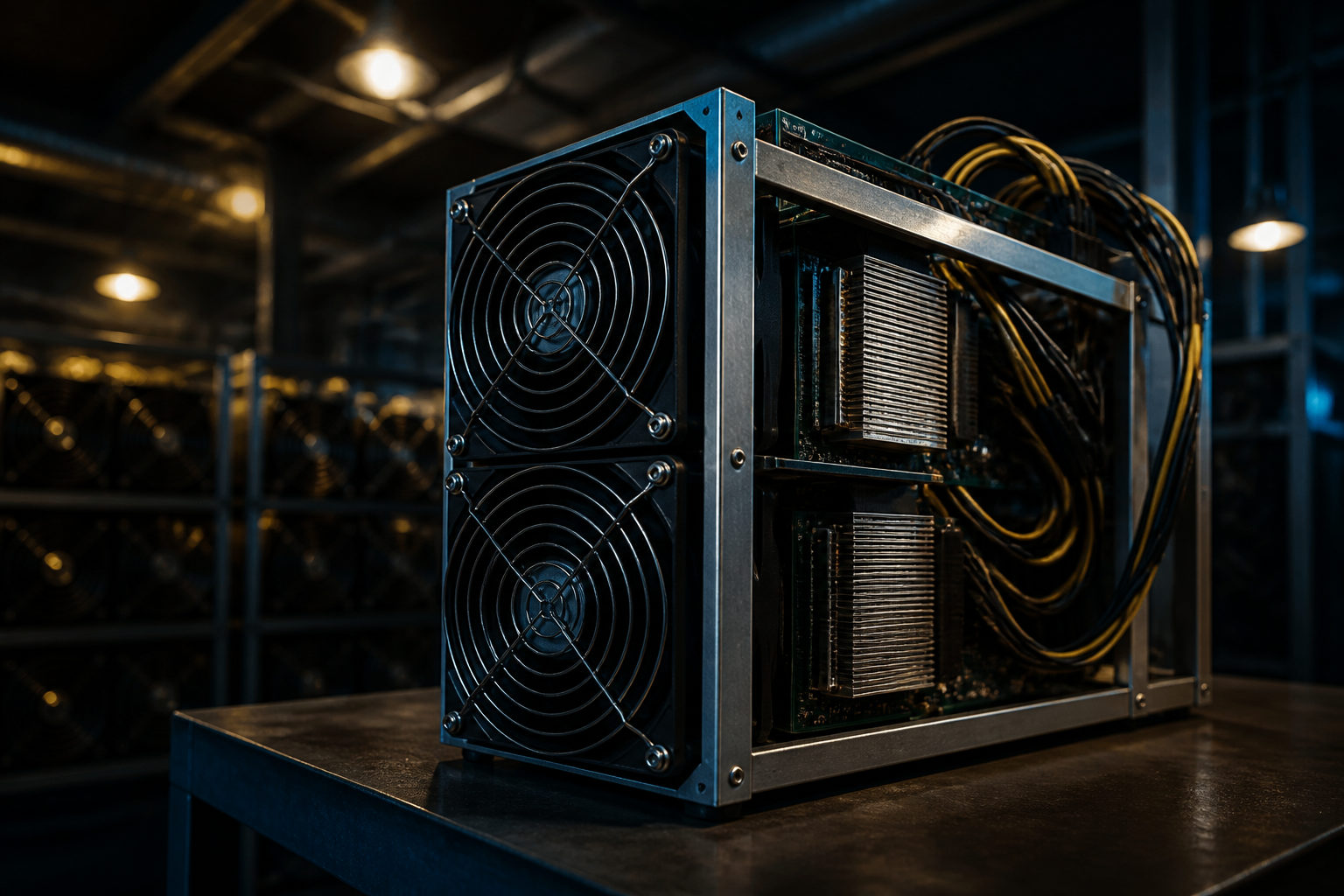
Is it hard to mine bitcoin? For most people, yes. Learning the basic idea is manageable; staying competitive in the ongoing race to add blocks is the hard part.
Think of mining as a nonstop bookkeeping contest
Bitcoin mining is often described as creating new coins, but that framing misses the day-to-day reality. A better starting point is to see it as an open contest to package transactions into a new block and have that block accepted by the network.
Roughly every 10 minutes, the network produces a new block. Miners keep trying candidate solutions, and the system adjusts mining difficulty so block production stays near that pace even when more machines join the competition or hardware gets faster.
Why bitcoin mining is difficult in practice
Many beginners assume the hard part is understanding the technology. In reality, the concept is often easier than the operation. The bigger challenge is turning that concept into a setup that can run steadily under real-world constraints.
| Source of difficulty | What it means in practice | Why it matters |
|---|---|---|
| Network competition | Many miners are trying to win the same block race | You are competing with highly specialized operations |
| Specialized hardware | Serious mining usually relies on ASIC machines | General-purpose computers are usually not efficient enough |
| Electricity needs | Mining equipment must run for long periods | Power conditions shape whether a setup is practical |
| Heat output | Machines generate a lot of heat while operating | You need a way to manage temperature over time |
| Noise | Mining rigs can be loud | A home environment may be a poor fit |
| Maintenance | Dust, connectivity, power issues, and hardware faults can interrupt operation | Downtime means you stop participating in the contest |
| Difficulty adjustment | The protocol keeps block timing near its target | As competition changes, the bar can move with it |
That is why the question should never be reduced to “Can I install mining software?” Software is only one layer. You also need suitable hardware, stable power, acceptable cooling conditions, and a place where continuous noise and heat will not create bigger problems than the mining itself.
Bitcoin’s monetary design adds another layer of context. The total supply is capped at 21 million coins, and new issuance slows over time. About every 4 years, or every 210,000 blocks, the block subsidy is cut in half. The halving years so far are 2012, 2016, 2020, and 2024.
How individuals can still take part
There is a big difference between being able to participate and being well-positioned to participate. Individuals still have several ways to approach bitcoin mining, but each path comes with a different burden.
| Approach | Who it may suit | Main challenge | What to understand first |
|---|---|---|---|
| Run your own ASIC | People willing to handle hardware and operating conditions | Power, cooling, noise, and upkeep all fall on you | This is closer to running equipment than pressing a start button |
| Join a mining pool | People who want a more structured way to participate | You still need hardware and stable operation | A pool changes how rewards are shared, not the physical demands |
| Use hosted equipment | People who do not want machines at home | You must judge the provider, terms, and transparency carefully | Outsourcing operation does not remove risk |
| Study the process only | Beginners focused on understanding bitcoin | It is easy to underestimate operating realities | Knowing the mechanics helps you decide whether to go further |
Mining pools are especially important to understand. A pool lets many miners combine effort under shared rules, which can make participation less uneven than going alone. Still, a pool does not erase the basic hurdles. You must deal with hardware, machine uptime, payout settings, wallet management, and security.
If you are thinking about running a machine at home, start with your environment rather than the setup guide. A space may be technically capable of powering a miner while still being a poor choice once heat, airflow, and sound become daily issues.
The costs beginners often underestimate
When people ask whether it is hard to mine bitcoin, they often focus on buying a machine. That is only the visible part. The larger question is whether you can support continuous operation without the surrounding conditions becoming the real obstacle.
| Factor | Common assumption | Operational reality |
|---|---|---|
| Power | If it plugs in, it should be fine | Stable power access matters just as much as the machine itself |
| Cooling | A fan alone will solve it | Heat management affects both equipment condition and room usability |
| Noise | If I can tolerate it briefly, it is manageable | Constant sound can become the reason a home setup fails |
| Maintenance | Mining can run unattended forever | Cleaning, monitoring, and troubleshooting are part of the job |
| Learning time | Mining is mainly a purchase decision | You also need to learn wallets, payout addresses, and pool settings |
| Exit friction | I can stop at any time with no hassle | Moving, reselling, or shutting down equipment can take effort |
Security belongs in this conversation too. The mining machine is only one piece of the chain. Your wallet, payout address, account login, and recovery material all need careful handling. A weak setup on the security side can create trouble even if the mining hardware itself is working as intended.
For many beginners, the most useful path is to learn in stages. Start with how blocks are produced, then learn what a mining pool does, and only after that look at hardware options. That sequence helps you separate curiosity about bitcoin from readiness to operate mining equipment.
When mining may be a poor fit for a beginner
If you do not have a suitable place for the machine, cannot deal with constant noise, are unsure about power conditions, or do not want ongoing maintenance tasks, mining may not be a sensible first step. Studying the system can still be valuable because mining explains how Bitcoin ties transaction ordering, issuance, and security together.
Bitcoin began with the genesis block in January 2009. Its white paper, Bitcoin: A Peer-to-Peer Electronic Cash System, appeared in 2008 under the name Satoshi Nakamoto, whose identity remains unknown. That background helps clarify why mining is not just about obtaining bitcoin; it is part of how the network secures and updates its ledger.
One more basic term helps beginners read mining and wallet material with less confusion: 1 satoshi is one hundred millionth of 1 BTC. It does not make mining easier, but it helps when you see balances, fees, or payout units discussed in smaller denominations.
FAQ
Can I still mine bitcoin with a regular computer?
In theory, any machine that performs the required calculations can try. In practice, regular computers usually cannot compete well against specialized ASIC hardware, so they are more useful for learning than for serious mining participation.
Does joining a mining pool make bitcoin mining easy?
A pool can make participation more predictable than mining alone because effort is coordinated and payouts follow pool rules. It does not remove the need for hardware, power, cooling, maintenance, or basic security.
Is home bitcoin mining realistic?
It depends less on the setup screen and more on the physical environment. Heat, noise, and power limitations are often the first reasons a home setup becomes impractical.
Is the hardest part the technical setup?
For many people, no. Learning the setup takes effort, but ongoing operation is often tougher because you need to keep the machine running reliably and deal with temperature, dust, connectivity, and power issues over time.
What should I check before deciding whether to try mining?
Start with the basics: space, power conditions, tolerance for noise, and willingness to maintain equipment. Then review wallet security and payout handling, because those details matter once a machine is actually running.
If you want a practical next step, make a short checklist for your own situation: where the machine would go, how heat would be handled, whether continuous noise is acceptable, and whether you want the responsibility of upkeep. Those answers are often more useful than reading one more hardware spec sheet.
Disclaimer: This article is for informational and educational purposes only and is not investment, financial, or legal advice. Crypto assets are highly volatile and you could lose your entire investment. Do your own research and decide carefully.