
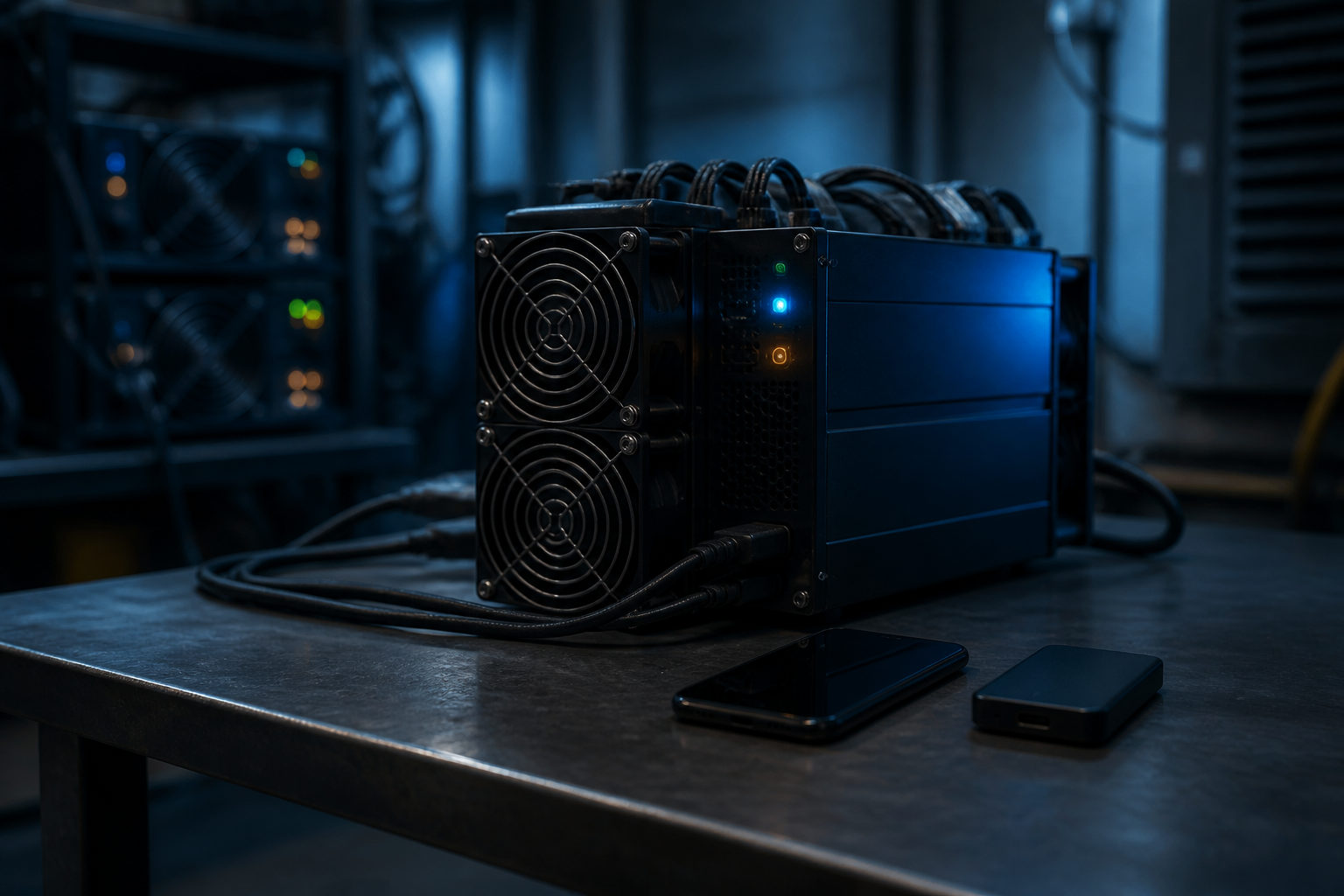
To farm bitcoins, you need specialized mining hardware, reliable electricity, cooling, stable internet, a wallet for payouts, and a practical way to participate, usually through a mining pool. The real barrier is rarely software setup alone; it is the ongoing cost, heat, noise, and maintenance.
Think of bitcoin mining as a nonstop bookkeeping race
A simple way to understand bitcoin mining is to picture a public ledger that anyone can inspect. Miners compete to add the next page of transactions by performing the calculations required by the network’s proof-of-work rules.
When a miner or a group of miners finds a valid block, that block can be accepted by the network, and the successful participant may receive the block reward plus transaction fees. Bitcoin launched with its genesis block in January 2009, and its supply cap is set at 21 million coins.
New blocks are produced about every 10 minutes. The block reward is reduced on a fixed schedule, with a halving about every 4 years, or every 210,000 blocks. That schedule matters because anyone looking into how to farm bitcoins is really deciding whether they can support a competitive operation over time, not just turn on a machine for a weekend.
What do you need to farm bitcoins in practice?
People often expect the answer to start with an app or a website. In reality, the checklist begins with hardware, power, environment, and payout setup. If those pieces do not make sense, the rest of the process will not either.
| Requirement | Why it matters | What happens without it | What to look for |
|---|---|---|---|
| ASIC miner | Provides the hashing power used to compete for blocks | General-purpose devices are not practical for bitcoin mining | Efficiency, stability, service support, noise profile |
| Electricity | Keeps the machine running continuously | High operating pressure or unreliable uptime | Power cost, circuit capacity, electrical safety |
| Cooling and airflow | Removes heat and helps protect hardware | Thermal throttling, shutdowns, shorter hardware life | Ventilation, dust control, room layout |
| Stable internet | Connects the miner to a pool or node | Shares may fail to submit consistently | Connection stability, latency, recovery from outages |
| Wallet | Receives mining payouts | No secure destination for earnings | Self-custody options, backup process |
| Mining pool account | Combines your hash power with others | Solo mining results are highly uneven | Fee structure, payout rules, transparency |
| Monitoring tools | Helps track uptime, temperature, and faults | Problems can go unnoticed for too long | Alerts, logs, compatibility |
Specialized hardware: ASIC miners
If you are asking what you need to farm bitcoins, start here. Modern bitcoin mining depends on ASICs, which are purpose-built machines designed for the hash function used by the Bitcoin network.
A regular desktop, a laptop, or a graphics-card setup may still perform calculations, but that does not make them suitable tools for this job. Today’s bitcoin mining environment rewards hardware efficiency, steady performance, and the ability to run for long periods under heavy load.
When choosing equipment, pay attention to operational factors rather than marketing claims. Buyers usually need to think about efficiency, failure rates, repair options, fan noise, shipping risk, and whether used machines have already seen long periods of wear.
Electricity and site conditions
Mining equipment is only useful if it can run continuously. That makes electricity one of the first practical requirements, not an afterthought. A machine that powers on for testing but cannot be supported by the local electrical setup is not a workable mining plan.
Home miners often run into issues with circuit limits, heat buildup, and constant noise. Even before pool settings or firmware updates enter the picture, a poor site can turn mining into a stop-and-start process full of interruptions.
The environment matters almost as much as the machine itself. If airflow is weak, dust is excessive, or hot air has nowhere to go, temperatures rise and stability tends to suffer. That means more manual checks, more downtime, and more stress on components.
Internet connection and pool access
A miner has to communicate with the outside world. It submits work, receives new work, and stays in sync with a mining pool or node. For that reason, stable internet matters more than headline speed in most small-scale setups.
Most individuals do not mine alone. They join mining pools so their machine’s contribution becomes part of a larger combined effort. In return, payouts are distributed according to pool rules, which makes income timing more predictable than solo mining.
This does not mean every pool is the same. Before you connect any machine, you should understand fee policies, payout thresholds, account security, and how the pool reports accepted work. If you cannot explain how the pool pays you, you are not ready to send hash power there.
Wallet and payout control
You also need a destination for the bitcoin you earn. That means setting up a wallet address before payouts begin. The exact wallet type can vary, but the core question stays the same: who controls the keys, and how is recovery handled?
Some people focus so much on miners and electricity that they treat the wallet as a minor step. That is risky. A wrong address, poor backups, or weak key handling can create bigger problems than a temporary machine outage.
Bitcoin’s smallest unit is the satoshi, with 1 satoshi equal to one hundred millionth of a BTC. You do not need to receive a whole coin at once for a payout to matter, so wallet setup should be done with precision from the start.
Basic operating skill
Mining is not a one-click activity. Machines can overheat, fans can fail, firmware can misbehave, and internet links can drop. Even if you never open the chassis or replace a part yourself, you still need to recognize when a machine is underperforming.
That is why one overlooked answer to the question of how to farm bitcoins is time. Someone has to watch the equipment, check whether hash rate is stable, confirm payouts are reaching the intended wallet, and react when something goes wrong.
Common ways people participate
Not everyone who wants exposure to bitcoin mining should run hardware at home. There are a few common participation paths, and each one shifts the balance between control, convenience, and dependence on third parties.
| Approach | Who it suits | Main advantage | Main challenge |
|---|---|---|---|
| Run your own miner on your own site | People with suitable power and space | High control over hardware and payouts | Heat, noise, maintenance, and local setup |
| Hosted mining | People without a workable site | Less hands-on site management | Trust in the host and contract clarity |
| Join a mining pool | Most individual miners | More regular payout structure | Need to understand fees and payout rules |
| Solo mining | People with special goals or conditions | Full independence | Very uneven results over long periods |
For most individuals, pooling is the practical choice. Solo mining offers independence, but results can be extremely uneven because finding blocks on your own is uncertain. Hosted setups can remove some physical headaches, yet they introduce a different problem: you must trust someone else’s operation, reporting, and service standards.
The biggest mistake: focusing on earnings before costs
When people search for what you need to farm bitcoins, they often mean, “Is this worth it?” Without live market data and your own site-specific costs, no article can give a universal profit answer. What an article can do is help you identify the cost categories that show up almost immediately.
| Cost area | What it includes | Easy to underestimate |
|---|---|---|
| Hardware cost | Miner, cables, power setup, cooling gear | Wear on used machines and repair history |
| Power cost | Ongoing electricity use | Circuit strain, outages, local restrictions |
| Environmental cost | Noise, heat, floor space | Impact on daily living or neighbors |
| Maintenance cost | Cleaning, replacement parts, troubleshooting | Failures after long hot runs |
| Operating risk | Pool policy changes or hosting disputes | Poor contract visibility and weak reporting |
| Security cost | Wallet backups and access control | Misconfigured payout addresses |
Bitcoin mining combines physical infrastructure with digital asset handling. You are dealing with energy use, machine reliability, payout setup, and custody discipline all at once. That mix is why many first-time miners underestimate the project.
If even one of those areas is weak, the whole setup can become frustrating fast. A person may understand bitcoin perfectly well and still be a poor fit for mining simply because their location, power conditions, or tolerance for maintenance do not match the job.
FAQ
Can I use a normal PC to farm bitcoins?
In theory, a normal computer can perform the required type of calculation. In practice, that is not a realistic route for bitcoin mining today because specialized ASIC hardware dominates this activity.
Do I need a mining pool to get started?
You do not strictly need one, but most individuals use a mining pool because solo results can be very uneven. A pool does not remove operating costs; it mainly changes how payouts are distributed over time.
Do mined bitcoins go straight to my bank account?
No. Mining payouts are usually sent to the wallet address you set in your pool or mining management system. That makes wallet setup and address accuracy part of the basic preparation.
Is home bitcoin mining practical?
It can be, but only if your electrical setup, airflow, and tolerance for noise are good enough. Many home attempts fail on site conditions rather than on the mining configuration itself.
What if I am not comfortable repairing hardware?
You can still participate, but you need enough operational awareness to spot problems early. If you use hosted mining, shift your attention to contract terms, reporting quality, and payout control.
Before buying any machine, write down your own checklist: power availability, room ventilation, noise tolerance, wallet readiness, and whether you can monitor the setup consistently. That list will tell you far more about whether you should farm bitcoins than any sales page will.
Disclaimer: This article is for informational and educational purposes only and is not investment, financial, or legal advice. Crypto assets are highly volatile and you could lose your entire investment. Do your own research and decide carefully.