
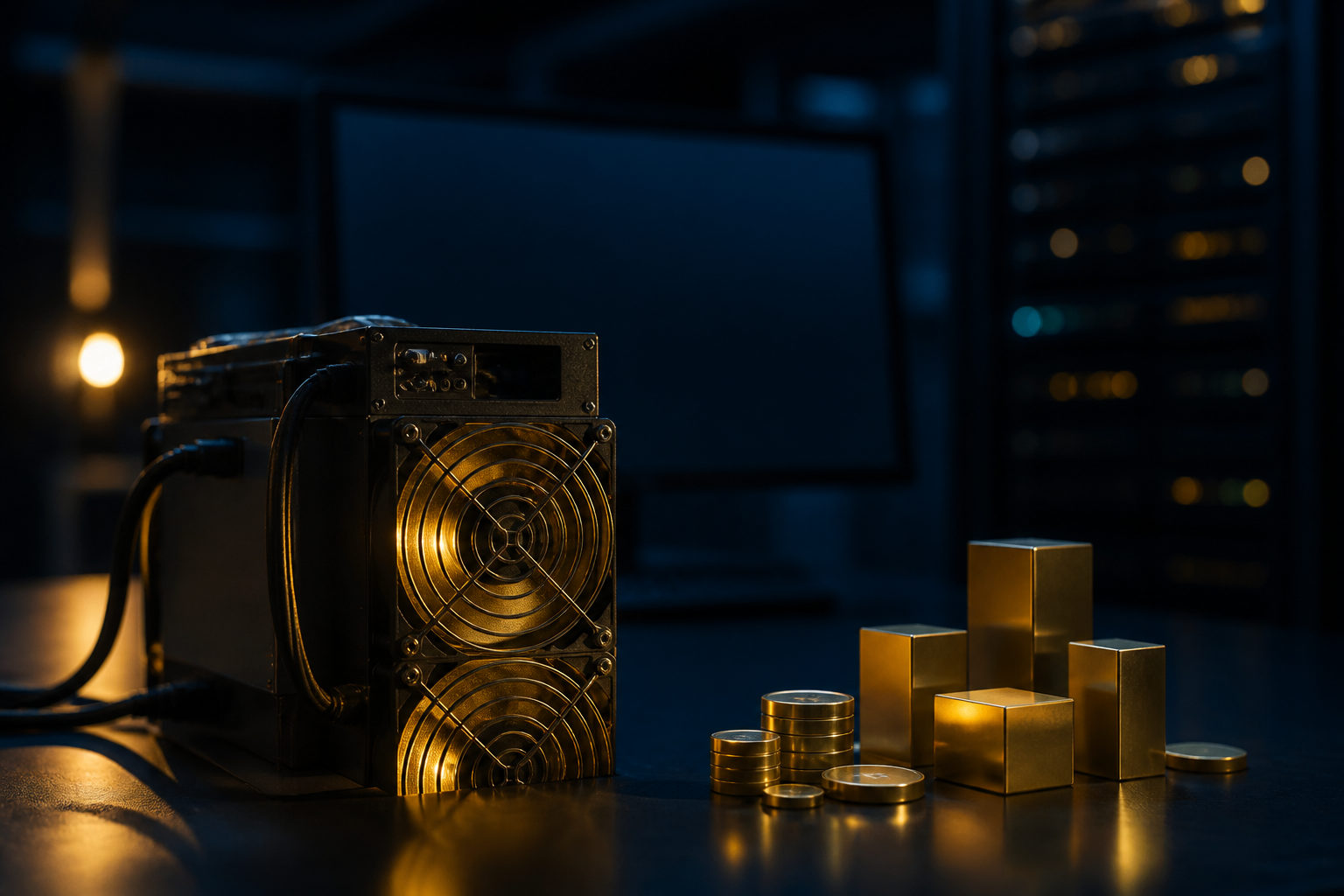
How much bitcoin do you get from mining? There is no fixed amount. The answer depends on how block rewards are shared, how much hash power you control, whether you mine alone or in a pool, and how much your operation costs to run.
Think of mining as a race to win the next bookkeeping slot
Bitcoin mining makes more sense when you stop viewing it as a machine that prints coins on command. A miner is competing for the right to add the next block to the blockchain. If that block is accepted by the network, the winning side receives the block reward and the transaction fees included in that block.
That means your outcome is tied to probability. More hash power usually gives you a larger share of the race, but it does not create a guaranteed payout every day. For most people, the practical question is not whether they can hit one lucky block. It is whether their share of total computing power is large enough to produce meaningful payouts over time.
Bitcoin also has a built-in issuance schedule. The total supply is capped at 2100万枚 in Chinese terms, or 21 million coins. The network produces a block about every 10 minutes, and the subsidy halves about every 4 years, or every 21万 blocks. That schedule matters because the pool of newly issued bitcoin available to miners shrinks over time, so the same setup can lead to very different results in different eras.
What you receive is shaped by several layers of distribution
People often mix up the block reward with their personal payout. Those are two different things. The block reward belongs first to the miner or mining pool that finds the block, and only then is it divided according to the rules of that setup.
| Layer | What it controls | Why it matters to your payout |
|---|---|---|
| Bitcoin protocol | New coin issuance and fee income | Sets the total reward available to miners |
| Network competition | Your share of total hash power | Affects your chance of earning rewards |
| Mining method | Solo mining, pool mining, or hosted models | Changes payout frequency and volatility |
| Pool policy | How shares are counted and fees are charged | Determines how much of the reward reaches you |
| Operating costs | Electricity, cooling, repairs, depreciation | Decides whether gross payout becomes real profit |
Your mining income usually comes from two sources: the block subsidy and transaction fees. Fees can vary with network activity, so even within the same halving cycle, payouts may move around. That is one reason why screenshots of a single day or a single payout are weak evidence.
For most individuals, the main issue is not the reward written into the protocol. It is the slice of that reward they can actually claim after the pool applies its rules. In pool mining, your role is to contribute valid work, usually measured through shares. The pool turns many small contributions into a larger combined chance of finding blocks, then distributes the proceeds.
Solo mining, pool mining, and cloud contracts do not work the same way
If you ask how much bitcoin mining gives you, the first follow-up should be how you plan to participate. The answer changes a lot depending on the route.
| Method | Who tends to use it | Payout pattern | Main drawback |
|---|---|---|---|
| Solo mining | Operators with large hash power and technical control | Rare but concentrated payouts when a block is found | Very high variance |
| Pool mining | Most individual miners | Smaller, more regular distributions | Pool fees and rule dependence |
| Cloud or hosted contracts | People who do not want to run hardware | Based on platform or contract terms | Counterparty risk and limited transparency |
Solo mining can look attractive because the full block reward and fees go to the successful miner. The problem is that success may be infrequent for smaller operators. You could wait a long time with nothing to show. Pool mining smooths that experience by giving you a share of collective output, which is why it is the standard route for most retail participants.
Cloud mining needs extra caution. The pitch is often simple: pay for access, skip the hardware hassle, collect bitcoin. In practice, the important questions sit in the contract details. Who owns the machines? What happens when equipment goes offline? Can the provider change terms, stop service, or suspend payouts? A polished sales page does not answer those points by itself.
The biggest gap often comes from costs and uptime, not the machine label
New miners tend to focus on one thing first: the device. Hardware matters, but it is only one part of the picture. The amount of bitcoin you receive is heavily affected by whether the machine can run consistently, whether electricity is affordable, and whether the site can handle heat, noise, and maintenance.
| Factor | Why it matters | Common mistake |
|---|---|---|
| Hash power | Defines your share of the competition | Looking only at headline specs |
| Electricity cost | Directly affects net outcome | Ignoring all-in power and facility expenses |
| Cooling and environment | Heat and dust can reduce performance and lifespan | Treating a home setup like a professional site |
| Pool rules | Shape distribution timing and deductions | Reading only marketing claims |
| Downtime | No work means no reward share | Underestimating repairs, outages, and disconnects |
This is where many expectations break down. A dashboard can show incoming bitcoin while the operation still struggles after power bills, wear and tear, and machine failures are counted. Mining output and mining success are related, but they are not the same measurement.
Bitcoin began with the genesis block in 2009年1月, and the system was designed so anyone could verify the rules. That does not mean anyone can mine efficiently under any condition. Modern mining is specialized. If you treat it as a casual side activity that works on a home computer, your estimate of how much bitcoin you will get is likely to be far too high.
How to estimate your own result before spending money
If you want a realistic answer, start with your own constraints instead of somebody else’s payout screenshot. Work through the setup in order. First review power access, then hardware, then the site conditions, and after that compare pool policies and withdrawal rules.
| Step | What to check | Warning sign |
|---|---|---|
| Power | Stable supply and manageable cost | Frequent outages or restrictive site limits |
| Hardware | Source, reliability, repair plan | Buying on price alone |
| Operating site | Cooling, noise, dust, network quality | Conditions that prevent continuous runtime |
| Pool choice | Fee structure, payout method, withdrawal terms | Vague or hard-to-verify rules |
| Exit plan | Ability to stop, switch, or resell equipment | Capital gets stuck with no easy way out |
Once you review those points, mining calculators and pool dashboards become more useful. Without that context, the same machine can look profitable in one situation and disappointing in another. The difference may come from power cost, downtime, or a pool policy that takes more off the top than you expected.
It also helps to remember that bitcoin is divisible. The smallest unit is the satoshi, and 1 satoshi equals one hundred millionth of 1 BTC. That is why pools can distribute very small amounts instead of waiting for whole-coin payouts. Small credits are normal in pooled mining, especially for individual operators.
FAQ
Can an individual still get bitcoin from mining today?
Yes, but the path is usually through a mining pool rather than solo mining. Individuals can still receive bitcoin, though the result depends on their hash power share, costs, and whether they can keep equipment running steadily.
Does a daily pool payout mean mining is profitable?
No. A payout only shows that your contributed work was counted and rewarded under the pool’s system. Profit depends on what remains after electricity, hardware wear, repairs, and other operating expenses are considered.
Can I mine a meaningful amount of bitcoin at home?
That depends less on the room and more on the conditions. If your power setup, cooling, noise tolerance, and uptime are poor, the effective output can drop quickly even if the machine looks fine on paper.
What changes after a halving?
The new bitcoin created per block is reduced, so the newly issued portion of miner revenue becomes smaller. Whether your own payout changes sharply also depends on fees, competition, and the efficiency of your setup.
Why do pool payouts often look tiny?
Pool mining divides total rewards among many participants, so your share can be small but frequent. Because bitcoin can be split into satoshis, pools can credit fine-grained amounts instead of waiting for large lump sums.
If you want to know how much bitcoin you may get from mining, start with a full cost and uptime review. That gives you a better answer than any headline claim, any sales pitch, or any isolated payout screenshot.
Disclaimer: This article is for informational and educational purposes only and is not investment, financial, or legal advice. Crypto assets are highly volatile and you could lose your entire investment. Do your own research and decide carefully.