
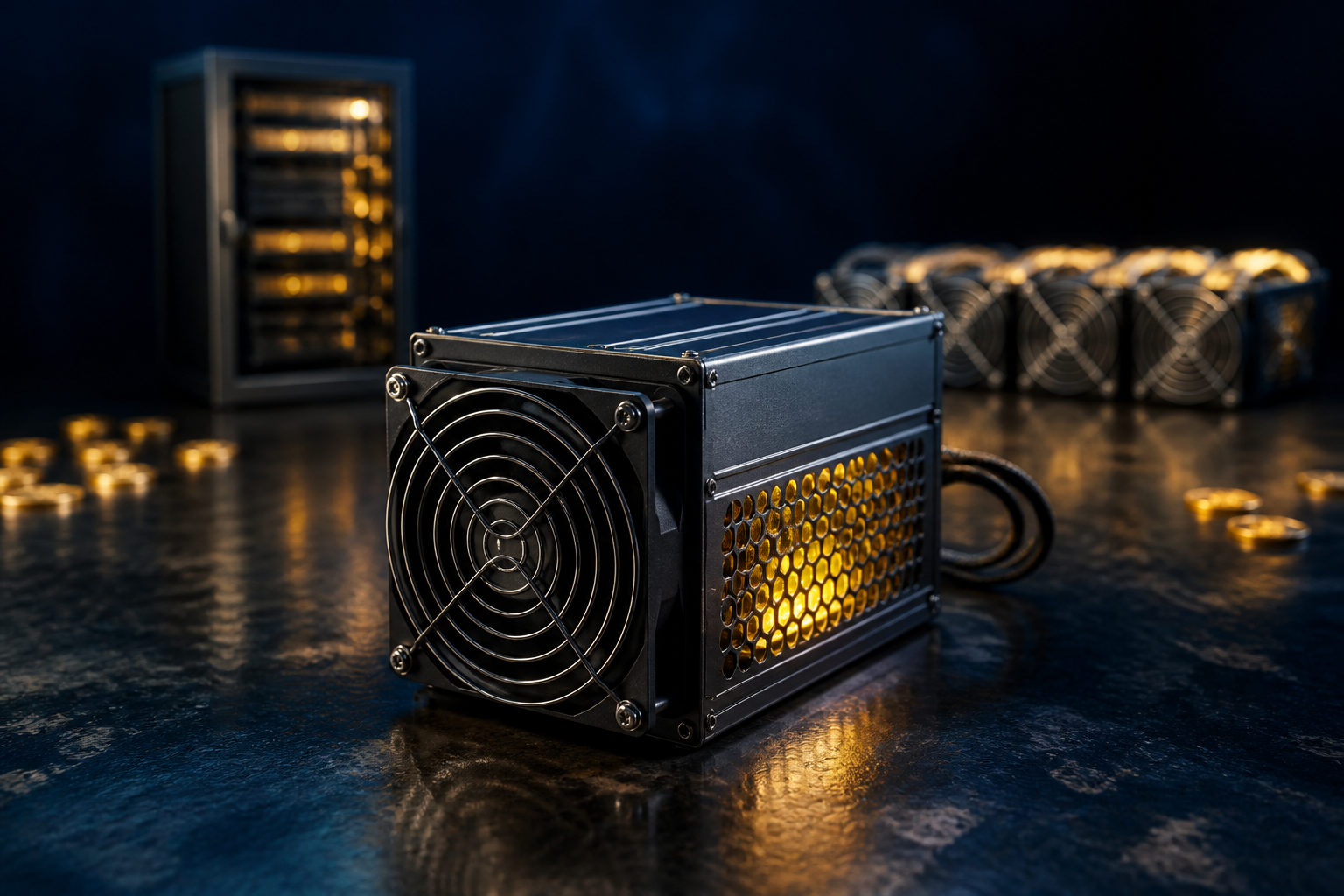
How many bitcoins do you get for mining? There is no single fixed amount for everyone. Your result depends on the block reward rules, transaction fees, whether you mine solo or in a pool, and how much of the network's total computing power you control.
What miners are actually competing for
A simple way to picture bitcoin mining is to think of a nonstop bookkeeping race. Miners use computing power to compete for the right to add a new block of transactions to the chain, and the winner gets the reward tied to that block.
That means the answer is not based on hours worked alone. A miner is trying to earn the block subsidy plus the transaction fees inside that block, and an individual miner's share depends on how they participate and how much hashing power they contribute.
Bitcoin has a fixed issuance schedule: the total supply is capped at 21 million coins, the genesis block appeared in January 2009, and a new block is found about every 10 minutes. The block subsidy is cut roughly every 4 years, or every 210,000 blocks, with halvings having taken place in 2012, 2016, 2020, and 2024.
So even if your machine stays the same, the amount of newly issued bitcoin attached to each block does not stay the same forever. Over time, halvings reduce the subsidy, while fees can make up a larger or smaller part of miner revenue depending on network activity.
The main factors that decide how much bitcoin you receive
| Factor | What it changes | Common misunderstanding |
|---|---|---|
| Block subsidy | Sets how much new bitcoin comes with each block | People often assume mining income stays constant over time |
| Transaction fees | Adds to the total reward in a block | Fees move up and down, so they are not a steady baseline |
| Mining method | Shapes whether payouts are lumpy or smoother | Solo mining is not automatically more profitable; it is just more volatile |
| Hardware hash rate | Affects your share of the competition | A machine that turns on is not the same as a machine that is competitive |
| Network difficulty | Changes how hard it is to find a block | Your relative position can shrink if other miners keep upgrading |
| Power and operations | Determines whether mined coins leave any margin after costs | Earning bitcoin is not the same as earning profit |
Start with the block subsidy. This is the protocol-level issuance that many beginners focus on first. But you do not simply collect the full block reward unless you mine solo and your setup actually finds a block on its own.
Transaction fees are the second piece. If users are willing to pay more to get transactions confirmed, the total value of a mined block goes up. Fees can change sharply with on-chain demand, so they should be treated as a variable input rather than a guaranteed line item.
Your hardware hash rate matters, but only in relation to everyone else. Stronger equipment gives you a better chance to win part of the race, yet the network is competitive and other operators keep adding or upgrading machines. What matters is not raw effort in isolation, but your share of the total hash power.
Costs belong in the same conversation from the start. When people ask how many bitcoins they get for mining, the useful follow-up is whether those coins are still worth it after electricity, cooling, hosting, maintenance, noise control, and downtime are taken into account.
Solo mining, pools, and indirect options lead to very different outcomes
If you want a realistic answer for your own case, first decide how you plan to participate. The route you choose changes the payout pattern as much as the hardware does.
| Approach | What you receive | Best suited for | Main trade-off |
|---|---|---|---|
| Solo mining | The full block reward and fees if you find a block | Operators with serious equipment and high tolerance for long dry spells | Payouts can be extremely irregular |
| Mining pool | A share of rewards based on contributed hash power | Most individual participants | You pay pool fees and accept the pool's payout rules |
| Cloud mining or hosted plans | Exposure to someone else's mining setup | People who do not want to run hardware directly | Contract terms and counterparty risk matter a lot |
| Buying bitcoin directly | Direct ownership of bitcoin | People who want exposure without operating machines | No mining income; timing and custody are your problem |
Solo mining attracts attention because the upside is easy to picture: find a block and you receive the whole reward. What is harder to appreciate is the waiting time and variance. A small operator can run for a long period without seeing any block at all.
Pools work differently. They combine the hash power of many miners, and when the pool finds a block, the reward is divided according to the pool's rules. For many people, that means smaller but more regular payouts, which is easier to manage than hoping for a rare full-block event.
Cloud mining and hosted arrangements look simpler on the surface, yet they shift the burden from machine management to contract review. You need to understand how payouts are calculated, what happens during downtime, how fees are deducted, and whether the provider can change terms or suspend service.
What most people should calculate: output first, net result second
A lot of newcomers search for a direct answer such as the amount of BTC mined per day. That can be a useful starting point, but it is only one layer of the picture. A better framework is to separate mining into protocol rewards, payout distribution, and operating reality.
| Layer | What to check | Frequent mistake |
|---|---|---|
| Protocol layer | Block subsidy, fees, halving schedule | Assuming public rules create personal income certainty |
| Payout layer | Pool method, fee structure, payout threshold, payment timing | Reading marketing claims but skipping the payout details |
| Operating layer | Electricity cost, cooling, noise, uptime, maintenance | Treating gross mined output as actual profit |
If your location is a poor fit for running high-power hardware over long periods, the theoretical mining output may never turn into a good real-world result. Heat, dust, power stability, internet reliability, and noise limits all affect uptime, and uptime matters because mining rewards depend on steady participation.
It also helps to know that bitcoin is divisible down to 1 satoshi, which is one hundred millionth of a BTC. Pool payouts can be very small, so asking whether you will mine a whole bitcoin is often the wrong benchmark. The better question is whether your setup can accumulate enough bitcoin over time to justify the money, effort, and operational burden involved.
If your main goal is simply to hold bitcoin, buying it directly is a different decision from mining it. Buying focuses on entry timing and custody. Mining adds hardware selection, ongoing operations, downtime risk, and a tougher cost equation.
FAQ
Can a home computer still mine bitcoin?
In theory, any machine can take part in the process. In practice, ordinary home computers are usually not competitive against specialized mining hardware, so the issue is less about access and more about whether the effort makes sense.
Why is my pool payout different each time?
Pool distributions can change with network difficulty, the pool's block-finding results, fee conditions, and the pool's own payout method. Even with similar uptime, the amount you receive can still move around.
Does halving mean a miner's income is cut in half right away?
The subsidy portion of a block is reduced by protocol design, but a miner's actual result also depends on fees, hardware efficiency, competition, and operating costs. So the protocol change is clear, while the personal impact is less direct.
What should I check first before deciding if mining is worth it?
Start with electricity conditions and hardware efficiency, then review the payout model you plan to use. Only after that does it make sense to estimate how much bitcoin you might receive.
What if I want bitcoin exposure without running mining gear?
You can buy bitcoin through a compliant venue and focus on storage and custody choices instead. That route removes equipment management, but it leaves you with market risk and whatever platform or custody risk you accept.
A short checklist before you start
| Checkpoint | Why it matters |
|---|---|
| Hardware type and efficiency | Shows whether you have a realistic chance to compete |
| Power and cooling conditions | Affects uptime and the odds that costs stay manageable |
| Pool payout rules | Directly shapes how much bitcoin actually reaches you |
| Wallet and withdrawal setup | Matters for receiving and storing mined coins safely |
| Maintenance and downtime plan | Helps limit losses from interruptions |
If you are seriously considering mining, work through this checklist before asking how much bitcoin you will get. The number that ends up in your wallet always passes through three filters: protocol rules, payout structure, and real operating costs.
Disclaimer: This article is for informational and educational purposes only and is not investment, financial, or legal advice. Crypto assets are highly volatile and you could lose your entire investment. Do your own research and decide carefully.