
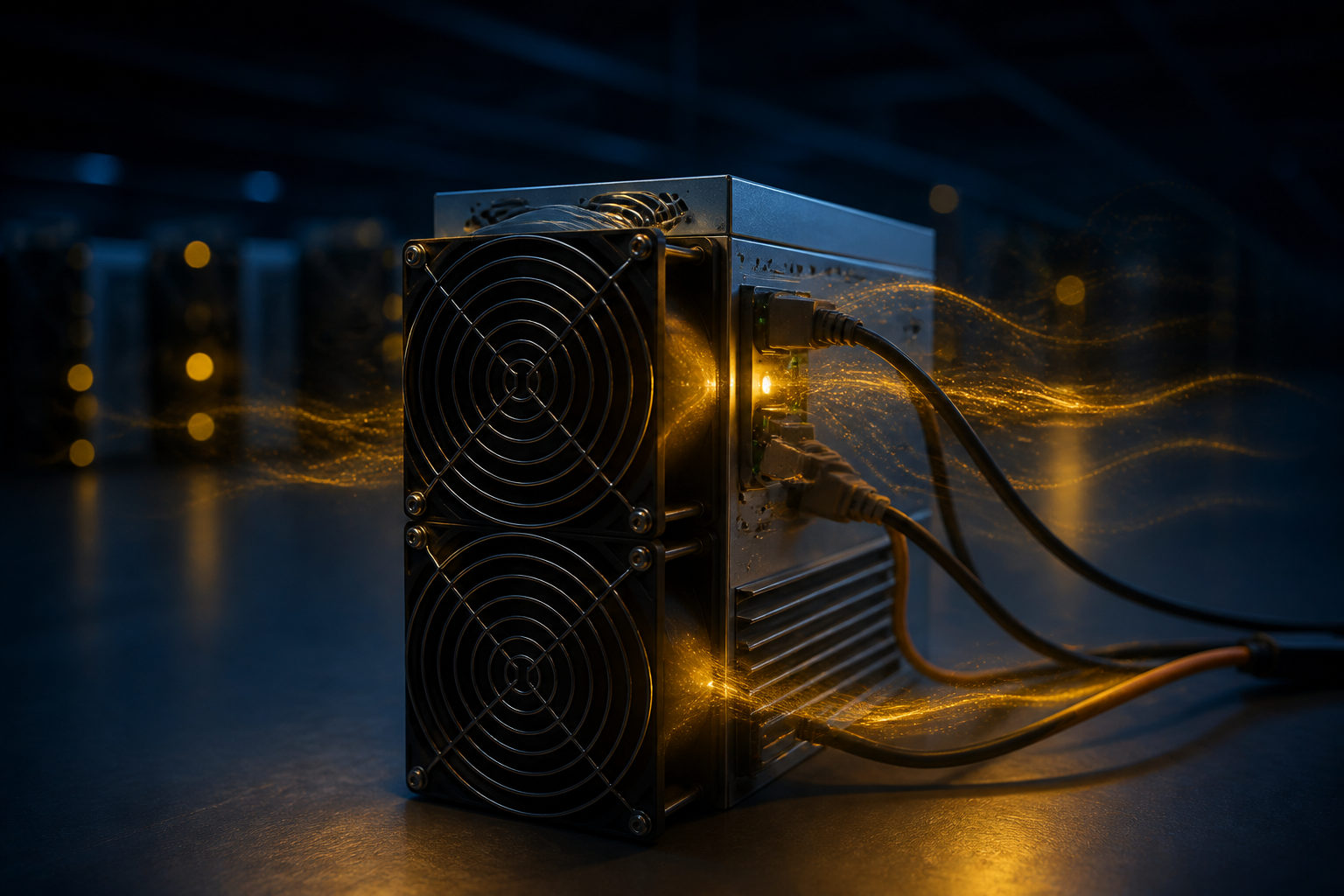
There is no miner-controlled “best difficulty” in Bitcoin mining. Bitcoin difficulty is adjusted at the network level, so the practical question is whether your hardware, power cost, cooling, and mining method make sense under the current rules.
Think of mining as a bookkeeping race
A simple way to understand Bitcoin mining is to picture an ongoing race to package new records into blocks. Mining machines keep making guesses, trying to produce a valid block that the network will accept. The first valid result gets the chance to add a new block to the chain.
In that race, difficulty is the height of the hurdle. When difficulty is higher, miners usually need more attempts before a valid result appears. When difficulty is lower, finding that result tends to take fewer attempts. The key point is that this hurdle is shared by the Bitcoin network as a whole. It is not a setting that one miner can dial up or down like a graphics option in software.
Bitcoin uses this mechanism to keep block production from speeding up or slowing down too much. The target pace is about one block every 10 minutes, so network difficulty adjusts as total mining power changes. If more machines join the race, difficulty rises. If enough mining power leaves, difficulty can fall. That keeps the system’s rhythm closer to its design goal.
Why “best difficulty” is the wrong question
When people ask what the best difficulty is in Bitcoin mining, they often mean one of two different things. Some assume they can choose an easier difficulty for themselves. Others are really asking when the network conditions are easier for a small miner to compete in.
On Bitcoin mainnet, an individual miner cannot choose a personal difficulty for real block production. If you are mining Bitcoin itself, you are working under the same global rules as everyone else. Your decisions sit elsewhere: which machine to buy, whether to mine solo or in a pool, where to run the hardware, how to handle heat, and how much ongoing cost you can tolerate.
There is another source of confusion: pool difficulty or share difficulty. Mining pools often assign internal work targets so they can measure each participant’s contribution. That helps with task distribution and payout accounting inside the pool. It does not mean the miner is changing Bitcoin’s network difficulty. The pool is setting a reporting standard for its own operation, while the Bitcoin network still decides whether a full block is valid.
This distinction matters because many new miners see a difficulty value inside a pool dashboard and assume they have found a performance lever. In practice, they are looking at a pool management tool, not a switch that rewrites Bitcoin’s consensus rules.
How difficulty affects real mining conditions
Difficulty changes do not alter the basic design of Bitcoin, but they do change the pressure miners feel. When difficulty rises, the same machine usually has to do more work before it has a chance to find a valid result. That makes hardware efficiency more important and makes weak setups less forgiving.
For solo miners, this pressure shows up as uneven outcomes. Mining alone means you are competing by yourself against the full network. Even if your machine runs continuously, results can be highly irregular. A pool combines the power of many miners and spreads outcomes across participants, so the experience is often smoother even though the network difficulty is the same.
Difficulty also shapes hardware life in economic terms. A machine may still function physically, yet become far less practical as competition grows. Older units can be pushed aside by more efficient models, especially when electricity is expensive or heat management is poor. A miner who focuses only on the purchase price can miss the larger picture: long-term operation depends on efficiency, stability, maintenance, and the local environment.
Home miners run into this quickly. Competitive equipment often creates serious noise and heat, and it needs reliable power and ventilation. Difficulty itself does not produce those side effects, but rising difficulty raises the value of efficient machines, and efficient machines usually come with demanding operating conditions.
What a beginner should evaluate before mining Bitcoin
Start with the participation model. You can mine solo, or you can join a pool. Solo mining gives you direct control over the process and a full view of what your machine is doing, but results can be very uneven. A pool shares the work and distributes outcomes according to contribution, which many beginners find easier to handle.
Then look at hardware reality. Bitcoin mining is a specialized computing contest. A general-purpose computer may help you learn concepts, inspect software, or interact with parts of the ecosystem, but it is not a practical way to compete on Bitcoin mainnet over time. For real mining, the discussion moves quickly to application-specific machines, power delivery, airflow, uptime, and parts replacement.
Electricity is one of the first hard limits. A machine that runs all day turns energy into a continuing operating expense. Add cooling needs, local temperature, possible downtime, dust control, and repair delays, and the mining setup becomes a small industrial system rather than a casual background task on a desktop.
Software and monitoring deserve equal attention. A miner has to connect correctly to a pool or node, keep settings in order, and watch for rejected shares, overheating, fan issues, or unstable firmware. Many beginners spend too much time looking for the “best difficulty” and too little time learning how to read the dashboard that tells them whether their machine is actually working well.
If you are still in the learning phase, spend time reading pool dashboards and block explorer data before buying hardware. Learn what hashrate means, what share submission indicates, how offline alerts appear, and why temperature matters. That knowledge improves decisions much more than chasing a difficulty level you cannot set yourself.
What “best” really means for a miner
For an individual, the useful meaning of “best” is not a magic difficulty number. It is the combination of conditions that fit your goals and constraints. Can your hardware efficiency stand up to your electricity cost? Can your space handle the heat and noise? Are you prepared to maintain the equipment and monitor it regularly? Do you prefer the uneven nature of solo mining, or do you want the steadier experience of a pool?
Different people land in different places. One person may approach mining as a technical hobby and value the process of setting up machines, observing the network, and learning how Bitcoin block production works. Another may be interested in Bitcoin itself but have no reason to operate mining hardware. Someone else may care more about asset exposure than infrastructure and choose a completely different route.
So when you see the search query “what is best difficulty in bitcoin mining,” the most accurate response is that Bitcoin mainnet does not offer a personal best-difficulty setting. The better line of thought is to ask whether your equipment, operating conditions, and mining method are a good fit for the network difficulty that already exists.
FAQ
Can I lower Bitcoin mining difficulty for my own machine?
No. On Bitcoin mainnet, network difficulty is shared across the system, and one miner cannot reduce it for personal use. A pool may assign different share targets internally, but that does not change Bitcoin’s block-validity rules.
Is pool difficulty the same as Bitcoin network difficulty?
Not necessarily. Pool difficulty often refers to internal share accounting and workload assignment. Bitcoin network difficulty is the broader standard tied to valid block discovery on the main network.
Should a beginner mine solo or join a pool?
Many beginners start with a pool because results are less uneven and the dashboards are easier to learn from. Solo mining makes more sense for people who already understand the hardware, the software stack, and the long stretches without a block.
Can a normal PC mine Bitcoin effectively?
A normal PC can help you learn software and concepts, but it is not a practical long-term tool for competing on Bitcoin mainnet. Real mining competition is built around specialized equipment and the conditions needed to keep that equipment running.
Where can I check live Bitcoin mining conditions?
You can review mainstream block explorers, pool dashboards, and market data services that publish network metrics. When reading those pages, separate network-wide indicators from pool-specific statistics so you do not confuse internal pool data with Bitcoin’s shared rules.
If you are close to starting, make a short checklist first: power stability, ventilation, noise tolerance, maintenance time, and whether you want to begin with a pool or go deeper into a full hardware setup. Those answers are far more useful than searching for a “best difficulty” that no individual miner can choose.
Disclaimer: This article is for informational and educational purposes only and is not investment, financial, or legal advice. Crypto assets are highly volatile and you could lose your entire investment. Do your own research and decide carefully.