
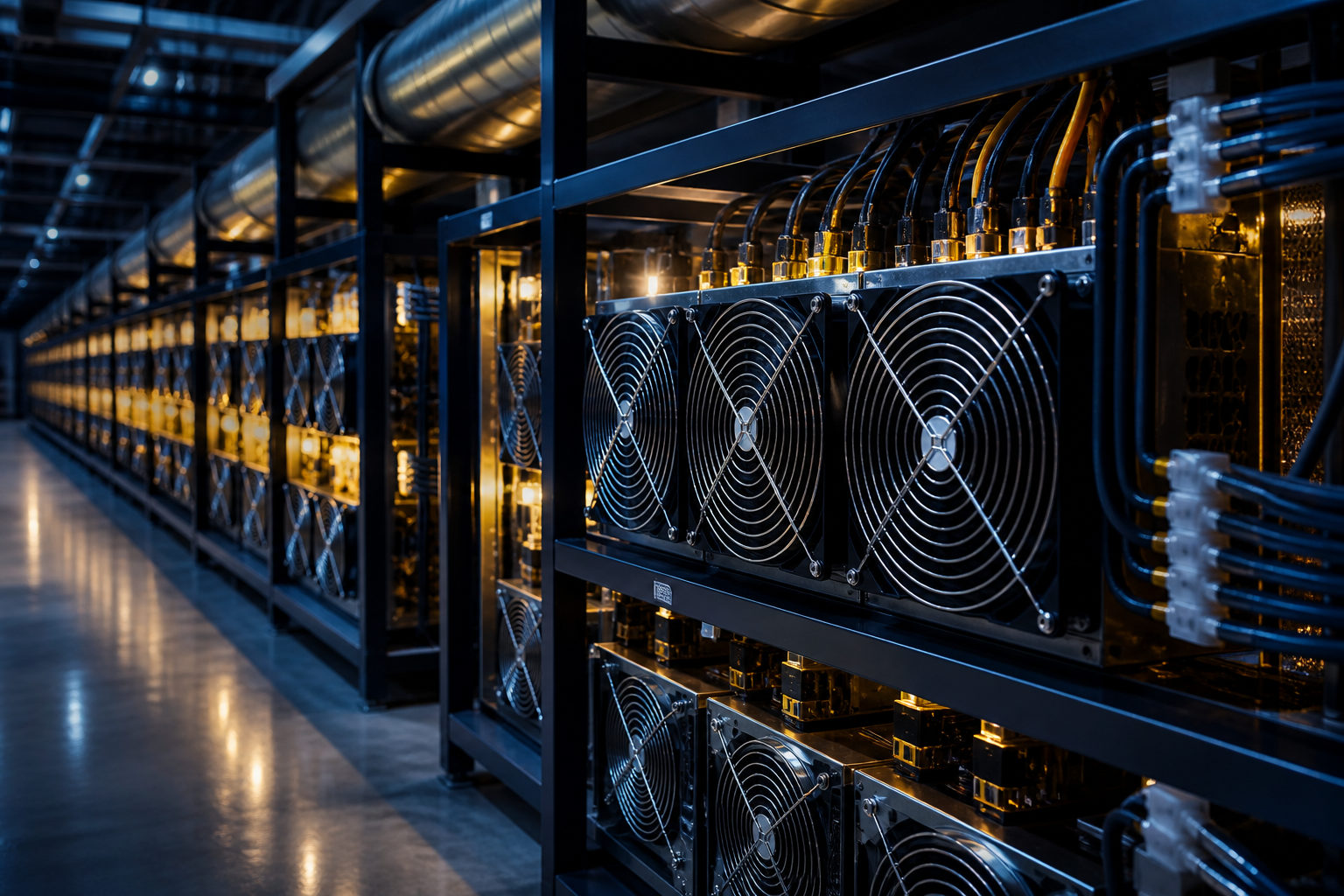
A bitcoin farm is a site that houses many mining machines, manages their power and cooling together, and runs them continuously to mine bitcoin.
What the term actually means
The word “farm” confuses many beginners. It can sound like a yield product, an app feature, or a marketing label for easy passive income. In practice, a bitcoin farm is a mining facility. Think of it as an industrial setup built to keep specialized machines running around the clock.
The core of a bitcoin farm is not the building itself. It is the combination of mining hardware, stable electricity, ventilation, heat control, network access, and people who can maintain all of it. The name comes from scale: machines are often deployed in rows and managed as a group, much like a production site.
If you want a plain-English definition, this is the simplest one: a bitcoin farm is a centralized mining operation.
How a bitcoin farm works
Mining machines perform repeated hash calculations in order to compete for the right to add blocks to the Bitcoin network. The network produces a block about every 10 minutes, so machines are always racing to contribute valid work. A farm exists to keep that process running as efficiently and consistently as possible.
That means the job is much broader than plugging in hardware. Electricity has to stay stable. Heat has to be removed before machines throttle or fail. Dust, airflow, noise, and machine health all matter. Even a brief disruption can reduce output or take part of the site offline.
Most farms connect their machines to a mining pool. A pool combines the computing power of many miners and distributes rewards according to its rules. For a newcomer, this explains why large mining operations care so much about uptime and coordination: their business depends on steady contribution, not occasional bursts.
| Part of the farm | What it does | Common beginner mistake |
|---|---|---|
| Mining machines | Produce hash power for mining | Assuming a regular home computer does the same job well |
| Power system | Keeps machines running continuously | Thinking cheap electricity alone decides profitability |
| Cooling and airflow | Reduces heat-related slowdown and failures | Equating more fans with good design |
| Network connection | Lets machines submit work reliably | Looking only at bandwidth and ignoring stability |
| Mining pool | Aggregates hash power and handles reward rules | Believing a pool guarantees profit |
| Operations team | Monitors machines and fixes issues | Treating mining as fully hands-off income |
Bitcoin farm vs. miner, mining pool, and cloud mining
These terms are related, but they are not interchangeable. A miner is the actual machine. A mining pool is a coordination system that combines hash power from many participants. A bitcoin farm is the physical and operational environment where many machines are deployed together. Cloud mining is usually a service where a customer buys exposure to someone else’s mining capacity.
The cleanest way to separate them is to ask who controls the equipment. If you own or manage the machines, the power setup, and the operating conditions, you are dealing with something close to a real mining farm. If you only buy a contract or dashboard balance from a provider, that is a service relationship, even if the marketing uses the word “farm.”
| Term | What it is | Who controls the equipment | Why the distinction matters |
|---|---|---|---|
| Miner | A single mining machine | The hardware owner | It is the basic unit of mining |
| Bitcoin farm | A centralized mining facility | The operator or equipment owner | It explains mining at business scale |
| Mining pool | A shared reward and coordination system | Miners keep equipment control; the pool sets payout rules | It affects how rewards are distributed |
| Cloud mining | A mining service or hashrate contract | Usually the provider | It changes your risk and visibility |
Common misunderstandings
One mistake is treating a bitcoin farm as a money printer. A farm can earn bitcoin from mining, but that does not mean income is automatic or stable. Results depend on hardware efficiency, operating costs, competition on the network, downtime, and management quality.
Another mistake is confusing mining with simply buying bitcoin. Buying bitcoin means acquiring the asset directly. Running a farm means operating equipment in order to compete for newly issued bitcoin and transaction fees. Those are different activities with different risks.
People also assume a bitcoin farm must be huge. Size helps explain the term, but scale alone does not define it. A smaller site with grouped machines, shared infrastructure, and organized maintenance can still fit the concept. What matters most is centralized operation.
A final source of confusion comes from promotional language. Some services borrow mining vocabulary to make an offer sound technical or tangible. The name matters less than the structure behind it.
FAQ
Is a bitcoin farm just a room full of computers?
Not in the usual sense. A real bitcoin farm uses specialized mining hardware and support systems built for continuous operation. The room is only part of the setup; power, cooling, networking, and maintenance are what make it a farm.
Can one person run a bitcoin farm?
It is possible to own or manage a small operation, but a farm still requires ongoing oversight. Even when the machine count is modest, someone has to deal with failures, temperatures, connectivity, and payout configuration.
Does joining a mining pool mean you have a bitcoin farm?
No. A pool is a coordination method, not a facility. You can join a pool with one machine at home, or with many machines at a larger site; the pool does not define whether your setup is a farm.
Is cloud mining the same as owning a bitcoin farm?
Usually no. In cloud mining, the provider often controls the hardware, site conditions, and reporting. The customer may only hold a contract or account entry, which is very different from controlling equipment directly.
Does a bitcoin farm create bitcoin in the way a factory makes products?
That comparison helps at a surface level, but it is not exact. A farm contributes computing power to a competitive network process and may receive block rewards and fees in return. It is participation in mining, not physical manufacturing.
What beginners should check when they see the phrase “bitcoin farm”
Start with a simple filter: is the offer about hardware, hosting, pooled mining, or a contract sold by a provider. Those categories can sound similar in ads, but they expose you to very different risks. Then look for concrete details about the machines, electricity, cooling, operating model, and reward distribution.
If those basics stay vague while the pitch focuses on easy returns, treat the label with caution. The most useful question is also the shortest one: who controls the machines, who pays the operating costs, and who receives the mining rewards.
Disclaimer: This article is for informational and educational purposes only and is not investment, financial, or legal advice. Crypto assets are highly volatile and you could lose your entire investment. Do your own research and decide carefully.