
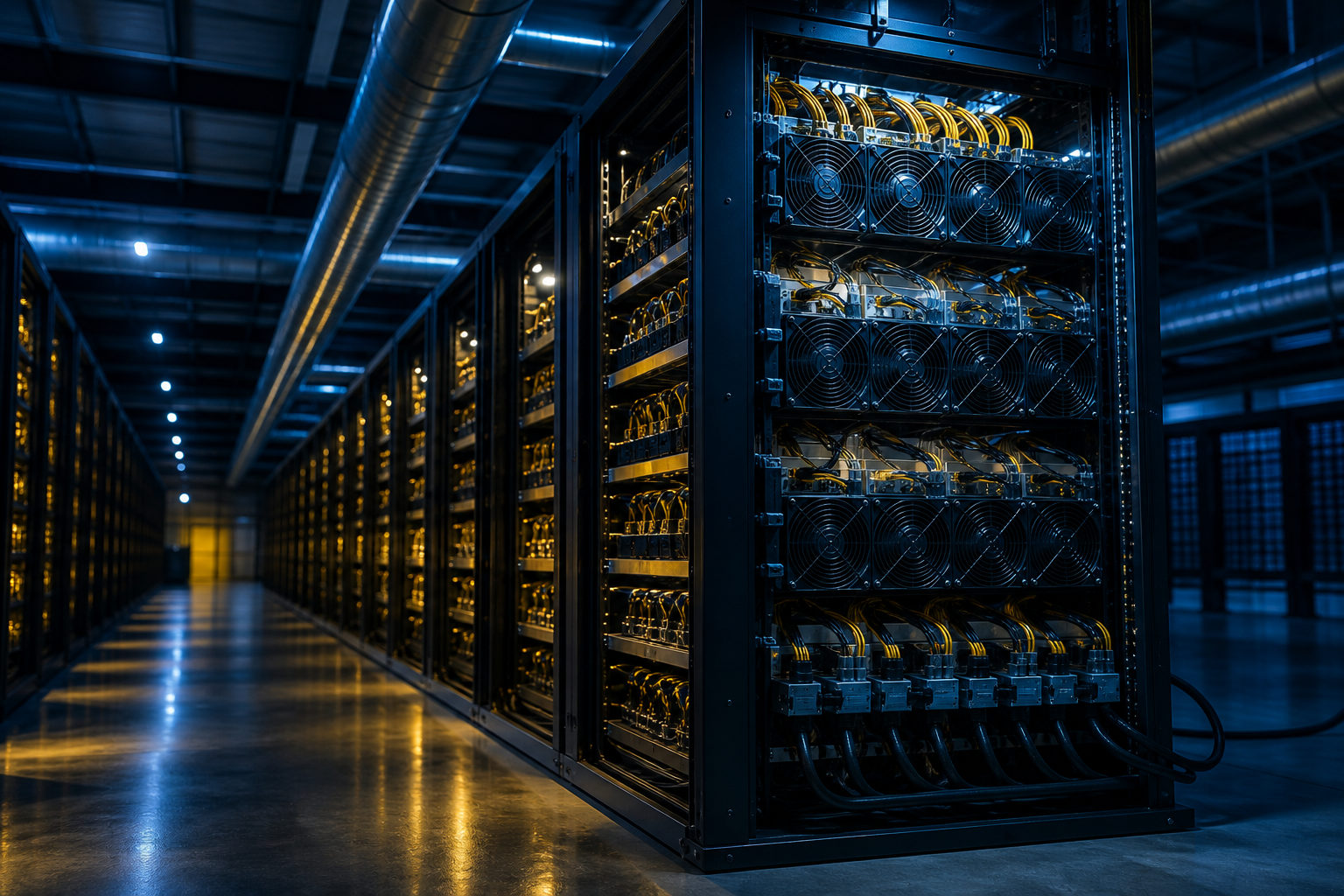
A bitcoin mining facility is a place built to run mining machines, power delivery, cooling, and internet connections together so they can compete to add new Bitcoin blocks.
Think of it as a venue for a bookkeeping race
The easiest way to understand a bitcoin mining facility is to start with the job Bitcoin miners are trying to do. Bitcoin works as a public ledger, and miners compete to package new transactions into a block and add that block to the chain under shared network rules.
That competition never stops. About every 10 minutes, a new block is produced, so miners keep running calculations over and over to search for a valid result before someone else does.
A facility exists because one machine on its own is only part of the picture. Once operators run many machines at the same time, they need a dedicated site with steady electricity, heat removal, network reliability, and ongoing maintenance. At that point, mining becomes less like using a gadget and more like operating industrial equipment.
What sits inside a mining facility
People often picture rows of machines and stop there. In practice, the visible hardware is only one layer; the hidden support systems decide whether the site can stay online without constant disruption.
| Component | What it does | What newcomers miss |
|---|---|---|
| Mining machines | Run hashing calculations to compete for blocks | Buying the units is easier than maintaining them over time |
| Power system | Delivers continuous electricity to the machines | Voltage issues, outages, and poor distribution design can hurt uptime |
| Cooling setup | Removes heat and keeps operating temperatures in range | Heat control affects stability, wear, and shutdown risk |
| Network connection | Sends work and results between the site and the pool or network | Latency and interruptions can reduce effective output |
| Racks and layout | Organize physical placement and airflow paths | Fitting machines into a room is not the same as designing a workable site |
| Monitoring and maintenance | Tracks offline units, temperature issues, and hardware faults | Without active monitoring, small problems can spread |
If the miners are the athletes, the rest of the facility is the support crew that keeps them in the race. A powerful machine does not help much if it overheats, loses connection, or keeps dropping offline.
Daily operations also matter more than many beginners expect. Dust, humidity, fan failures, replacement parts, remote restarts, and firmware issues all affect whether the site can keep contributing useful work.
How a mining facility takes part in Bitcoin mining
At the rule level, a facility does the same thing as a solo miner: it runs machines that perform hashing work in search of a valid block solution. The difference is scale. A larger site needs coordination across power, cooling, internet service, machine management, and repair routines.
Most facilities connect to a mining pool. That does not change how Bitcoin works; it changes how participants coordinate. Instead of waiting alone for an unpredictable block win, miners combine hash power through a pool and receive distributions based on the pool's rules.
| Participation model | Who it fits | Main trade-off |
|---|---|---|
| Small home setup | People learning the process firsthand | Simple to start, but noise, heat, and power limits appear quickly |
| Self-built facility | Operators with a site, technical ability, and operational control | More control, much more complexity |
| Hosted machines | People who want hardware exposure without running the site themselves | Less site work, more dependence on contract terms and the host |
| Mining pool participation | Most mining operators | Smoother distribution patterns, but still operational and counterparty risk |
Bitcoin also follows a known issuance schedule. The total supply cap is 21 million coins, and the block subsidy declines over time. Halving years have included 2012, 2016, 2020, and 2024.
That matters because a mining operator cannot control the network's competitive environment. What operators can control is site quality: uptime, machine health, repair speed, contract review, and whether the facility can run consistently under real conditions.
The hard part is not turning machines on
A bitcoin mining facility is often discussed as if the main question were which machine to buy. The harder question is whether the whole site can keep functioning day after day without hidden weaknesses draining performance.
| Cost or risk area | Why it matters | Frequent mistake |
|---|---|---|
| Electricity cost | Mining machines need continuous power, so energy is a core operating variable | Looking only at the headline rate and ignoring stability or extra charges |
| Cooling and environment | Heat, airflow, and dust directly affect reliability | Assuming basic air conditioning solves the whole problem |
| Hardware wear | Machines age and face competition from newer equipment | Treating miners like static assets that keep the same value |
| Downtime | When machines are offline, some expenses can continue while work stops | Ignoring repair delays and replacement logistics |
| Compliance and contracts | Site use, electricity arrangements, and partner agreements can all create friction | Focusing on equipment first and paperwork later |
| Counterparty risk | Hosts, pools, and suppliers can influence outcomes | Taking promises of smooth operation at face value |
Noise is another reality that gets brushed aside in casual discussions. As machine count rises, sound and heat stop being side issues and become site-defining constraints.
That is why asking whether mining is still possible is usually too broad to help. A better set of questions is practical: Can the operator secure suitable power, manage heat, review hosting terms, handle failures, and tolerate interruptions without the whole plan breaking down?
FAQ
Is a bitcoin mining facility the same as a mining pool?
No. A facility is the physical place where machines and support systems run, while a pool is a coordination method that groups many miners and distributes results under stated rules. One facility can connect to a pool, but the two ideas are separate.
Can a few machines at home count as a mining facility?
In a broad sense, yes, because they form a setup that mines Bitcoin. In normal usage, though, people usually mean a dedicated site with organized power, cooling, networking, and ongoing maintenance.
Does a larger facility always have an advantage?
Scale helps only when operations keep up with it. More machines also mean more heat, more points of failure, and more pressure on maintenance, so poor management can erase the benefit of size.
Can someone participate without building a site?
Yes. Some people use hosted mining arrangements or join pools through machines managed elsewhere. That reduces hands-on site work, but the details of ownership, fees, downtime handling, and exit terms matter a lot.
Why do people compare mining to running industrial equipment?
Because the work depends on machines that draw power, generate heat, fail, and need service. The challenge is continuous operation, not a one-time purchase.
If you want to evaluate a mining facility seriously
Start with an operations checklist before you think about expansion. Review the site, power quality, cooling design, internet reliability, maintenance process, and hosting or pool rules in plain detail.
Then test on a small scale and watch what actually happens: disconnects, temperature behavior, repair response, and how the facility handles routine disruptions. For most people, understanding those basics is more useful than chasing a large setup too early.
Disclaimer: This article is for informational and educational purposes only and is not investment, financial, or legal advice. Crypto assets are highly volatile and you could lose your entire investment. Do your own research and decide carefully.