
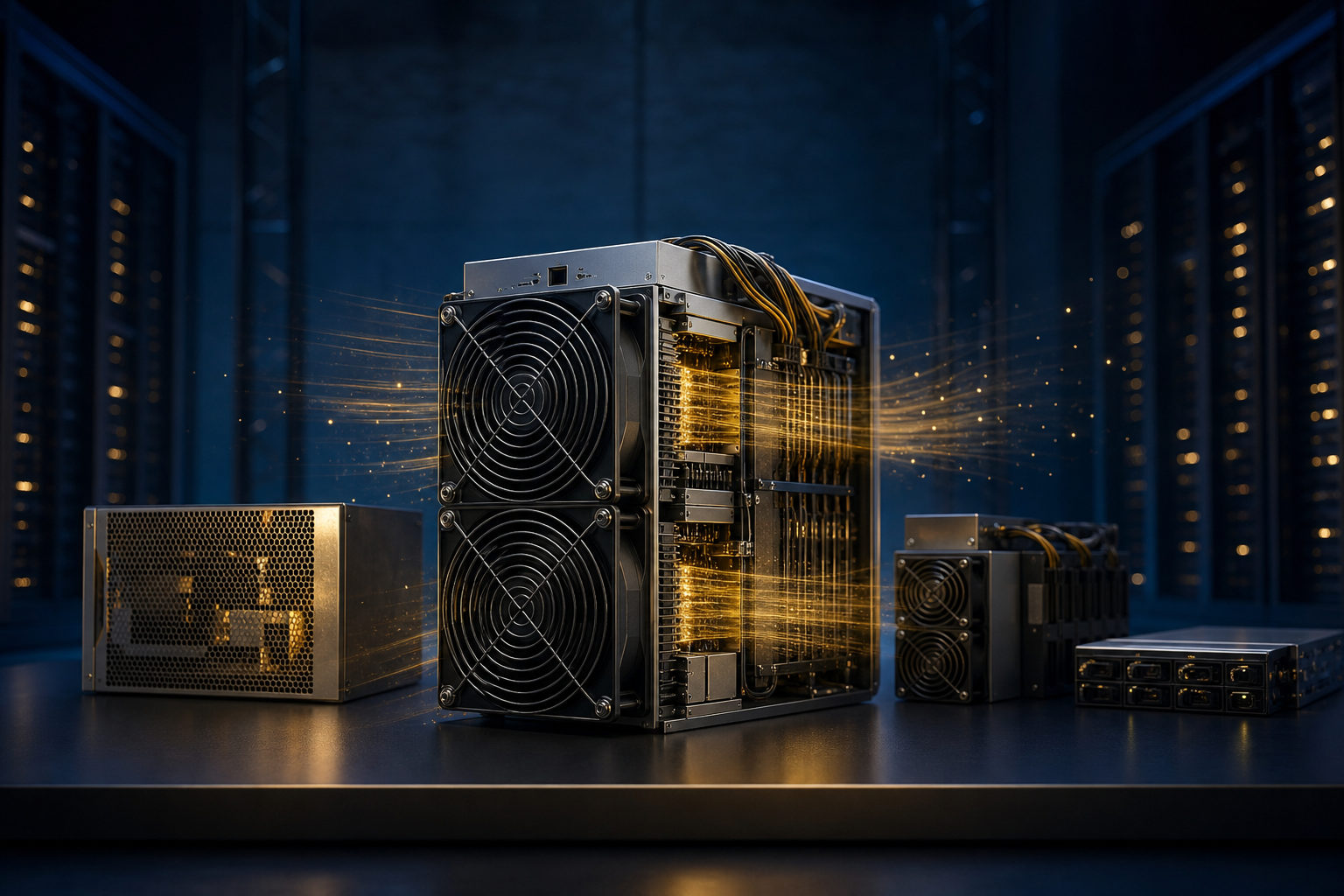
A bitcoin mining machine is a specialized device built to compete in Bitcoin’s block production process. In plain terms, it is hardware designed to perform repeated hash calculations, not just a regular computer with mining software installed.
What a bitcoin mining machine actually does
The easiest way to understand a bitcoin mining machine is to picture Bitcoin as a running contest to update a public ledger. New transactions are grouped into a candidate block, and miners use machines to keep trying different inputs until one result meets the network’s current rules. The first valid result gives that miner a chance to add the next block to the blockchain and collect the block reward plus transaction fees.
That does not mean the machine is “creating money” in the usual sense, and it is not solving a useful business problem like rendering video or training a model. Its job is narrower than that. It performs huge numbers of SHA-256 hash attempts as part of Bitcoin’s proof-of-work system. Bitcoin produces a new block about every 10 minutes, and mining machines are the hardware that makes this competitive process possible.
So if someone asks what a bitcoin mining machine is, the direct answer is simple: it is purpose-built computing hardware used to mine Bitcoin by carrying out high-speed hashing work for a chance to win block production rights.
What bitcoin mining machines are called
People use several names for the same general idea. You may see bitcoin mining machine, bitcoin miner, mining rig, mining hardware, or ASIC miner. In current Bitcoin usage, the most precise term is usually ASIC miner. ASIC stands for application-specific integrated circuit, which tells you the key point right away: the device is built for one task rather than many.
That is the main difference from a normal desktop computer or laptop. A general-purpose computer is meant to run many kinds of software, store files, browse the web, and handle varied workloads. A bitcoin mining machine is optimized for one algorithm and one role. Its value comes from sustained hashing performance, power efficiency, thermal control, and the ability to run continuously under heavy load.
This also answers a common search intent behind questions such as “what are bitcoin mining machines called.” Today, people usually mean ASIC miners when they talk about hardware for Bitcoin mining. Older forms of hardware were part of Bitcoin’s early years, but modern mining is associated with specialized machines rather than home computers.
How a bitcoin mining machine works
The machine itself does not decide which transactions are honest or important. It follows instructions from mining software and the broader mining setup. A miner or mining pool assembles a candidate block, then the machine repeatedly computes hashes while certain block data changes from attempt to attempt. If one of those hashes satisfies the network difficulty target, that block can be broadcast to the network for validation.
Other nodes then verify the block. If it passes validation, the block is accepted into the chain. The mining machine’s role in this process is mechanical but essential. It supplies the raw computational work required by proof of work, which is one of the core mechanisms Bitcoin uses to secure ordering and make rewriting history expensive.
There is an important practical detail here: a single machine only has a chance of finding a valid block based on its share of the total network hash rate. Because the competition is intense, many miners do not mine alone. They connect machines to a mining pool, which combines the computing power of many participants and distributes proceeds according to pool rules. That does not remove risk or cost, but it can smooth out the timing of payouts compared with solo mining.
Beginners often mix up the parts of the setup. The machine is hardware. The mining pool is the coordinated participation model. The wallet is where bitcoin can be received and stored. These are linked in practice, but they are not the same thing.
What you need before trying to mine
If you are thinking about participating rather than only learning the concept, focusing on the machine alone is a mistake. Real-world mining depends on a full operating environment. At minimum, that means suitable hardware, stable electricity, internet access, cooling, enough space, tolerance for noise, and a way to manage the machine securely.
- Hardware: Bitcoin mining today usually means an ASIC miner plus a matching power setup and physical placement.
- Electricity: A mining machine is designed to run continuously, so power stability and ongoing electricity cost matter immediately.
- Networking: Mining does not need extreme bandwidth, but it does need reliable connectivity so the machine can stay in sync with the pool or node.
- Cooling and airflow: Mining hardware produces heat and usually significant fan noise, which makes many home environments a poor fit.
- Configuration and security: You need to set pool details, worker information, and wallet destinations correctly while protecting account access.
Another point that new users often miss is maintenance. A mining machine is not a plug-and-forget appliance. Continuous operation means dust buildup, thermal stress, fan wear, cable issues, and downtime management all become part of the job. If the machine is running, the environment around it matters almost as much as the device itself.
Bitcoin’s own issuance rules also shape mining reality. The block subsidy halves about every 4 years, or every 210,000 blocks. Halving events have already occurred in 2012, 2016, 2020, and 2024. That does not tell you what any machine will earn, but it does show why mining conditions are not static. Hardware decisions live inside a moving system with changing competition and fixed protocol rules.
The cost reality behind bitcoin mining machines
It is easy to discuss mining hardware as a piece of tech and ignore the business side. That is a mistake. Bitcoin mining is tied to power cost, heat management, operating discipline, and hardware efficiency. For many individuals, the biggest obstacles are not setup instructions. They are electricity bills, sound levels, ventilation, physical space, local safety constraints, and the fact that equipment ages while competition continues.
Mining machines also do not behave like ordinary consumer electronics. A newer model can change the standing of older hardware quickly if it delivers better efficiency. At the same time, mining outcomes are affected by Bitcoin price, network difficulty, machine uptime, pool fee structure, and maintenance needs. That is why there is no honest universal answer to whether buying a mining machine is “worth it.” The answer depends on operating conditions, not on the machine in isolation.
For many people, mining is less about owning bitcoin and more about running a specialized hardware operation. If your goal is simply to gain bitcoin exposure, buying bitcoin directly and storing it safely is often far simpler than managing mining hardware. Mining makes more sense for people who can handle the operational side, not just the purchase decision.
FAQ
Is a bitcoin mining machine just a powerful computer?
No. In current Bitcoin usage, it usually means specialized ASIC hardware built for a narrow task. A powerful computer is still general-purpose hardware, while an ASIC miner is optimized almost entirely for repeated Bitcoin mining calculations.
Can you mine Bitcoin with a home PC today?
In theory, any machine that can perform the relevant calculations can participate. In practice, specialized mining hardware is far better suited to modern Bitcoin mining, so a typical home PC is usually not competitive.
Do bitcoin mining machines work on their own?
Not really. The hardware is one part of a broader setup that includes software, power, cooling, networking, and often a mining pool. Without those supporting pieces, the machine cannot operate in a practical mining environment.
What is the difference between a mining machine and a mining pool?
A mining machine provides hash power. A mining pool coordinates the combined hash power of many miners and distributes proceeds based on pool rules. One is hardware; the other is an organizational system for participation.
What should a beginner check before buying a bitcoin mining machine?
Start with electricity, airflow, noise, space, and maintenance capacity. If those basics do not work, comparing machine models is usually premature because the operation itself will be hard to sustain.
If you are deciding whether a bitcoin mining machine is right for you, list your power setup, cooling options, available space, noise tolerance, and maintenance ability before you compare models. That checklist will tell you more than any marketing sheet.
Disclaimer: This article is for informational and educational purposes only and is not investment, financial, or legal advice. Crypto assets are highly volatile and you could lose your entire investment. Do your own research and decide carefully.