
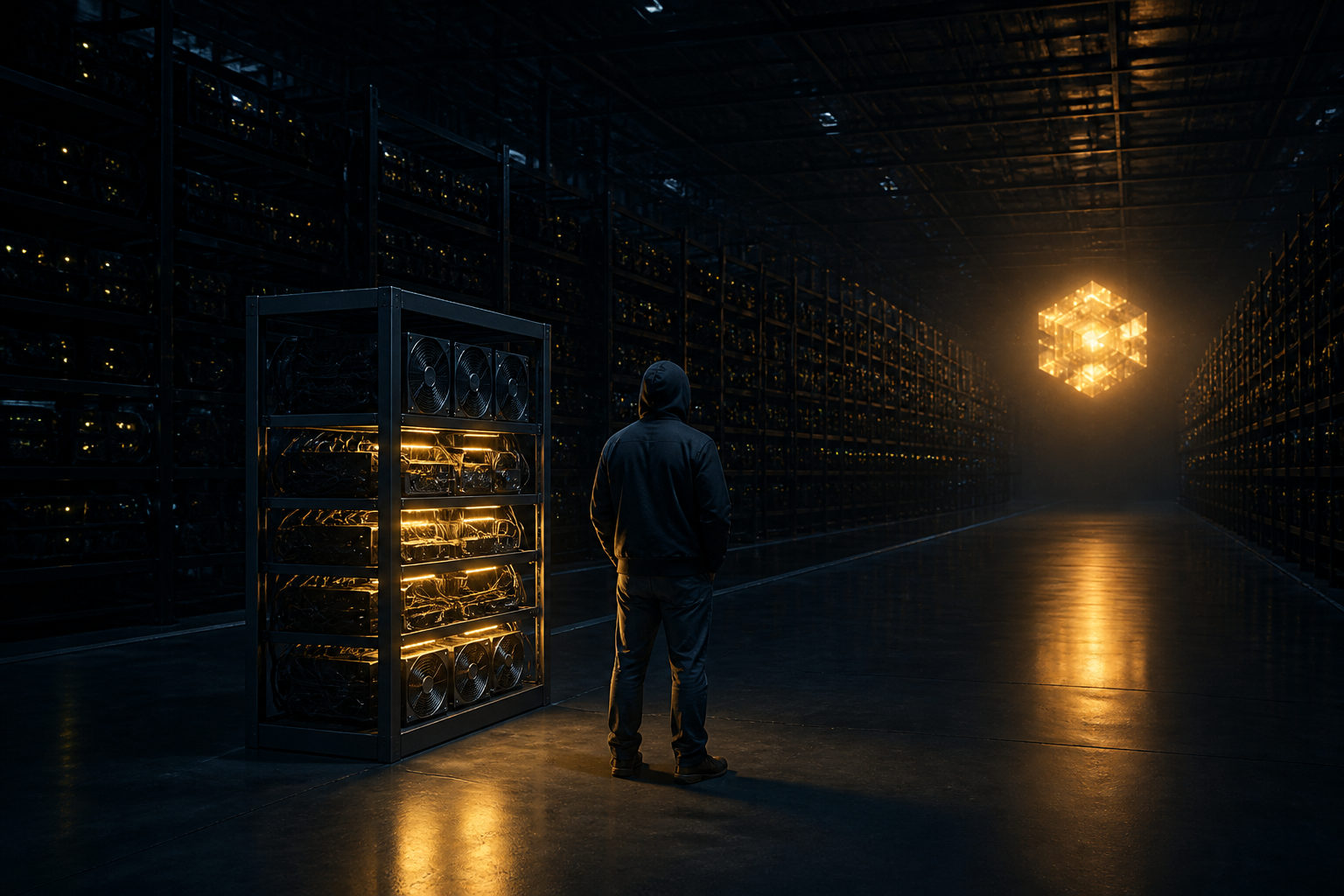
The chance of mining a bitcoin comes down to one thing first: how much hash power you control compared with the rest of the network. If your share is tiny, your odds of finding a block on your own are tiny too; in a mining pool, payouts are steadier, but that is different from winning a full block yourself.
Think of mining as a nonstop bookkeeping race
Bitcoin mining is the process of competing for the right to add a new block of transactions to the chain. A simple way to picture it is a race that never stops. Machines around the world keep trying different hashes, and the first one to produce a valid result gets to propose the next block.
On average, the network produces a block about every 10 minutes. That average applies to the whole network, not to each participant. For an individual miner, the experience can feel random: long stretches of nothing, followed by a result that arrives earlier than expected, or not at all for a very long time.
That is why the question “what is the chance of mining a bitcoin” needs to be unpacked before it can be answered well. Are you asking about solo mining, pool mining, the odds of finding a block, or the time it takes to accumulate one BTC through repeated pool payouts? Those are related questions, but they are not the same problem.
What actually determines your odds
Your share of total hash power
The network does not care how many coins you own. It does not care how strongly you believe in Bitcoin. What matters in mining is computational work. The more hash power you contribute, the more attempts you make during a given period, and the larger your long-run share of block discovery becomes.
New miners often treat constant uptime as if it guarantees a turn. It does not. Probability has no memory in the way people casually imagine it. Running a machine without interruption means you stay in the contest; it does not mean the network is building toward a moment when you are “due.”
Difficulty adjusts over time
Bitcoin changes mining difficulty to keep block production near the target pace of about 10 minutes. If more miners join the network and total hash power rises, the network can become harder to compete in even if your own machine has not changed.
That is one reason there is no fixed universal answer to the odds question. A miner’s chance is tied to a moving environment. The same device can feel very different depending on how much competition it faces at that time.
Solo mining and pool mining create different outcomes
In solo mining, you either find a block or you do not. The result is highly uneven. If your machine wins, you receive the full block reward attached to that block under the protocol rules. If it does not, you may wait a long time with no payout at all.
Mining pools group the hash power of many participants. The pool as a whole finds blocks more often than a small miner could alone, then divides payouts according to its rules and each miner’s contribution. That smooths out income, but it also changes what people mean when they say they “mined a bitcoin.” In many cases, they mean their cumulative pool payouts eventually added up to one BTC, not that they personally found a block on their own machine.
Why solo mining is usually hard for individuals
The first reason is specialization. Bitcoin mining today usually depends on dedicated hardware, stable electricity, cooling, and regular maintenance. A home setup may still teach you a lot about how mining works, but the competition often comes from operators running purpose-built systems at scale.
The second reason is that cost sits right next to probability. People start with the odds question, yet what they often want to know is whether participation makes practical sense. Hardware, electricity, heat, noise, downtime, repair, and pool rules all shape the real experience. You cannot separate the mathematics of mining from the operational side for very long.
There is also the reward schedule built into Bitcoin itself. The total supply is capped at 21 million coins. New issuance has followed a halving cycle about every 4 years, or every 210,000 blocks, with halving years that include 2012, 2016, 2020, and 2024. That schedule matters because the structure of rewards changes over time, which changes how miners think about participation even before they consider market price.
If your goal is very specific and personal, such as running one machine and hoping to mine a whole bitcoin by yourself, the challenge is usually greater than beginners expect. You are entering a global competition with transparent rules and direct performance measurement. Enthusiasm does not improve your odds unless it leads to more effective hash power and a setup you can keep running.
Common ways to take part in mining
Run your own hardware
This is the most direct path. You buy the machine, set up the network connection, manage cooling, and deal with the day-to-day realities of keeping it online. The upside is control. The downside is that every practical issue lands on you, from noise in the room to heat management and maintenance.
Join a mining pool
For many people, a pool is easier to live with because results are less erratic. You still need hardware and a working setup, yet your returns arrive as smaller, more regular allocations rather than rare all-or-nothing events.
When comparing pools, read the payout method, fees, withdrawal rules, wallet support, and service reliability. Many misunderstandings start when a newcomer focuses on a headline claim and skips the details that actually govern distribution.
Study the process before buying equipment
If you are still trying to answer the core question of your odds, education may be the better first move. Learn what a block is, how hashing works, why difficulty changes, how pool payouts are calculated, and how wallet addresses receive funds. That base knowledge often saves people from expensive confusion later.
Plenty of beginners assume mining is mostly a hardware decision. Then they discover that electricity access, airflow, downtime planning, and payout rules affect the experience just as much. Understanding the process first gives you a better frame for deciding whether direct participation even suits your situation.
Important mistakes to avoid when thinking about “the chance”
The biggest mistake is treating long-run expectation as a short-run promise. A miner can operate for a long period without a satisfying result and still be behaving exactly as probability would allow. Another miner can enjoy a lucky stretch and draw the wrong lesson from it.
A second mistake is mixing up block discovery with payout receipt. In a pool, what shows up in your dashboard may be your share of the pool’s output under its accounting rules. That is not the same event as your own machine independently finding a block.
A third mistake is asking for a single number without defining the frame. The odds per attempt, the odds over a period, and the odds of eventually accumulating one BTC through pool distributions are different discussions. If the frame stays vague, the answer may sound confident while telling you very little.
If you want current conditions, use major block explorers, mining pool dashboards, and market data platforms. For price, check a live market source rather than relying on a quoted figure from an article with no real-time feed.
FAQ
Can a regular home computer still mine Bitcoin?
In theory, any machine that can perform the required computations can participate. In practice, ordinary consumer computers usually cannot compete well with dedicated mining hardware on hash rate and efficiency, so they are better for learning than for serious mining goals.
Does joining a pool improve my chance of mining a bitcoin?
If you mean the chance of receiving payouts more regularly, then yes, a pool usually makes results smoother. If you mean your own machine single-handedly winning a full block reward, pool mining changes the model to shared output rather than individual block wins.
Can one mining machine ever produce a whole bitcoin?
It can happen, but the answer depends on time, competition, hardware performance, and whether you mine solo or in a pool. A pool participant is more likely to think in terms of cumulative payouts adding up over time.
What should I check before deciding to mine?
Start with electricity, cooling, noise tolerance, hardware access, and your understanding of pool and wallet rules. If those basics are still unclear, it usually makes more sense to learn the process before spending money on equipment.
Where should I look for live price and network conditions?
Use major market trackers, block explorers, and official pool pages. The useful skill is not memorizing one figure; it is learning how to read price screens, block status, pool terms, and unit labels without confusing one for another.
If you want a practical answer to the chance of mining a bitcoin, rewrite the question in a more useful way: will you mine solo or with a pool, what ongoing costs can you carry, and do you fully understand how payouts are calculated and received? Those answers matter more than chasing a single percentage in isolation.
Disclaimer: This article is for informational and educational purposes only and is not investment, financial, or legal advice. Crypto assets are highly volatile and you could lose your entire investment. Do your own research and decide carefully.